Renewable energy – matching electricity supplies to demands
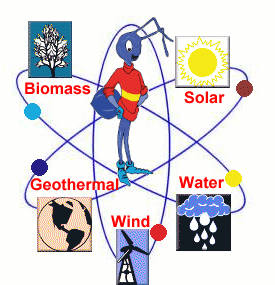 MATCHING SUPPLIES OF ELECTRICITY TO VARIABLE DEMANDS FOR ELECTRICITY, DESERTEC UK, 9 Aug 12 It is sometimes suggested that renewable sources of electricity cannot provide more than about 20% of our electricity supplies because they are intermittent or variable. But all sources of electricity are intermittent because they need to be taken out of service for scheduled maintenance and because, like any kind of equipment, they are liable to unscheduled breakdowns. With all sources of power, load factors are normally well short of 100%.
The variability of sources such as wind power is much less of an issue than is sometimes suggested, as described in Managing Variability (PDF, 402 KB, a report by independent consultant David Milborrow commissioned by Greenpeace, WWF, RSPB, Friends of the Earth, July 2009).
Not only are all sources of electricity intermittent, and many of them are variable, but the demand for electricity is variable too—and there can be quite large changes from one minute to the next. The often-quoted example is how there can be a sharp peak in demand for electricity when there is a commercial break in a popular TV programme and many people go and put the kettle on to make a cup of tea.
There is a range of techniques available for matching supplies with constantly varying demands. When electricity supply systems are properly engineered, they should be able to accommodate sources of electricity that are 100% renewable.
Any or all of the following techniques may be used:
Large-scale ‘HVDC’ transmission grids. In an area like Europe, there are several potential benefits from building a ‘supergrid’ of highly-efficient HVDC transmission lines to link existing HVAC transmission grids (see electricity transmission grids). One of the most important benefits is that this kind of large-scale grid can make it much easier to match variable supplies with variable demands. For example, the wind may stop blowing in any one spot but it almost never stops blowing everywhere across a wide area like Europe. If there is a peak in demand in any one area, it can almost always be met from spare capacity in one or more other areas. Large-scale storage facilities, such as pumped-storage systems in Norway and the Alps, may be widely shared. Submarine HVDC transmission lines that have been laid between Norway and Denmark and between Norway and the Netherlands enable both pairs of countries to benefit in this way.- Complementary sources of power……
- Power on demand. … . http://www.desertec-uk.org.uk/elec_eng/supply_demand.html
No comments yet.
1 This Month

of the week – Shut Down Drone Warfare!


Tell the Ukrainian Government to Drop Prosecution of Peace Activist Yurii Sheliazhenko

Petition to revoke the licensing of the Near Surface Nuclear Disposal Facility (NSDF) at Chalk River. https://www.ourcommons.ca/petitions/en/Petition/Details?Petition=e-7247
To see nuclear-related stories in greater depth and intensity – go to https://nuclearinformation.wordpress.com
-
Archives
- April 2026 (7)
- March 2026 (251)
- February 2026 (268)
- January 2026 (308)
- December 2025 (358)
- November 2025 (359)
- October 2025 (376)
- September 2025 (257)
- August 2025 (319)
- July 2025 (230)
- June 2025 (348)
- May 2025 (261)
-
Categories
- 1
- 1 NUCLEAR ISSUES
- business and costs
- climate change
- culture and arts
- ENERGY
- environment
- health
- history
- indigenous issues
- Legal
- marketing of nuclear
- media
- opposition to nuclear
- PERSONAL STORIES
- politics
- politics international
- Religion and ethics
- safety
- secrets,lies and civil liberties
- spinbuster
- technology
- Uranium
- wastes
- weapons and war
- Women
- 2 WORLD
- ACTION
- AFRICA
- Atrocities
- AUSTRALIA
- Christina's notes
- Christina's themes
- culture and arts
- Events
- Fuk 2022
- Fuk 2023
- Fukushima 2017
- Fukushima 2018
- fukushima 2019
- Fukushima 2020
- Fukushima 2021
- general
- global warming
- Humour (God we need it)
- Nuclear
- RARE EARTHS
- Reference
- resources – print
- Resources -audiovicual
- Weekly Newsletter
- World
- World Nuclear
- YouTube
-
RSS
Entries RSS
Comments RSS
 nuclear-news
Leave a comment