Reflections on the past week in nuclear news

Christina Macpherson’s websites & blogs
The nuclear ‘ renaissance’ really looks like a stillbirth today, as the USA Nuclear Regulatory Commission is forced, by an Appeals Court ruling, to suspend all new licensing of nuclear reactors. That applies to both new reactors, and old ones that seek relicensing.
The appeals court struck down the NRC’s Waste Confidence Rule, which stated that there was “reasonable assurance” a permanent waste site would be created “when needed, and also the Temporary Storage Rule , which allowed he storage of nuclear waste at nuclear power facilities for an indefinite period.
This has effectively frozen at least 19 final reactor licensing decisions – and must have repercussions for the global nuclear industry – and for Australia’s uranium industry.
Japan – many revelations of deception in the struggle to come to terms with the continuing nuclear disaster. TEPCO cheating by radiation doses being doctored, videos being doctored. Failure of the “Balloon Survey” to try to find out what’s going on inside Fukushima reactor No 1. Management of Fukushima area population is inept – “worse than in Chernobyl”.
India: Prime Minister Singh not happy with Russia’s immunity from accountability, regarding the nuclear reactors they are selling for Kudankulam nuclear power plant – Russia would get off scot free of costs, in the event of a nuclear accident.
Tanzania: Does anybody care? UNESCO’s World Heritage Committee caved in to commercial and government lobbyists – allowing a boundary change that will permit uranium mining at the magnificent Tanzania Selous Game Reserve. Environmental groups urging WHC to rethink this.
Australia: the gloom for uranium miners continues, with the spot price uranium market “at a standstill” ,and no improvement in sight. BHP’s massive Olympic Dam uranium mine might not go ahead – shareholders jittery.
USA. That naughty 82 year old Catholic anti nuclear nun – described as “violent’ and a “danger to the community” – now facing court felony charges that call for 10 years in prison! And she’s out on bail – heavens, we’re all in danger.
History of deception in Japan’s development of nuclear reprocessing
Japan would have to do what the Americans and Europeans had failed to do – make an experimental breeder program a commercial success.
during the Reagan administration – legislation that dramatically changed U.S. policy. The United States ceded virtually all control of U.S.-origin nuclear materials shipped to Japan.
International corporations and officials sacrificed the safety and security of the public to carry out the deception. Under the guise of a peaceful nuclear power program, they made huge profits.
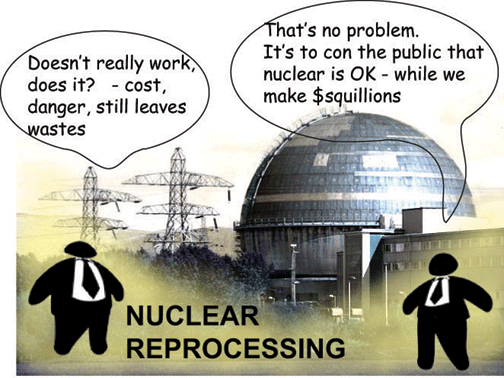
United States Circumvented Laws To Help Japan Accumulate Tons of Plutonium, DC Bureau By Joseph Trento, April 9th, 2012“……Energy has always been Japan’s Achilles’ heel. Her need for oil in the face of an American embargo triggered Japan’s attack on Pearl Harbor, and the continued shortage was a recurring theme in her defeat in that war. Only one act could take more credit for Japan’s humiliation – the splitting of the atom that gave birth to the nuclear bomb. Now Japan would turn that same atom to its own purposes — to ensure a stable source of energy well into the next century and, equally important, to ensure that the homeland never again suffered the indignity of defeat.
Japan approached the nuclear problem the same way it tackled the electronics and automobile industries. A core group of companies were each given key tasks with long-term profit potential. Then the government nurtured these companies with whatever financial, technological and regulatory support needed to assure their success. The strategy worked brilliantly to bring Japan from post-war oblivion to economic dominance in a single generation. Continue reading
Secret shipment of radioactive spent nuclear fuel to South Carolina
This shipment of research reactor fuel to SRS in no way means that the public is open to receipt of highly radioactive commercial spent fuel from U.S. nuclear reactors for consolidated storage at SRS, which some narrow special interests are eyeing

Radioactive Spent Fuel Containing Bomb-Grade Uranium Arriving at SRS http://aikenleader.villagesoup.com/blog/blogpost/radioactive-spent-fuel-containing-bomb-grade-uranium-arriving-at-srs/881381
By Thomas Clements | Aug 09, 2012 A secretive shipment of radioactive spent research reactor fuel containing highly enriched uranium (HEU) from Germany is soon to arrive at the Department of Energy’s (DOE) Savannah River Site (SRS) near Aiken, South Carolina, where it will be indefinitely stored. The shipment is likely to be transiting the Naval Weapons Station in Charleston, South Carolina. Continue reading
Nuclear reactor licensing in USA – an uncertain future
An Uncertain Phase for Nuclear Power Licenses NYT By MATTHEW L. WALD , August 9, 2012, In a rare action, the Nuclear Regulatory Commission has acceded to a petition filed by anti-nuclear groups that it halt some licensing activities until the agency can sort out its troubled policy on nuclear waste….
.. The crux of the waste issue is that for years, the commission has licensed reactors on the assumption that the federal government would eventually establish a disposal system for spent fuel. An official policy known as the “waste confidence decision” stated, in typical commission lingo, that there was “reasonable assurance” that a burial place would eventually be available and that the fuel could in the meantime be stored in spent fuel pools or on site in dry casks without significant environmental risks.
But in June the United States Court of Appeals for the District of Columbia ruled that in reaching this conclusion, the commission did not comply with the National Environmental Policy Act, a law that mandates that environmental impact studies be issued before such a finding is reached.
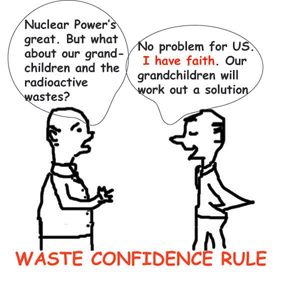
The commission is now pondering whether it can fix the problem by issuing a broad generic statement about the safety of storage in pools and dry casks or whether it will have to do a reactor-by-reactor review. Continue reading
The very dodgy plans for Small Modular Nuclear Reactors (SMRs)
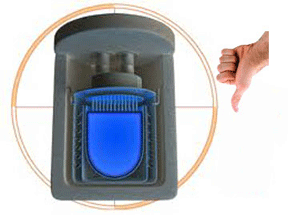 As SMRs are being promoted for overseas markets, SRS officials will not say what plans are for used reactor vessels or highly radioactive spent fuel which would be taken back to the production site.
“If SRS would become a nuclear waste dumping site due to involvement in SMR programs, this is something that the public in the Aiken area and in South Carolina will soundly reject,”
Documents Reveal Time-line and Plans for “Small Modular Reactors” (SMRs) at the Savannah River Site (SRS) Unrealistic and Promise no Funding http://aikenleader.villagesoup.com/blog/blog/documents-reveal-time-line-and-plans-for-small-modular-reactors-smrs-at-the-savannah-river-site-sr/840884 By Thomas Clements | Jun 19, 2012 One SMR Design being Eyed at SRS for Use of Plutonium Fuel (MOX) and Production of Tritium Gas Used in Nuclear Weapons
Documents obtained under the Freedom of Information Act (FOIA) by the Alliance for Nuclear Accountability (ANA) in Columbia, South Carolina reveal unrealistic plans for pursuit of “small modular reactors” (SMR) at the Department of Energy’s Savannah River Site, located near Aiken, South Carolina. Continue reading
September – Washington rally for a nuclear free future
http://ecowatch.org/2012/dc-rally-nuclear-free/
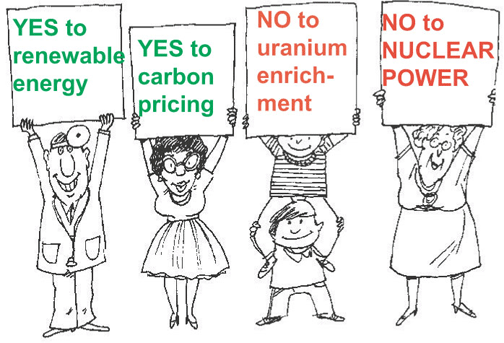
Coalition Against Nukes Thousands of anti-nuclear activists from across the U.S. will converge on Washington, D.C. this Sept. 20 – 22 for aRally for a Nuclear-Free Future.
The three-day event, brought together by the grassroots network Coalition Against Nukes (CAN), will feature a Congressional briefing on nuclear dangers attended by Rep. Dennis Kucinich (OH), a peaceful demonstration at the Nuclear Regulatory Commission (NRC), a presentation of petitions at the embassies of Japan and India, and a demonstration at the Capitol to increase awareness of the dangers of nuclear power plants and spread of global radiation. Continue reading
Nagasaki calls for worldwide nuclear abolition treaty
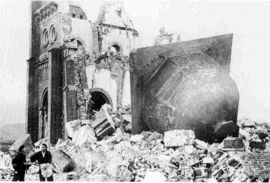 Nagasaki calls for worldwide nuclear abolition treaty Japan Times, 9 Aug 12, Kyodo NAGASAKI — Nagasaki urged world leaders Thursday to conclude a treaty banning nuclear weapons at a ceremony marking the 67th anniversary of its atomic bombing.
Prayer for peace: Nagasaki atomic-bombing survivor Shigeko Iwamoto prayed for the dead in front of the Peace Statue on Thursday morning as the city marked the 67th anniversary of the attack on Aug. 9, 1945. KYODO Continue reading
Falure of TEPCO’s Balloon Survey of Fukushima Nuclear Reactor 1
 Fukushima I Nuke Plant Reactor 1 Balloon Survey of 5th Floor Was Unsuccessful http://ex-skf.blogspot.ca/2012/08/fukushima-i-nuke-plant-reactor-1.html AUGUST 8, 2012 VIDEO & Pics

I had to laugh and cry, looking at the photographs of the huge, red and white balloon with cameras attached using duct tape. This is sad.
According to TEPCO’s press release on 8/8/2012, the balloon couldn’t pop out onto the operating floor (5th floor) because it was stopped by a cable on the 4th floor. The balloon did take photographs of the 4th floor.
The purpose of the survey (not fulfilled by this project) was to see what the 5th floor was like, in order to prepare for the future removal of fuel assemblies from the Spent Fuel Pool. (See my post from July 23, 2012.)
5 TEPCO employees and 14 affiliate company workers did the work, for about 35 minutes, receiving maximum 1.54 millisievert for the shortened work.
From TEPCO’s Photos and Videos Library, 8/8/2012:
This is a iconic example how Tepco is thinking and handling the disaster.
A balloon and duct tape… How desperate can you be?
It also shows that they have no solution and no ideas how to’fix’ this. It’s clearly infixable, but ‘m affraid it will take a few more ‘balloons and duct tape solutions’ before they ( goverment and big corp. ) can/will admit it’s hopeless.
In the mean time ( a few years probably ) they will try to start more nuclear reactors, to be able to keep the cashflow going to their endless deep pockets. The money is too juicy to let this just stop right now. And that’s why we will see more of these actions; completely meaningless, but as long as they can keep the show going on an pretending they are ‘fighting’ against this disaster, the money keeps coming.
It’s all about the money ( as usual ) and the bill is paid by… right, we, the people, the taxpayers, and in Fukushima and surroundings they pay the highest price… their lives.
Sad there is still not enough ‘uprising’ in Japan ( and the rest of the world). Every day that this continueing, is a lost day for the people of Japan and in particular for those poor souls in Fukushima.
Effects of ionising radiation on the brain and other organs
 Neuropsychiatric effects of incorporated radionuclides http://fukushimavoice-eng.blogspot.com.au/2012/08/neuropsychiatric-effects-of.html?spref=tw
http://www.physiciansofchernobyl.org.ua/eng/books/Niagu/pdfs/Chapter6Rev.pdf
Neuropsychiatric Effects of Ionizing Radiation
Chapter 6 Neuropsychiatric Effects of Chronic Irradiation Continue reading
Fukushima evacuation zone – radiation measure – “off the chart”
Off the Chart: University researchers film while measuring radiation levels in evacuation zone — “‘Over’ means it’s beyond the capacity of the measuring device” (VIDEO) http://enenews.com/off-the-chart-university-researchers-film-while-measuring-radiation-levels-in-evacuation-zone-over-means-its-beyond-the-capacity-of-the-measuring-device-video Off the Chart: University researchers film while measuring radiation levels in evacuation zone — “‘Over’ means it’s beyond the capacity of the measuring device” (VIDEO) August 8th, 2012 By ENENews
Aug 8, 2012Inside the Barricaded Fukushima Nuclear Zone
Uploaded by: yohkawano
Filmed: July 18, 2012
Description: The following depicts a one day journey inside the barricaded Fukushima Nuclear taken on July 18, 2012, almost a year and a half after the Nuclear Disaster. Read the entire story here
Group of academics from Niigata University and UCLA measuring radiation levels around the Fukushima nuclear plant At 2:45 in
[Camera shows radiation dose quickly climbing to ~30 microsieverts per hour]
Narrator: ‘Over’ means it’s beyond the capacity of the measuring device. At 4:00 in
[Camera shows computer screen]
Narrator: Here, the measurements go beyond the height of the chart.
VIDEO on dangers of internal radiation exposure
NHK broadcasts warnings about internal radiation exposure — Doctor: “Even a low dose will cause damage” (VIDEO) August 9th, 2012 By ENENews Dr. Shuntaro Hida: Dangers of INTERNAL Radiation Exposure http://www.youtube.com/watch?v=JONsKfdn_-M
NHK World
Uploaded by: rumorecurioso
Uploaded August 8, 2012
At 2:45 in
Doctor Shuntaro Hida: Still now the nature of the radiation damage cannot be understood from a medical point of view, nor can it be treated.
At 4:15 in
Hida: Internal radiation exposure is indeed dangerous. Once you absorb even a low dose it will cause damage.
At 4:45 in
Hida: You should spend the rest of your lives working together to shut down nuclear plants and abolish nuclear weapons.
At 5:25 in
Hida: The government and other elites say that people don’t need to worry about internal exposure. But I’ve seen evidence to the contrary.
Tougher charges against elderly Catholic anti nuclear nun: could face 10 years in prison
 New charges filed in nuclear weapons plant breach The Sacfamento Bee, By ERIK SCHELZIG Associated Press, Aug. 9, 2012 – NASHVILLE, Tenn. — A federal grand jury toughened the charges against three anti-war protesters who authorities say cut their way through three security fences and spray-painted slogans on the walls of a nuclear weapons plant in Tennessee.
An indictment released Thursday in Knoxville charges an 82-year-old Roman Catholic nun with Sisters of the Holy Child Jesus, a gardener and a housepainter with “depredation”
of the Y-12 National Security Complex in Oak Ridge. The charge carries a maximum penalty of 10 years in prison. Continue reading
On the News With Thom Hartmann
On the News With Thom Hartmann: Corporations Are Bribing Foreign Government Officials, and More Truthout , 09 August 2012 By Thom Hartmann, The Thom Hartmann Program | News Report In today’s On the News segment: On Tuesday, the Nuclear Regulatory Commission announced that it would temporarily freeze any new licenses or renewal of licenses for nuclear power plants around the country; corporations are bribing foreign government officials; Florida Gov. Rick Scott is defending the Firearm Owners’ Privacy Act; and more.
I’m Jim Javinsky – In for Thom Hartmann – on the news… You need to know this. No nukes!…at least for a little bit. On Tuesday, the Nuclear Regulatory Commission announced that it would temporarily freeze any new licenses or renewal of licenses for nuclear power plants around the country. That decision by the NRC was prompted by a U.S. Court of Appeals ruling back in June that the NRC has insufficiently dealt with the problem of nuclear waste material – thus violating the National Environmental Policy Act. Currently, the NRC provides licenses under the assumption that it will find ways to dispose of nuclear waste in the future when it becomes “necessary” or that nuclear waste can be safely stored at reactors sites. As we’re seeing in Japan, there are a lot of problem with nuclear waste stored inside the reactor building – and the U.S. Court of Appeals recognized as much when they issued their ruling against the NRC. One of the main litigants in the case against the NRC – Stephen Smith, the executive director of the Southern Alliance for Clean Energy said about the NRC’s decision, “We believe it is appropriate to halt nuclear licensing decisions and stop creating an inter-generational debt of nuclear waste that will burden our children and grandchildren for centuries to come.” Time to ditch nuclear power!…
Was Yasser Arafat poisoned by radiation? Swiss experts asked to investigate
Swiss radiation experts invited to examine Arafat’s remains http://www.ottawacitizen.com/news/Swiss+radiation+experts+invited+examine+Arafat+remains/7061676/story.html#ixzz23B4nMoZa Announcement follows disagreement over investigation By Mohammed Daraghmeh, The Associated Press August 9, 2012
Swiss experts have been invited to the West Bank to test Yasser Arafat’s remains for possible poisoning, the chief investigator looking into the 2004 death of the Palestinian leader said Wednesday. Continue reading
Murky history of Japan’s fast breeder nuclear reactor program
 United States Circumvented Laws To Help Japan Accumulate Tons of Plutonium, DC Bureau By Joseph Trento, on April 9th, 2012“…….From the very start, the Japanese breeder program was predicated on the belief that Japanese industry could do what the Americans and Europeans had failed to do – run the extremely complicated breeder cycle safely and profitably. That belief was rooted in Japan’s national self-confidence, nurtured by two generations of success in manufacturing. Japan’s dedicated and educated workforce and its special brand of quality management made it the world leader in a host of industries. Nuclear power generation would, it was believed, merely be one more success, made possible by Japan’s superior workers and management.
Thirty years ago even Japan’s harshest critics might have agreed that perhaps it could succeed where Western efforts had failed. But that optimism soon faded as a string of nuclear catastrophes demonstrated that nuclear industries are far different than any other. Both the Monju fast-breeder reactor in 1995 and the Tokai reprocessing plant in April 1997 suffered serious, accidental radiation leaks; both accidents were the subjects of attempted cover-ups. Most egregious was the fire and leak of radioactive sodium at the Monju FBR. Japan’s Power Reactor and Nuclear Fuel Development Corporation (PNC), the government corporation that operated Monju, lied repeatedly to the public about the accident. PNC attempted to suppress video footage that showed the cause of the accident: a ruptured pipe in a secondary cooling system that had spilled an estimated two to three tons of radioactive sodium – the largest such leak in the history of fast-breeder technology. One of the reasons PNC gave for releasing the misinformation was that Monju was too important to Japan’s energy program to jeopardize the reactor’s operation. In other words, the public’s safety was secondary to the breeder program.
Had it not been for a courageous act by a group of Fukui prefecture officials in the early morning of December 11, PNC’s attempted cover-up probably would have succeeded. Suspecting a cover-up, the officials entered the plant and secured the videotape. The action came as a direct result of a previous accident at Fukui’s Tsuruga Unit I reactor in the early 1980s. Fukui prefecture officials were not permitted to investigate that mishap. When the Monju accident took place, the officials were determined not to be turned away a second time. Following revelations that the agency itself had been involved in trying to withhold the video, a PNC executive committed suicide……. http://www.dcbureau.org/201204097128/national-se
1 This Month

of the week – Shut Down Drone Warfare!


Tell the Ukrainian Government to Drop Prosecution of Peace Activist Yurii Sheliazhenko

Petition to revoke the licensing of the Near Surface Nuclear Disposal Facility (NSDF) at Chalk River. https://www.ourcommons.ca/petitions/en/Petition/Details?Petition=e-7247
To see nuclear-related stories in greater depth and intensity – go to https://nuclearinformation.wordpress.com
-
Archives
- April 2026 (7)
- March 2026 (251)
- February 2026 (268)
- January 2026 (308)
- December 2025 (358)
- November 2025 (359)
- October 2025 (376)
- September 2025 (257)
- August 2025 (319)
- July 2025 (230)
- June 2025 (348)
- May 2025 (261)
-
Categories
- 1
- 1 NUCLEAR ISSUES
- business and costs
- climate change
- culture and arts
- ENERGY
- environment
- health
- history
- indigenous issues
- Legal
- marketing of nuclear
- media
- opposition to nuclear
- PERSONAL STORIES
- politics
- politics international
- Religion and ethics
- safety
- secrets,lies and civil liberties
- spinbuster
- technology
- Uranium
- wastes
- weapons and war
- Women
- 2 WORLD
- ACTION
- AFRICA
- Atrocities
- AUSTRALIA
- Christina's notes
- Christina's themes
- culture and arts
- Events
- Fuk 2022
- Fuk 2023
- Fukushima 2017
- Fukushima 2018
- fukushima 2019
- Fukushima 2020
- Fukushima 2021
- general
- global warming
- Humour (God we need it)
- Nuclear
- RARE EARTHS
- Reference
- resources – print
- Resources -audiovicual
- Weekly Newsletter
- World
- World Nuclear
- YouTube
-
RSS
Entries RSS
Comments RSS
 nuclear-news