50,000 at Hiroshima remembrance rally, opposing nuclear weapons and nuclear power
Nuclear fears focus attention on Hiroshima anniversary, THE HINDU, 6 Aug 12, Interest in the anniversary of the US atomic bombing of the western Japanese city of Hiroshima was heightened on Monday amid growing public frustration with the country’s decision to restart atomic reactors after last year’s nuclear accident.
Most participants at the 67th anniversary commemorations expressed their opposition to nuclear power generation. Those attending also included people who once lived near a nuclear plant in Fukushima prefecture in north-eastern Japan that was the site of the 2011
meltdowns of three reactors.
Such attendees included Tamotsu Baba, the mayor of Namie town, all of whose residents were forced to leave after the accident.
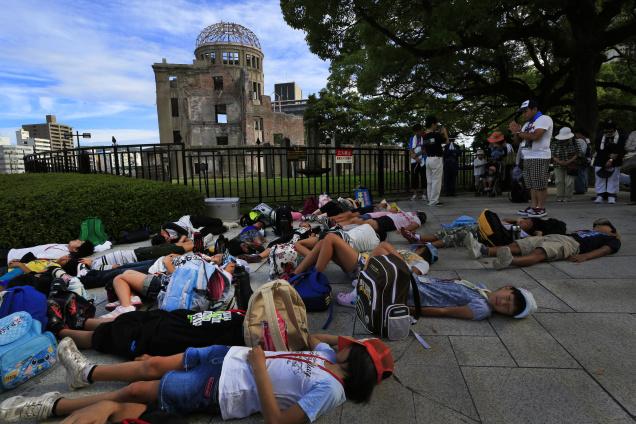 Students lie down symbolising deaths from nuclear wars and accidents
About 50,000 people attended the observance in Peace Memorial Park near ground zero, Hiroshima’s city government said. Mayor Kazumi Matsui called for the elimination of nuclear weapons at the ceremony…. http://www.thehindu.com/news/international/article3733249.ece
Remembrance of Nuclear Energy Disaster Victims
heres a video with Paul Gunter from Beyond Nuclear and others making statements and prayers at the New York memorial.. the introduction is very interesting
http://www.youtube.com/watch?v=oKiUteVBrR8
Discrimination, mental health issues, among Fukushima’s brave clean-up workers
 Doctors: Japan Nuclear Plant Workers Face Stigma By MALCOLM FOSTER Associated Press abc News, TOKYO August 5, 2012 (AP) A growing number of Japanese workers who are risking their health to shut down the crippled Fukushima Dai-ichi nuclear power plant are suffering from depression, anxiety about the future and a loss of motivation, say two doctors who visit them regularly.
But their psychological problems are driven less by fears about developing cancer from radiation exposure and more by something immediate and personal: Discrimination from the very community they tried to protect, says Jun Shigemura, who heads a volunteer team of about ten psychiatrists and psychologists from the National Defense Medical College who meet with Tokyo Electric Power Co. nuclear plant employees. Continue reading
Obama would spend up big on weapons, and Romney, even bigger
 a Romney administration would fork out roughly $800 billion toward national defense in 2016 — a notably higher amount than the trimmed-down $578 billion proposed by the Obama administration.
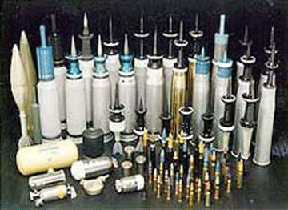 Is Pentagon spending good for the economy? By Guy Taylor-The Washington Times , August 5, 2012 In a time of deep deficits and tight budgets, President Obama says theDefense Department cannot be entirely spared the scalpel. But Mitt Romney, his likely opponent in November’s election, says the U.S. must spend more on the Pentagon now because it will pay off with a stronger economy in the long run.
Analysts said the differences stem from a deep philosophical divide. Continue reading
Nuclear power plants can’t cope with increasingly hot summers
 simply getting permission to suck in hotter water does not make the problem go away..
despite a myriad of potential problems and two decades of climate warnings, it is sobering to note that none of the US reactors were built to account for any of this
[The new reactors] they are still PWRs and they still require a large reserve of cool, circulating water to keep them operating and nominally safe.
 For Nuclear Power This Summer, It’s Too Darn Hot, Truth Out, 05 August 2012 By Gregg Levine, You know that expression, “Hotter than July?” Well, this July, July was hotter than July. Depending on what part of the country you live in, it was upwards of three degrees hotter this July than the 20th Century average. Chicago, Denver, Detroit, Indianapolis and St. Louis are each “on a pace to shatter their all-time monthly heat records.” And “when the thermometer goes way up and the weather is sizzling hot,” as the Cole Porter song goes, demand for electricity goes way up, too….. Take, for example, Braidwood, the nuclear facility that supplies much of Chicago with electricity: Continue reading
A “regional” nuclear war would have global unmanageable effects
The Red Cross has determined that if nuclear weapons were used today, any attempts at responding or coping with the humanitarian needs of survivors would be utterly overwhelmed. These new climate and health studies demonstrate that a limited, regional nuclear war would have global health and humanitarian consequences on a scale never seen before
 A treaty banning nuclear weapons is urgent, necessary and achievable, and negotiations on such a treaty should begin. Now.
Preventing another Hiroshima, By Rebecca Johnson, ICAN 6 August 2012 “…….recent studies demonstrate that a regional nuclear war would cause global famine, jeopardising over a billion people.
The new “nuclear winter” studies update the 1980s research , examining the use of 100 Hiroshima-sized nuclear weapons on urban centres in India and Pakistan. This limited regional scenario (0.04 percent of the explosive power in today’s arsenals) recognises the fallibility of deterrence and that suspicious neighbours could reproduce the risk factors that led to the Cuban Missile Crisis, including miscalculation, miscommunication, military escalation and, potentially, rogue commanders. Growing cyberwarfare capacities in
many countries add an extra dimension of volatile danger to an explosive mix. Continue reading
Video about Fukushima children and thyroid abnormalities
 36 Percent of Fukushima Children Have Abnormal Thyroid http://www.youtube.com/watch?v=o0KeNRRtfKU It seems that the children of Fukushima are the first to suffer the effects of the massive nuclear meltdown at former Fukushima NPP. A study carried out by the Fukushima Prefecture Health Management Survey has found that 36 percent of the children have abnormal thyroid growths.
Reference:
http://www.businessinsider.com/fukushima-children-have-abnormal-thyroid-growt…
http://www.businessinsider.com/a-stunning-36-percent-of-fukushima-children-ha…
http://enenews.com/now-35-8-of-fukushima-children-have-thyroid-cysts-or-nodules
http://fukushimavoice-eng.blogspot.jp/
http://www.businessinsider.com/fukushima-children-have-abnormal-thyroid-growt…
Canadian Nuclear Expert: Reactor is releasing 200 trillion becquerels of tritium every year — Becomes a part of your body and all living things — Gives off beta particles which produce damage that can result in cancer (VIDEO) http://enenews.com/canadian-nuclear-expert-reactor-releasing-200-trillion-becquerels-tritium-every-year-becomes-part-body-all-living-gives-beta-particles-produce-damage-result-cancer-video August 5th, 2012 at 4:05 pm ET
By ENENews
Interview with Gordon Edwards
SolarIMG
May 7, 2012
Excerpts
- Gentilly reactor [in Quebec, Canada] releases 200 trillion becquerels of tritium every year
- Tritium is a chronic problem
- No way it can be filtered out of [drinking] water
- Becomes a part of all living things
- Beta particle goes ripping through nearby molecules
- Sometimes manifests itself as cancer
Wikipedia: Gordon Edwards was born in Canada in 1940, and graduated from the University of Toronto in 1961 with a gold medal in Mathematics and Physics and a Woodrow Wilson Fellowship. In 1972, he obtained a Ph.D. in Mathematics from Queen’s University. […] Edwards has worked widely as a consultant on nuclear issues and has been qualified as a nuclear expert by courts in Canada and elsewhere.
SolarIMG Podcast
Environment sacrificed as UNESCO caves in to pressure on Tanzania uranium mining
Uranium Mining Project Posed to Destroy One of World’s Last Remaining Wildlife Heritage in Tanzania http://hamsayeh.net/articles/2110-uranium-mining-project-posed-to-destroy-one-of-worlds-last-remaining-wildlife-heritage-in-tanzania.html , 06 August 2012 UNESCO Fails to Protect World Heritage at Cradle of Mankind by uranium-network.org August 02, 2012
Elephants, Rhinos and the environment under threat from 60 million tons of radioactive waste as World Heritage Committee agrees boundary change that will allow uranium mining at the Tanzania Selous Game Reserve – a World Heritage site. – A foreign uranium mining conglomerate will be allowed to exploit the precious Selous Game Reserve in Tanzania after the World Heritage Committee (WHC) decided, at its July 2012 session in Russia, to accept what was described as a “minor boundary change” of the site. The change had been requested by the Government of Tanzania, in order to make way for the development of a major uranium mine, Mkuju River Uranium Project, owned by Russian ARMZ and Canadian Uranium One.
The decision to allow the boundary change would allow the Mkuju River uranium project, situated in the South of the Selous Game Reserve at its transition to the Selous Niassa Wildlife Corridor, to go forward.
The Tanzanian Government lobbied heavily for the boundary change, after declaring its intent to ” win the battle” against the UNESCO WHC. Continue reading
Heat danger, even when nuclear reactors are shut down
For Nuclear Power This Summer, It’s Too Darn Hot, Truth Out, 05 August 2012 By Gregg Levine, ”……when it comes to nuclear power, as global temperatures continue to rise and water levels in rivers and lakes continue to drop, an even more disconcerting threat emerges.
When a coal plant is forced to shut down because of a lack of cool intake water, it can, in short order, basically get turned off. With no coal burning, the cooling needs of the facility quickly downgrade to zero.
A nuclear reactor, however, is never really “off.”
When a boiling water reactor or pressurized water reactor (BWR and PWR respectively, the two types that make up the total of the US commercial reactor fleet) is “shutdown” (be it in an orderly fashion or an abrupt “scram”), control rods are inserted amongst the fuel rods inside the reactor. The control rods absorb free neutrons, decreasing the number of heavy atoms getting hit and split in the fuel rods. It is that split, that fission, that provides the energy that heats the water in the reactor and produces the steam that drives the electricity-generating turbines. Generally, the more collisions, the more heat generated. An increase in heat means more steam to spin a turbine; fewer reactions means less heat, less steam and less electrical output. But it doesn’t mean no heat.
The water that drives the turbines also cools the fuel rods. It needs to circulate and somehow get cooled down when it is away from the reactor core. Even with control rods inserted, there are still reactions generating heat, and that heat needs to be extracted from the reactor or all kinds of trouble ensues–from too-high pressure breaching containment to melting the cladding on fuel rods, fires, and hydrogen explosions. This is why the term LOCA–a loss of coolant accident–is a scary one to nuclear watchdogs (and, theoretically, to nuclear regulators, too).
So, even when they are not producing electricity, nuclear reactors still need cooling. They still need a power source to make that cooling happen, and they still need a coolant, which, all across the United States and most of the rest of the world, means water. http://truth-out.org/news/item/10707-for-nuclear-power-this-summer-its-too-darn-hot
Privacy concerns about Department of Homeland Security and drones
Drones tested as tools for police and firefighters, The Department of Homeland Security is trying to accelerate the use of unmanned aircraft for hostage standoffs, hazardous spills and other scenarios. Legal experts worry about civilian privacy. By Brian Bennett, Los Angeles Times August 5, 2012, “…. some legal experts are worried about the effect of surveillance drones in U.S. skies.
“This is putting the cart before the horse where DHS and other federal agencies are looking to put money toward drone use without looking at what it means for privacy and civil liberties,” said Jennifer Lynch, a lawyer with the Electronic Frontier Foundation in San Francisco.
DHS has awarded hundreds of thousands of dollars in grants to at least 13 police departments to buy small surveillance drones. But safety restrictions imposed by the Federal Aviation Administration — and the fact that some models have proved difficult to use — have kept most on the ground.
That could change soon. Congress this year passed a law requiring the FAA to ease restrictions on commercial drone use in U.S. airspace by 2015. Next year, the administration is expected to issue a rule allowing law enforcement and first responders to fly small unmanned aerial vehicles…. Some lawmakers have also criticized DHS, which has a fleet of 10 Predator B drones for border security, for not addressing safety and privacy concerns earlier.
“DHS seems either disinterested or unprepared to step up to the plate to address the proliferation of drones, the potential threats they pose to our national security, and the concerns of our citizens of how drones flying over our cities will be used, including protecting civil liberties of individuals under the Constitution,” Rep. Michael McCaul (R-Texas) complained after the department declined to send an official to an oversight hearing he had called about domestic use of drones….. http://www.latimes.com/news/nationworld/nation/la-na-drones-testing-20120805,0,6483617.story
Call for Russian accountability in nuclear power reactors sold to India
Bring Russia under N-liability clause: Activists http://timesofindia.indiatimes.com/india/Bring-Russia-under-N-liability-clause-Activists/articleshow/15370086.cms TNN | Aug 6, 2012, CHENNAI: People’s Movement for Nuclear Energy (PMANE) on Sunday demanded that the Centre scrap the 2008 Inter-Governmental Agreement (IGA) with Russia as it puts the onus on the Indian government and the Nuclear Power Corporation of India Limited (NPCIL) for any damage in the event of an accident occurring at the Kudankulam Nuclear Power Plant (KNPP) site in Tamil Nadu.
PMANE convenor S P Udayakumar, in a letter to MPs from TN and other states, stated that the agreement in effect boiled down to the Russian government or their companies having no liability whatsoever for their technology and the equipment used at the site.
He said that under Article 13 of the IGA, the operator of the power plant units at the site would be fully responsible for any damage within and outside the Indian territory caused to any person and property. This simply allows the polluter to go scot free.
He said any blanket waiver to the foreign suppliers would make the Nuclear Liability Act a cruel joke. “Russians claim that the Kudankulam reactors are the best and the safest in the world. If that is so, why should they shy away from offering any liability for their technology and components, but keep insisting that the Indian operator, NPCIL, is responsible for all damages?” he asked.
PMANE’s reaction comes in the wake of Prime Minister Manmohan Singh questioning the department of atomic energy’s decision not to exercise its ‘right to recourse’ in the event of a nuclear accident in the up-coming units 3 and 4.
Much uncertainty in predicting cancer deaths from Fukushima radiation
Trying to Tally Fukushima, NYT, By MATTHEW L. WALD, 19 July 12 “….In the slippery question of “How bad was Fukushima,” two Stanford University researchers have published a paper that casts the accident in a new light. It still seems hazy, though …… The study’s significance is not clear. The International Commission on Radiological Protection, the body from which the United States draws most of its radiation limits, warned of the limitations of such predictions in a 2007 position paper.
It said that calculating the collective radiation dose of the whole population and then trying to derive numbers on risks from it presented problems. “Collective effective dose is not intended as a tool for epidemiological risk assessment,” the group said, “and it is inappropriate to use it in risk projections.”
“The aggregation of very low individual doses over an extended time period is inappropriate, and in particular, the calculation or the number of cancer deaths based on collective effective doses from trivial individual doses should be avoided,” that paper added…
Radioactive water leaked from Vermont nuclear plant
Vermont Yankee employees allow water to drain from spent fuel pool http://www.commonsnews.org/site/site05/story.php?articleno=5817&page=1 The Commons August 1, 2012 By Anne Galloway/vtdigger.org VERNON—About 2,700 gallons of water from the spent fuel pool at Vermont Yankee Nuclear Power Plant drained into a wastewater system on July 22.
The 300,000 gallon pool contains 2,500 spent fuel assemblies removed from the reactor core. The spent fuel assemblies are submerged below more than 20 feet of water.
The water drained about six inches over the course of about 30 minutes when employees who were working on the fuel pool cleanup system left drain valves open. Operators in the control room discovered the problem after an alarm system went off, according to Rob Williams, spokesman for the plant.
The radioactive water drained into a wastewater collection tank….
Arnie Gundersen, a nuclear engineer and former member of a Vermont Yankee oversight panel, said several steps in a procedure were skipped by employees. He is concerned about oversight and employee training at the plant as older workers retire. Procedures, he said, must be much more specific.
“It’s a big deal, it’s a safety-related system, we’re not talking about mowing the lawn at VY,” Gundersen said. “There’s 300,000 gallons in the pool, and it lost 1 percent of the water in 30 minutes. It is radioactive water, it’s not like what you put in a water cooler.”
5 US states await Japanese debris on coast (some of it radioactive)
US braces for Fukushima debris http://www.abc.net.au/news/2012-08-05/an-fukushima-debris-alert/4178438 August 05, 2012 Groups from Japan and the United States are planning for the expected arrival of an estimated 40,000 tonnes of tsunami debris along North America’s Pacific coast.
Five states are expecting the debris to arrive between October 2012 and February next year. Continue reading
India’s secret escalation of the nuclear arms race
India’s Secret Nuclear Weapons Program, The Market Oracle, by Marya Mufty, Aug 05, 2012 If there was any arms race in the region, India has won it, at whatever the cost may be. But the claims to have good neighbourly relations, with MFN-status, no-war pact or no-first-use nuclear arsenal are just a dream seemingly never to come true.
In April this year India yanked open the door of the exclusive ICBM (International Ballistic Missile) club with the first test of Agni-V. Now, if DRDO is to be believed, India has quietly gate-crashed into an even more exclusive club of nuclear-tipped submarine-launched ballistic missiles (SLBMs).
The most ironic part of this achievement on part of India is that New Delhi had been able to successfully keep it as a secret ‘black project’. Continue reading
1 This Month

of the week – Shut Down Drone Warfare!


Tell the Ukrainian Government to Drop Prosecution of Peace Activist Yurii Sheliazhenko

Petition to revoke the licensing of the Near Surface Nuclear Disposal Facility (NSDF) at Chalk River. https://www.ourcommons.ca/petitions/en/Petition/Details?Petition=e-7247
To see nuclear-related stories in greater depth and intensity – go to https://nuclearinformation.wordpress.com
-
Archives
- March 2026 (237)
- February 2026 (268)
- January 2026 (308)
- December 2025 (358)
- November 2025 (359)
- October 2025 (376)
- September 2025 (257)
- August 2025 (319)
- July 2025 (230)
- June 2025 (348)
- May 2025 (261)
- April 2025 (305)
-
Categories
- 1
- 1 NUCLEAR ISSUES
- business and costs
- climate change
- culture and arts
- ENERGY
- environment
- health
- history
- indigenous issues
- Legal
- marketing of nuclear
- media
- opposition to nuclear
- PERSONAL STORIES
- politics
- politics international
- Religion and ethics
- safety
- secrets,lies and civil liberties
- spinbuster
- technology
- Uranium
- wastes
- weapons and war
- Women
- 2 WORLD
- ACTION
- AFRICA
- Atrocities
- AUSTRALIA
- Christina's notes
- Christina's themes
- culture and arts
- Events
- Fuk 2022
- Fuk 2023
- Fukushima 2017
- Fukushima 2018
- fukushima 2019
- Fukushima 2020
- Fukushima 2021
- general
- global warming
- Humour (God we need it)
- Nuclear
- RARE EARTHS
- Reference
- resources – print
- Resources -audiovicual
- Weekly Newsletter
- World
- World Nuclear
- YouTube
-
RSS
Entries RSS
Comments RSS
 nuclear-news