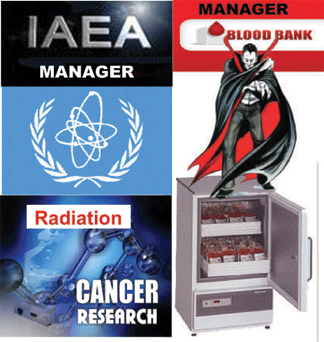
IAEA’s conflict of interest in advising about radiation and health
 In fact, researchers have been surprised to find that genetic damage, and above all perigenetic damage, which is responsible for genomic instability, to descendants is far worse than to parents; and this risk increases from one generation to the next.
After a year, [for Fukushima’s children] the damage caused by the mixture of internal and external radiation to children should be measured, by comparison with data from before 2011 in the same areas, or by comparing data with communities further away, that were spared the radioactive fallout. Birthweight, incidence of stillbirth, perinatal mortality up to 28 days, birth deformities (heart problems should be investigated later), and among the genetic diseases, Down’s syndrome, should all be studied.
In order to achieve its objectives, the IAEA cannot admit that these serious and common illnesses were caused by ionising radiation, because once known, it would prevent the development of the nuclear industry throughout the world.
The IAEA is therefore a poor source of advice for national health authorities
 Fukushima, Precious Time Has Been Lost http://readersupportednews.org/opinion2/303-
 211/12736-fukushima-precious-time-has-been-lost RSN, By Dr. Michel Fernex, The Fukushima Collective Evacuation Trial 02 August 12
It is a privilege to be able to lend personal support to the Fukushima Evacuate Children Lawsuit. There is no better measure of the moral health of a society than how it treats the most vulnerable people within it, and none or more vulnerable, or more precious, than
children who are the victims of unconscionable actions. For Japan, and for all of us, this is a test that we must not fail. (Noam Chomsky 12 Jan. 2012)
What should WHO have done after Chernobyl?” asked Dr Nabarro in 2002 when he was Acting Director-General of the World Health Organization. I replied immediately, and then confirmed it in writing: “Convene a Scientific Working Group on Ionising Radiation and Genetics” like the one in 1956, and add the words “and Genomic Instability”.
In 1956, in response to this question, WHO convened a study group in
Geneva that included the Nobel prize winner in genetics, Professor
Muller, and other luminaries of international repute in the field.
Together, these scientists reminded the world that « The genome is the
most valuable treasure of human kind. It determines the life of our
descendants and the harmonious development of the future generations.
As experts, we confirm that the health of future generations is
threatened by the expansion of the nuclear industry and the growth of
the quantity of radioactive sources. We also consider that the fact of
appearance of new mutations observed in people to be fatal for them
and for their descendants.” Since then, geneticists have been
exploring a new area: genomic instability caused in particular by
radiation.
Since 1959, an agreement signed between WHO and the International Atomic Energy Agency, and then a number of additional legal texts, prohibit WHO from intervening in nuclear accidents.
But in 1986, the Minister of Health in the USSR asked WHO to set up an international
Research Project and aid for the victims of Chernobyl. There was no
response for eighteen months, because WHO had no authority to
intervene. The IAEA, promoter of civil nuclear power, responded. In
the project they designed, there was no mention of genetics, but they
gave high priority to dental caries and this became the subject of
investigations and research.
What genetic damage has been done to the population following the
accident at Fukushima? Are the alterations already recorded in the
cells of those workers who have exhausted themselves, over the last
year, in an effort to reduce the dissemination of radionuclides into
the environment. What about people who inhaled radioactive material
and ate contaminated food ? Has this induced genomic instability? And
the children that have been born since, or who will be born to fathers
or mothers who have been irradiated. Have they inherited the fragile
genomes of their parents ?Are they, perhaps, going to be even worse
affected than their parents ?
In fact, researchers have been surprised to find that genetic damage, and above all perigenetic damage, which is responsible for genomic instability, to descendants is far worse than to parents; and this risk increases from one generation to the next. R.J.Baker and his
colleagues, studying the DNA of genes transmitted from mother voles to
their babies, found levels of mutation, from generation to generation,
reaching 100 times higher than anything we have previously encountered
up to now in the animal kingdom. The area in which these rodents live
has seen its level of radioactivity decrease, because Caesium 137 is
carried in rainwater and infiltrates deep into the soil, where it can
be recycled by plants.
One might think that in forests far away from Chernobyl that these
rodents would react positively to these improved radiological
conditions. But the mutations and the genome fragility have increased
over 22 generations in populations of voles studied by Goncharova and
Ryabokon in Belarus. These geneticists have observed the opposite of
an adaptation to radioactivity: an increase in genomic instability in
all populations studied, from 30 to 300 kilometres away from the
stricken reactor. In the least contaminated zones, near Minsk, the
genomic instability is slow, but it will persist and worsen up to 22
generations later.
The genetic effects observed in both humans and rodents has led
Professor Hillis, at the University of Texas, to conclude in his
editorial in the review Nature, 25th April 1996: « We know today that
the mutagenic effect of a nuclear accident can be far more serious
than we ever suspected, and the eucaryotic genome can present levels
of mutation that, up to now, would not have been considered possible.
»
At Fukushima, genomic instability needs to be followed up over generations, starting with grandparents and parents, then the children and grand children. After a year, the damage caused by the mixture of internal and external radiation to children should be measured, by
comparison with data from before 2011 in the same areas, or by comparing data with communities further away, that were spared the radioactive fallout. Birthweight, incidence of stillbirth, perinatal mortality up to 28 days, birth deformities (heart problems should be
investigated later), and among the genetic diseases, Down’s syndrome,
should all be studied. Brain damage with tumours, and developmental
retardation which, like decreases in IQ, will become evident at school
age. The sex ratio should also be examined, given what we know about
Chernobyl, where the deficit in female births is manifested in the
absence of thousands of girls from populations in countries close to
Chernobyl, and even as far away as Germany, where the deficit was
measurable.
Haemotologists and immunologists should study lymphocytes and
immunoglobulins, and search for autoantibodies in particular to the
endocrine glands, such as the thyroid and the islets of Langerhans in
the pancreas. These glands can be altered because they tend to
accumulate Iodine 131 and then radioactive Caesium.
The statutes of the International Atomic Energy Agency (IAEA) oblige
the organization to take decisions that are politically imposed upon
it. These may be less costly, but they are medically unacceptable.
These statutes serve as a reminder that the principle objective of the
IAEA, which is a UN agency, is « to accelerate and enlarge the
contribution of atomic energy to peace, health and prosperity
throughout the world”.
In order to achieve its objectives, the IAEA cannot admit that these serious and common illnesses were caused by ionising radiation, because once known, it would prevent the development of the nuclear industry throughout the world.
The IAEA is therefore a poor source of advice for national health authorities; it denies the health catastrophe and gives priority to
economic considerations; its statutes forbid attributing to, or
associating serious illness with, radiation. Incorrect estimates delay
the evacuation of communities that have been highly exposed to
radiation. It was almost incomprehensible that at Fukushima there was
no distribution of stable iodine to the population that would soon be
under threat. Such a preventive measure would have been welcomed, as
Keith Baverstock showed in Poland after Chernobyl.
The first victims of a serious nuclear accident are and will be
children, with an increase in allergies and an aggravation of
infectious diseases, which become chronic and involve serious
complications. Professor Titov showed that in Belarus, the immune
system was profoundly altered after the accident. Both white blood
cells and gamma globulins were altered. This needs long term
monitoring. Research needs to be done on the autoantibodies directed
against beta cells in the islets of Langerhans in the pancreas, or
against cells in the thyroid gland. Hashimoto’s thyroiditis has the
same aetiology as Type 1 diabetes, both of which increased after the
nuclear accident. At Chernobyl, this form of diabetes affected younger
and younger children. This diabetes did not exhibit the same
characteristics as the Type 1 we find in our countries. So it is an
illness caused by ionising radiation. Other diseases of the endocrine
system affect the sex glands, with problems occurring in young girls
at puberty and with male sterility.
In equal doses, external radiation is ten to a hundred times less
damaging than chronic internal radiation, which essentially results
from the oral absorption of radionuclides. These concentrate in organs
like the thymus, the endocrine glands, the spleen, the bone surfaces
and the heart.
Bandajevsky showed in autopsies conducted after Chernobyl, that
concentrations of Caesium 137 are twice as high in children’s organs
than in those of adults, having lived in the same areas. The highest
levels measured in tissue were in the pancreas and thymus of new born
children and in breast fed infants (Bandazhevsky, SMW 133: p.488-490,
2003).
In order to protect children, we must give complete protection to
pregnant women. Children can avoid absorbing radionuclides, if we
provide them with uncontaminated food and drink, at home and in
school. Taking holidays in uncontaminated areas is also beneficial.
Pectin reduces the absorption of Strontium 90, of radioactive caesium,
and of uranium derivatives. It also accelerates the elimination of
radionuclides both in faeces and in urine. Bacteria in the colon
manage to partly metabolize these long glucide chains, fragments of
which can be absorbed; they then mobilize radionuclides in the
organism. The food additive, pectin, is considered by scientists at
the European Commission research centre at Ispra (Italy) to be very
well tolerated and to have no contraindications.
A contaminated organism can be protected also by taking vitamins E and
A, as well as carotenoids, that act as antioxidants. Carrots, beetroot
and many red fruits contain these substances. Jersey cows produce milk
that is very rich in carotenoids and in vitamin A, and is very good
for children.
The dosimeters that have been given to children should be replaced by
mobile spectrometers which measure the whole body, and these can be
transported to schools periodically. These spectrometers measure the
caesium 137 load in the body. If the load is above 20 Bq/kg of body
weight, contact should be made with the family to eliminate the source
of contamination.
Epidemiological and medical problems should be studied and treated
from birth right through to puberty by paediatricians, geneticists and
immunologists, in the communities that have been contaminated. They
should compare the current situation in Fukushima with data from
comparable areas that were not contaminated.
What should the authorities be doing ?
More contamination could exacerbate the genetic damage that has
already occurred and with advice from geneticists this should be
avoided. To reduce internal radiation, which forms 80% of the risk for
the inhabitants of the contaminated regions, the industries
responsible or the government authorities should provide
uncontaminated food.
Where there is contamination of the organism by radionuclides,
children should receive cures of chelators that accelerate the
elimination of accumulated radionuclides. These are polysaccharides,
like pectin from algae, vegetables and fruit.
In the long term, molecules with antimutagenic properties should be
researched, selected and developed.
No comments yet.
1 This Month

of the week – Shut Down Drone Warfare!


Tell the Ukrainian Government to Drop Prosecution of Peace Activist Yurii Sheliazhenko

Petition to revoke the licensing of the Near Surface Nuclear Disposal Facility (NSDF) at Chalk River. https://www.ourcommons.ca/petitions/en/Petition/Details?Petition=e-7247
To see nuclear-related stories in greater depth and intensity – go to https://nuclearinformation.wordpress.com
-
Archives
- March 2026 (244)
- February 2026 (268)
- January 2026 (308)
- December 2025 (358)
- November 2025 (359)
- October 2025 (376)
- September 2025 (257)
- August 2025 (319)
- July 2025 (230)
- June 2025 (348)
- May 2025 (261)
- April 2025 (305)
-
Categories
- 1
- 1 NUCLEAR ISSUES
- business and costs
- climate change
- culture and arts
- ENERGY
- environment
- health
- history
- indigenous issues
- Legal
- marketing of nuclear
- media
- opposition to nuclear
- PERSONAL STORIES
- politics
- politics international
- Religion and ethics
- safety
- secrets,lies and civil liberties
- spinbuster
- technology
- Uranium
- wastes
- weapons and war
- Women
- 2 WORLD
- ACTION
- AFRICA
- Atrocities
- AUSTRALIA
- Christina's notes
- Christina's themes
- culture and arts
- Events
- Fuk 2022
- Fuk 2023
- Fukushima 2017
- Fukushima 2018
- fukushima 2019
- Fukushima 2020
- Fukushima 2021
- general
- global warming
- Humour (God we need it)
- Nuclear
- RARE EARTHS
- Reference
- resources – print
- Resources -audiovicual
- Weekly Newsletter
- World
- World Nuclear
- YouTube
-
RSS
Entries RSS
Comments RSS
 nuclear-news
Leave a comment