IAEA’s conflict of interest in advising about radiation and health
 In fact, researchers have been surprised to find that genetic damage, and above all perigenetic damage, which is responsible for genomic instability, to descendants is far worse than to parents; and this risk increases from one generation to the next.
After a year, [for Fukushima’s children] the damage caused by the mixture of internal and external radiation to children should be measured, by comparison with data from before 2011 in the same areas, or by comparing data with communities further away, that were spared the radioactive fallout. Birthweight, incidence of stillbirth, perinatal mortality up to 28 days, birth deformities (heart problems should be investigated later), and among the genetic diseases, Down’s syndrome, should all be studied.
In order to achieve its objectives, the IAEA cannot admit that these serious and common illnesses were caused by ionising radiation, because once known, it would prevent the development of the nuclear industry throughout the world.
The IAEA is therefore a poor source of advice for national health authorities
 Fukushima, Precious Time Has Been Lost http://readersupportednews.org/opinion2/303-
 211/12736-fukushima-precious-time-has-been-lost RSN, By Dr. Michel Fernex, The Fukushima Collective Evacuation Trial 02 August 12
It is a privilege to be able to lend personal support to the Fukushima Evacuate Children Lawsuit. There is no better measure of the moral health of a society than how it treats the most vulnerable people within it, and none or more vulnerable, or more precious, than
children who are the victims of unconscionable actions. For Japan, and for all of us, this is a test that we must not fail. (Noam Chomsky 12 Jan. 2012)
What should WHO have done after Chernobyl?” asked Dr Nabarro in 2002 when he was Acting Director-General of the World Health Organization. I replied immediately, and then confirmed it in writing: “Convene a Scientific Working Group on Ionising Radiation and Genetics” like the one in 1956, and add the words “and Genomic Instability”. Continue reading
Fukushima children – physical and mental health issues
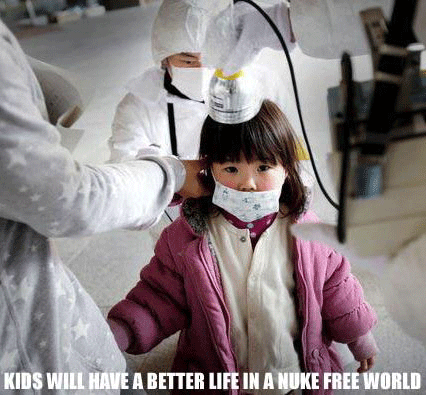 Kids’ safety key worry in Fukushima,Japan Times, Attendees of latest public hearing on energy fear low-level radiation, By NATSUKO FUKUE, 3 Aug 12, FUKUSHIMA — A year and half after the start of the nuclear crisis, many who attended the government’s latest public hearing on energy policy in Fukushima on Wednesday still expressed concern about the impact of radiation on their children……what concerns many parents in Fukushima is their children’s exposure to low levels of radiation…..
A 50-year-old woman living in Koriyama, Fukushima Prefecture, told The Japan Times after the public hearing that she fears young people will be harmed by the radiation, and that discrimination against Fukushima residents will continue.
“I’ve tried to prepare myself mentally for the discrimination my son may face when he looks for a job or when he gets married, just because he was in Fukushima last March,” said the woman, who withheld her name. Continue reading
Decentralised solar power made poor Indian villagers the winners!
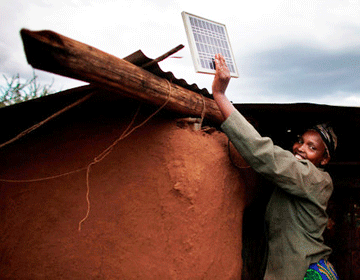 Solar Power Helped Keep the Lights On in India By David Biello | August 1, 2012 Every day, at least 400 million Indians lack access to electricity. Another nearly 700 million Indians joined their fellows inenergy poverty over the course of the last few days, or roughly 10 percent of the world’s population.
Oddly enough, some of the formerly energy poor—rural villagers throughout the subcontinent—found themselves better off than their middle-class compatriots during the recent blackouts, thanks to village homes outfitted with photovoltaic panels. In fact, solar power helped keep some electric pumps supplying water for fields parched by an erratic monsoon this year.
That monsoon is partly to blame for the blackouts as well. A lack of rain has meant a reduction in power from India’s hydroelectric dams. Pair that with problems with the supply of coal to burn and the northern half of India found itself with not enough electricity supply to meet demand. One ironic anecdote illustrates this conundrum nicely: coal miners in northern India were trapped when their electric lifts failed as a result of the blackout exacerbated by a lack of coal….. http://blogs.scientificamerican.com/observations/2012/08/01/solar-power-kept-the-lights-on-in-india/
India’s huge electricity blackout – but Solar Electricity was OK
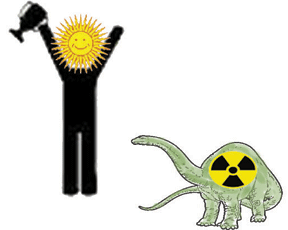 India’s Massive Blackout Proves Solar Energy’s Mettle http://www.energymatters.com.au/index.php?main_page=news_article&article_id=3322 by Energy Matters, 3 Aug 12, In what has been described as the world’s largest blackout event, solar panels again proved their worth.
India is plagued by electricity shortages, due in part to massive demand on ageing and inadequate infrastructure. Some of the increased demand isn’t just attributable to a growing population, but how the population utilises power – for example, the popularity of energy hungry air-conditioners.
The country’s hydro-electric stations are also suffering due to a poor monsoon season and coal is in short supply in some areas. While regular blackouts are a part of life in many of the nation’s regions, an incident on Tuesday set a new and unenviable record when over 600 million people simultaneously found themselves without mains power – the equivalent to nearly 55 times the population of Australia.
The event occurred just after Monday’s failure of India’s northern grid, which left 370 million people without electricity.
The nation’s capital, New Delhi, was not spared. Some forms of public transport ground to a halt and the financial impact on businesses is said to be in the hundreds of millions of dollars. However, the New York Times points out some of India’s “energy poor” were winners during the events. Many households in affected rural areas had the lights stay on thanks to their small off grid solar power systems that incorporatedeep cycle battery storage.
With the possibility of another such event occurring, decentralized energy generation using renewable energy sources will likely gain even more attention in India.
The nation already has ambitious goals for solar power; having set a target of20,000MW of installed solar capacity by 2022. The nation’s grid-connected solar energy capacity had reached 1030.66 MW at the end of June and off-grid solar panel system capacity (1kW+) was estimated to be 85.21 MW.
“Scrap Nuclear Power!” – Fukushima public hearing
Fukushima residents say resounding “no” to nuclear energy , Aug 1 2012
*Public hearings could affect nuclear policy decision
* Fukushima prosecutors launch probe after residents complaints
* Reactor restarts galvanise anti-nuclear movement (Adds Prosecutors
launch two probes against Tepco execs, officials)
By Kiyoshi Takenaka FUKUSHIMA, Japan, Aug 1 (Reuters) – Get out of nuclear power and do it fast, angry Fukushima residents told Japanese government officials on Wednesday at a public hearing on energy policy held in an area ravaged by a nuclear disaster that has whipped up opposition to atomic power.
The Fukushima hearing, the ninth out of 11 planned nationwide, sought to gather views on n uclear power’s role in the nation’s energy mix as the government struggles to cover a power shortfall by that could threaten economic growth….. “I want all the reactors in Japan shut
immediately and scrapped,” a grey-haired woman, who introduced herself as a farmer living 65 km (40 miles) from the Fukushima plant, said at the public hearing in the prefecture capital.
“Many people are now aware that the government’s talking of ‘no immediate risk to health’ is tantamount to ‘long-term health risk’,” she said to the applause of about 200 residents packed in a small concert hall.
Goshi Hosono, minister in charge of the response to the nuclear crisis, was heckled as he apologised for the suffering of people in Fukushima….. http://www.reuters.com/article/2012/08/01/japan-nuclear-fukushima-idUSL4E8J143E20120801
The secret, corrupt, and unaccountable face of India’s nuclear establishment
On account of the reluctance of the national media, print and electronic, to take up investigative journalism in the nuclear field , the Indian public has been deprived of a fair and full opportunity to know the true face of the Indian nuclear establishment.
Who Benefits From Nuclear Power Plants In India? By Buddhi Kota Subbarao. Ph.D. 02 August, 2012 Countercurrents.org The rest of the world is moving towards renewable energy and away from nuclear power. But India is pouring most of its energy budget into
establishing more and more nuclear power plants. It raises two compelling questions. Why is the present Union Government of India committing an enormous portion of its energy budget to imported nuclear power plants? Who benefits from these nuclear power plants?
The answers to these questions are not difficult to find. The secrecy that surrounds nuclear issues affords the Union Government to deal with vast sums of money in an easy way. Corrupt practices in the nuclear field do not get exposed as easily as in other fields. Big
money and political ambitions go hand in hand. This is one part of the answer. The other part is the way the Indian nuclear establishment functions.
Indian nuclear establishment has some unique features. Pursuit is more for administrative power and less for knowledge in science and technology. Consequently, pretence to knowledge grew over the years. Accountability is conspicuous by its absence. Mediocre results and at
times even nil results are proclaimed as outstanding achievements. The cleverness of the Indian nuclear establishment is from the way it can claim indigenous development and at the same time devise methods to import foreign technology. Continue reading
Big oil companies fight renewable energy through “think tanks”
 rather than providing the public with education for the greater good, faux “think tanks” like Manhattan Institute and the Heartland Institute masquerade as “pro-free market” organizations yet they defend oil subsidies and attack renewable energy support. The organizations are funded by fossil fuel companies like Exxon,
New report outlines coordinated attacks by big oil on renewable energy Examiner, AUGUST 2, 2012 BY: ALICIA BAYER A new report released today by the Sierra Clubshows that over the past decade the fossil fuel industry and its well-funded backers have mounted a coordinated campaign to discredit renewable energy and hinder its growth. Continue reading
Japan could become second biggest solar power nation New Scientist, 02 August 2012 by Rob Gilhooly WITH nuclear power on the ropes in Japan, it could be solar power’s time to shine. Minamisoma City in Fukushima prefecture has signed an agreement with Toshiba to build the country’s biggest solar park. The deal comes weeks after Japan introduced feed-in tariffs to subsidise renewable energy – a move that could see the nation become one of the world’s largest markets for solar power.
Parts of Minamisoma are around 10 kilometres from the Fukushima Daiichi nuclear power plant, and land there has been contaminated by radiation fallout. “Moving away from a dependency on nuclear is of course involved [with the agreement to build the solar park],” a city official said.
Both Minamisoma and neighbouring Namie have called for the cancellation of plans to build a nearby nuclear power plant – although Minamisoma has received $6.4 million over the past 25 years for initially agreeing to host the facility.
A number of Japanese municipalities have started solar projects in recent months. Plans have been drawn up for large-scale solar parks in Hokkaido and Kyushu, while SB Energy began operating two megasolar facilities, in Kyoto and Gunma, on 1 July.
“New solar projects are being generated day by day,” says Toshiba’s Yuji Shimada. Some estimates suggest the move could help Japan leapfrog Italy andbecome the second-biggest market for solar power after Germany… http://www.newscientist.com/article/mg21528764.800-japan-could-become-second-biggest-solar-power-nation.html
Investment expert agrees on poor economic outlook for nuclear power
“Fundamentally, [Mr] Immelt is right. In the end it’s going to be a combination of gas, wind and solar,” says Samer Salty, chief executive of Zouk Capital, a London private equity investor in clean energy projects..
Because of the vast investment needed and the construction risks involved, it is unlikely that the private sector will be willing to fund new nuclear plants without subsidies and incentives from cash-strapped governments.
Mr Atherton says: “There are few companies in the world that can take a loss of that size [the €2bn Olkiluoto cost overruns] and remain solvent.”
 Wind taken out of nuclear power’s sails Ft.com By Pilita Clark, Rebecca Bream and Guy Chazan, 2 Aug 12, It is one thing for a green pressure group to claim nuclear power is too expensive, but quite another when the charge comes from the head of an atomic industry pioneer such as General Electric.
GE built some of the world’s first commercial atomic reactors in the 1950s and has remained an industry leader since its nuclear joint venture with Japan’s Hitachi in 2007.
Some investors say that Jeff Immelt, GE chief executive, was merely stating an inconvenient industry truth when he told the Financial Times at the weekend that nuclear power was “really hard” to defend financially, and most countries were moving to a mix of gas and renewable energy. Continue reading
Serious security breach at Oak Ridge nuclear weapons plant
the activists had passed through four fences and walked for “over two hours” before reaching the uranium storage building, on which they hung banners and strung crime-scene tape.
“It is unbelievable this could happen,” Stockton said. “The significance is outrageous. If they were terrorists, they could have blown open the door and got inside.” Stockton said the security breach was the “worst we’ve ever seen.”
Oak Ridge uranium plant shut after protesters breach 4 fences, reach building By Mark Hosenball, Reuters NBCNews US, 2 Aug 12, The U.S. government’s only facility for handling, processing and storing weapons-grade uranium has been temporarily shut after anti-nuclear activists, including an 82-year-old nun, breached security fences, government officials said on Thursday. Continue reading
NHK: Criminal inquiry into nuclear accident begins — Fukushima disaster “a criminal act by the gov’t and Tepco”? — Multiple prosecutors coordinating investigation http://enenews.com/nhk-criminal-inquiry-nuclear-accident-begins-fukushima-disaster-criminal-act-govt-tepco-multiple-prosecutors-coordinating-investigation\ Japanese Prosecutors will start investigating the Fukushima nuclear accident as a criminal act by the government and Tokyo Electric Power Company.Title: Prosecutors: criminal inquiry in nuclear accident Source: NHK WORLDDate: Aug. 1, 2012
Prosecutors in the 3 districts [Fukushima, Tokyo, and Kanazawa] on Wednesday officially accepted the complaints and decided to open the case, coordinating with each other.
Radioactivity in Tokyo

 Dr. Chris Busby: Entomb the reactors or have ‘Mad Max’ scenario. http://optimalprediction.com/wp/dr-chris-busby-entomb-the-reactors-or-have-mad-max-scenario/ 3 Aug 12, Chris Busby is calling for sealing off the Fukushima reactors, since they are still releasing huge amounts of radionuclides. Cost is no object. I would say that the whole site needs to be entombed, since steam and smoke are coming out of fissures in the ground. Also a boronated concrete barrier needs to be built underground, to stop the leakage of corium into the groundwater and the sea.
Busby has also done tests on an air-conditioning filter in a Tokyo apartment (here andhere), and has found huge amounts of cesium and uranium in it. Where there is uranium, there is plutonium too. These radionuclides are incredibly toxic.
USA to put nuclear weapons in Australia, and make the Australians pay for them?
 Nuclear drumbeat grows as US eyes Australia, Crikey, by
  Harley Dennett , 2 August 2012 Australian policymakers could not be getting a clearer picture of what our US ally expects of us. Nuclear weapons and joint military bases aimed at containing our largest trading partner will, sooner or later, be put in our backyard — and we’ll be expected to pay for the privilege.
The Center for Strategic and International Studies report making headlines over a proposal to establish a US base in Perth to host nuclear-powered aircraft carriers and manned and unmanned ISR (intelligence, surveillance and reconnaissance) drones is but the first report commissioned by this Congress. The second — as revealed by Crikey in May — will focus on positioning nuclear force in the Pacific.
Defence Minister Stephen Smith’s denials overnight were revealed as word trickery by the comments of the US Deputy Assistant Secretary of Defense for Plans Robert Scher in Congressional hearings early this morning, who pointed out that “no US bases” really means they expect Australia and other allies to share the costs of hosting large numbers of American troops at these so-called “shared facilities”: Continue reading
Future of Crystal River nuclear plant in doubt, as costs rise
Repair costs rise at Crystal River nuclear plant Tampa Bay Times, By Ivan Penn, Times Staff Writer Aug 02, 2012 The cost to fix the broken Crystal River nuclear plant appears to be on the rise.
The previous top estimate of $1.3 billion is likely too low, Duke Energy CEO Jim Rogers confirmed in an interview Thursday.
The utility has not decided whether to repair or permanently shutdown the plant. An independent technical evaluation commissioned on the facility by Duke’s board is expected to be complete in about a month, Rogers said…… http://www.tampabay.com/news/business/energy/repair-costs-rising-at-progress-energys-troubled-crystal-river-nuclear/1243770
A new obstacle to Kudankulam nuclear plant
Kudankulam nuclear plant hits new hurdle, PM asks who will pay for mishap http://www.ndtv.com/article/india/pm-says-no-to-the-russians-in-the-kudankulam-project-250419 by Sunil Prabhu, Edited by Prasad Sanyal August 02, 2012 New Delhi: The Kudankulam nuclear power plant in Tamil Nadu has run up against new hurdles. This time, Prime Minister Manmohan Singh wants to know from the Department of Atomic Energy who will pay if there is a mishap at the power plant.
The PM, who is also the Minister for Atomic Energy, is questioning the department’s decision not to exercise the right to recourse – for units 3 and 4 of the project – in the event of a mishap at the plant. The plant is being built with Russian collaboration and the Russians have said they are keen that right to recourse should not apply to any part of this project. That would mean that the Russians will have no liability in case of an accident.
The PM has said that if such a waiver is granted to the Russian partners, other countries like the US and France, partnering India on such projects, will seek waiver too. Continue reading
1 This Month
10 March A LIVE WEBINAR THE REAL EFFECTS OF NUCLEAR POWER
What the Industry Isn’t Telling Us
1:00 PM Mountain, 2 pm Central, 3 pm Eastern. Live on the Keepers of the Water Facebook page



18 March Webinar @ 1 PM EST: An Assessment of SMR Projects: The Case of Canada
register for the zoom:
https://us02web.zoom.us/webinar/register/WN_o8BIIOUvQ2ONJR1nta65DQ#/registration


of the week – STOP SMALL MODULAR REACTORS IN CANADA
To see nuclear-related stories in greater depth and intensity – go to https://nuclearinformation.wordpress.com
-
Archives
- March 2026 (99)
- February 2026 (268)
- January 2026 (308)
- December 2025 (358)
- November 2025 (359)
- October 2025 (376)
- September 2025 (258)
- August 2025 (319)
- July 2025 (230)
- June 2025 (348)
- May 2025 (261)
- April 2025 (305)
-
Categories
- 1
- 1 NUCLEAR ISSUES
- business and costs
- climate change
- culture and arts
- ENERGY
- environment
- health
- history
- indigenous issues
- Legal
- marketing of nuclear
- media
- opposition to nuclear
- PERSONAL STORIES
- politics
- politics international
- Religion and ethics
- safety
- secrets,lies and civil liberties
- spinbuster
- technology
- Uranium
- wastes
- weapons and war
- Women
- 2 WORLD
- ACTION
- AFRICA
- Atrocities
- AUSTRALIA
- Christina's notes
- Christina's themes
- culture and arts
- Events
- Fuk 2022
- Fuk 2023
- Fukushima 2017
- Fukushima 2018
- fukushima 2019
- Fukushima 2020
- Fukushima 2021
- general
- global warming
- Humour (God we need it)
- Nuclear
- RARE EARTHS
- Reference
- resources – print
- Resources -audiovicual
- Weekly Newsletter
- World
- World Nuclear
- YouTube
-
RSS
Entries RSS
Comments RSS
 nuclear-news