Special BHP “protected area” gives police stronger rights over peaceful anti uranium protest
Elder Kevin Buzzacott, who had previously tried to stall the mine expansion through a legal challenge, said the uraniumindustry was ”deadly”. “The sooner it stops the better. If people really knew what they were destroying they wouldn’t touch it.”
Police accused over Olympic Dam protest BY: SARAH MARTIN, The Australian July 16, 2012 PROTESTERS at BHP Billiton’s Olympic Dam mine have accused police of heavy-handedness, as more than 400 people joined a “mutant zombie march” to the Roxby Downs site yesterday.
Organiser Nectaria Calan said police were harassing protesters and depriving the group of their civil liberties by demanding identification and controlling access to and from their campsite. ”They have barricaded us into camps . . . and you can’t get out with a two-wheel-drive,” she said.
“They are forcing us to go through the roadblock with an escort through the protected area, where police have increased powers. We feel like our civil liberties are being undermined.” Continue reading
In South Australia, police firmly protect BHP against peaceful anti nuclear protestors
 The protestors intend to march again on Monday. Donna Jackson, from the Larrakia people – the traditional owners of
land around Darwin – says she travelled to the mine to protest against uranium being transported through the Northern Territory. ”We don’t want uranium coming through our harbour. It’s too unsafe,” she said. ”We have a big wet season every year, nearly two metres of rain and there’s been lots of spillage. (photo from ABC)
 (includes video} Anti-nuclear protesters disperse after police stand-off http://www.abc.net.au/news/2012-07-15/anti-nuclear-protesters-disperse-after-police-standoff/4131790 July 16, 2012 Anti-nuclear demonstrators called off Sunday’s protest outside the Olympic Dam uranium mine in South Australia’s outback after a two-hour stand-off with police.
Organisers say about 450 people had just started their march from their campsite to the gate of the BHP Billiton mine, when their route was blocked by police officers. Continue reading
Cancer and birth deformities toll, due to uranium radiation in Punjab groundwater
The effect of all this can be seen in the growing number of patients in the Malwa belt with cancer and other diseases and children being born with abnormalities. In fact, a train that connects Bathinda with Bikaner in neighbouring Rajasthan is known as the ‘Cancer Express’ as it ferries a large number of cancer patients from Punjab to Bikaner for treatment at a cancer hospital.
Groundwater contaminated, Punjab battles uranium curse Times of IndiaI Jul 13, 2012, CHANDIGARH, The high incidence of cancer and other diseases in Punjab’s Malwa belt has been highlighted over the last decade. Now, union Rural Development Minister Jairam Ramesh has confirmed the presence of uranium and other heavy metals in groundwater in the state, particularly the Malwa region, and serious efforts are afoot to control the damage. Continue reading
Months passed before nuclear plant’s fire was reported to regulators
Browns Ferry nuclear plant had a control room fire in January, regulators took months to notify public Al.com, July 13, 2012, By Brian Lawson, The Huntsville Times HUNTSVILLE, Alabama –– TVA’s Browns Ferry nuclear plant near Athens had a fire in one its control rooms in January, but public notice of the event was not issued until this week.
The roughly 10-minute fire in the Unit 3 control room was caused by an electrical component determined to be about 34 years old, some four times older than its recommended shelf life, according to a TVA incident report.
TVA’s report on the Jan. 26 fire was submitted to the Nuclear Regulatory Commission on March 26. An NRC spokesman said Friday he had no explanation why the report was not made public by the NRC until July 9.
The fire was reportedly caused by a failed power supply in a panel. It burned out some plant alarms and warning lights….. Those problems should have alerted TVA, said David Lochbaum, a former Browns Ferry engineer and director of the nuclear safety program for the Washington, D.C.-based Union of Concerned Scientists. ….. TVA reported the Unit 3 capacitors all dated back to the original construction of the unit, 34 years ago.
Browns Ferry was the site of the worst nuclear plant fire in U.S. history in 1975. A plant employee using a candle to look for air hose leaks accidentally ignited some sealing material, the fire resulted in operators having no control over the plant for about an hour. Browns Ferry officials didn’t notify Limestone County Emergency Management officials about the fire until the following day……
Fatal flaws inherent in nuclear power generation
Made in Japan? Fukushima Crisis Is Nuclear, Not Cultural TruthOut, 14 July 2012 By Gregg Levine, Capitoilette | News Analysis “……..As the Diet’s report makes abundantly clear–far more clear than any talk about Japanese culture–the multiple failures at and around Fukushima Daiichi were directly related to the design of the reactors and to fatal flaws inherent in nuclear power generation.
Return for a moment to something discussed here last summer, The Light Water Paradox: “In order to safely generate a steady stream of electricity, a light water reactor needs a steady stream of electricity.” As previously noted, this is not some perpetual motion riddle–all but one of Japan’s commercial nuclear reactors and every operating reactor in the United States is of a design that requires water to be actively pumped though the reactor containment in order to keep the radioactive fuel cool enough to prevent a string of catastrophes, from hydrogen explosions and cladding fires, to core meltdowns and melt-throughs.
Most of the multiple calamities to befall Fukushima Daiichi have their roots in the paradox. As many have observed and the latest Japanese report reiterates, the Tohoku earthquake caused breaches in reactor containment and cooling structures, and damaged all of Fukushima’s electrical systems, save the diesel backup generators, which were in turn taken out by the tsunami that followed the quake. Meeting the demands of the paradox–circulating coolant in a contained system–was severely compromised after the quake, and was rendered completely impossible after the tsunami. Given Japan’s seismic history, and the need of any light water reactor for massive amounts of water, Fukushima wouldn’t really have been a surprise even if scientists hadn’t been telling plant operators and Japanese regulators about these very problems for the last two decades…..
And while the rapid degeneration of the tubing might be peculiar to San Onofre, the dangers inherent in a system that requires constant power for constant cooling–lest a long list of possible problems triggers a toxic crisis–are evident across the entire US nuclear fleet. Cracked containment buildings, coolant leaks, transformer fires, power outages, and a vast catalogue of human errors fill the NRC’s event reports practically every month of every year for the past 40 years. To put it simply, with nuclear power, too much can go wrong when everything has to go right.
And this is to say nothing of the dangers that come with nuclear waste storage. Like with the reactors, the spent fuel pools that dot the grounds of almost every nuclear plant in America and Japan require a consistent and constantly circulating water supply to keep them from overheating (which would result in many of the same disastrous outcomes seen with damaged reactors). At Fukushima, one of the spent fuel pools is, at any given point, as much of a concern as the severely damaged reactor cores. http://truth-out.org/news/item/10333-made-in-japan-fukushima-crisis-is-nuclear-not-cultural
UK to sell out of nuclear power company URENCO
Nuclear sale set to net billions for UK The Government is holding a “beauty parade” for bankers to advise it over a potential sale of the UK’s multi billion-pound stake in nuclear power giant Urenco. Telegraph UK, By Emma Rowley, Rowena Mason, and Helia Ebrahimi 15 Jul 2012 Continue reading
An argument in favour of letting Iran have the nuclear bomb
Iran’s leaders are not irrational, as often portrayed, and that far from being emboldened they would be less bellicose if they acquired nuclear weapons for fear of sparking a nuclear conflict.
Most experts believe Iran has not yet made a decision on whether to go ahead and is
12-18 months away from a bomb were it to decide to pursue that option.
Let Iran have the bomb: US professor Kenneth Waltz THE AUSTRALIAN, BY: CHRISTINA LAMB, WASHINGTON From: The Times July 16 A LEADING US foreign policy expert has suggested Iran should be allowed to develop atomic weapons amid growing frustration at the failure of efforts to persuade it to halt its nuclear program. Continue reading
After one MOX nuclear reprocessing disaster, Britain plans another one!
Pete Wilkinson, an independent environmental consultant, said it “beggared belief” that ministers were going down this path after losing an estimated £600m from operating an original MOX plant.
“It would be interesting to see the commercial arrangements which justify turning Britain into a nuclear waste dump for plutonium that no-one else wants.”
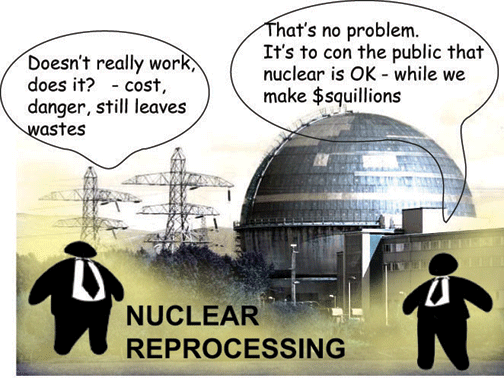
 UK nuclear authority takes ownership of German plutonium UK risks becoming a ‘nuclear laundry’ looking after unwanted waste from other countries, warns industry expert Terry Macalister guardian.co.uk, 13 July 2012 Britain risks being turned into a “nuclear laundry” by taking ownership of German plutonium in return for cash, the government was warned on Friday.
The move came along with confirmation that ministers were moving towards a controversial decision to build a new mixed oxide fuel (MOX) plant despite having just agreed to close an existing one which lost millions of pounds.
Britain has the largest stockpile of plutonium in the world but has taken permanent control of a further 4 tonnes under a deal with German nuclear power companies.. Continue reading
France’s huge and growing nuclear waste problem
 Nuclear waste in France set to double http://www.upi.com/Science News/2012/07/13/Nuclear-waste-in-France-set-to-double/UPI 21671342208921/#ixzz20dUEDe8D PARIS, July 13 (UPI) –– France’s nuclear waste agency says the amount of such waste in the country will double by 2030, and some of it will remain radioactive for 2 million years.

The current 45 million cubic feet of nuclear waste in France is likely to reach 95 million cubic feet in the next 18 years, a report by Andra, the agency charged with stocking and disposing of nuclear waste, said.
The current amount of waste represents 4 pounds for every person in the country.
With nuclear power the principle source of electricity in France, the Andra report warns of major problems stockpiling waste, Radio France Internationale reported. While only 0.2 percent of current stocks are highly radioactive, some of the material, such as neptunium 237, can remain active for more than 2 million years.
The socialist government of Francois Hollande has resisted pressure from its coalition partners to drastically reduce the nuclear power industry, responsible for 59 percent of all the nuclear waste generated in the country, RFI reported.
Anti nuclear protest in Tokyo: police crack down
Japanese Journalist: “Like Palestine” at Tokyo protest — ‘Iron fence’ erected as last resort of Prime Minister’s regime http://enenews.com/japan-journalist-like-palestine-at-tokyo-protest-iron-fence-erected-as-last-resort-of-prime-ministers-regime By ENENews Ryusaku Tanaka’s Journal from July 13, 2012 translated by Dissensus Japan:
In front of the Prime Minister’s Office, it became like Palestine.
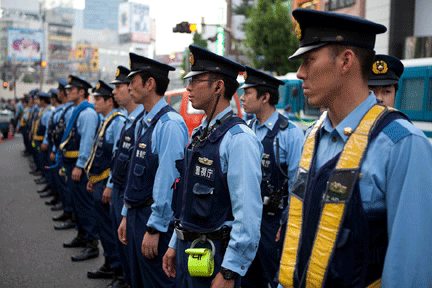
See more pictures of Friday’s Tokyo anti nuclear protest at http://shoottokyo.com/2011/06/13/anti-nuclear-protests-across-tokyo/#comment-23926
During the meeting against the restarting of nuclear power that happens every friday, the police separated the sidewalk from the roadway with iron fences after having considered it was dangerous that people overflow on the roadway (It happened at the meeting last week and two weeks ago). The jurisdiction, Enforcement Division of Kôjimachi Police station explained in a phone interview: “It’s for the security of the crowd”. But isn’t it the same thing than to surround palestinian people saying that It’s to avoid terrorism? As I went to report about the wall of Palestine since the process of its plan, I couldn’t help comparing it.
The movement against the policy of Noda’s regime to promote nuclear power spreads. They don’t want people to have this image. It seems that their worries are increasing much stronger because the snap general election will be hold soon. Their plant scheme succeeded at first glance.
The iron fence is the last resort of PM Noda’s regime and of the Police and has a very bad reputation among the protesters.
UK’s secretive discussions on the unknown cost of new nuclear power
 “Discussions are happening in smoke-filled rooms, over champagne and croissants, to establish a price that we will all pay,” said Ian Marchant, chief executive officer of the U.K.’s second-largest energy supplier SSE Plc (SSE), which dropped plans to develop reactors in
September. “There is no transparency as to what that price will be.”
“What you have is a whole bunch of people saying they know what a new reactor will cost and they don’t,”

U.K. Seen Doubling Power Price to Guarantee New Reactor Bloomberg News, By Kari Lundgren on July 13, 2012. “……The future of the U.K.’s nuclear industry will be decided on one number: the price the government’s willing to guarantee Electricite de France SA will get
for generating atomic power. Continue reading
High radiation stalls efforts to close down Fukushima nuclear reactor No.3
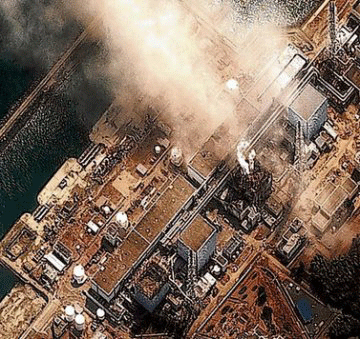 VIDEO Robot probe detects high radiation at No.3 reactor http://www3.nhk.or.jp/daily/english/20120713_10.html The operator of the Fukushima Daiichi nuclear plant has detected high levels of radiation in the basement of the No. 3 reactor, with a maximum dose of 360 millisieverts per hour.
Tokyo Electric Power Company sent in a robot on Wednesday to the room where the suppression chamber is located. It was the first robot to probe this area of the plant. TEPCO released video taken inside. They show that a door on the southwestern side is broken. There is no other apparent damage or sign of water leakage.
But high levels of radiation were detected. Readings exceeded 100 millisieverts per hour in a number of locations. Average levels were higher than those in the No.2 reactor.
Engineers lost control of the remote-controlled robot after around 3 hours of operation. They say there are problems with the connecting cable and they’ve been unable to regain control.
TEPCO officials say they have no option but to leave the robot where it is for the time being.
This may pose a problem to the utility’s efforts to decommission the reactor. The operators are in a hurry to identify and repair damage to the reactor’s suppression chamber and containment vessel. They want to pump in water in order to remove the melted fuel lying at the bottom.
A litany of ongoing, and rising, costs for San Onofre nuclear power plant
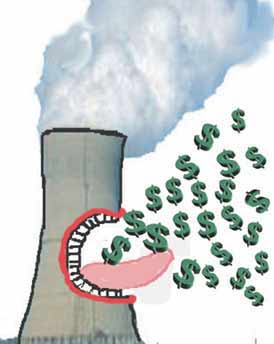
 The Sustainability Alliance of Southern California last night hosted a discussiont: “Nuclear Power in Southern California – Can We Afford It? San Diego Reader, 13 July 12, “… Featured speakers were Alliance for Nuclear Responsibility executive director Rochelle Becker and counsel for the Alliance/former executive director and commissioner of the California Energy Commission John Geesman.
A recurring theme of the talk was the cost of nuclear power, touted as a cheap alternative to gas-fired power plants or other means of power.
“For San Onofre, [the original cost estimate] was under $180 million dollars. But it was $4.7 billion dollars when finished,” Becker said. She also pointed out that the cost of new seismic studies needed due to the discovery of earthquake faults near the plant has risen from an original estimated cost of $21 million to a new request by plant operator Southern California Edison to bill its customers as well as those of San Diego Gas & Electric up to $64 million for the studies. Continue reading
High radiation level at Fukushima school, even after ‘decontamination’
 1,000,000 Bq/kg of cesium detected at Fukushima school… after being ‘decontaminated’ — “It’s obvious they will just leave it” – Local Official y 13th, 2012 By ENENews July 11, 2012 post by Koichi Oyama, Minamisoma city council member, translated by Dissensus Japan:
1.000.000 Bq detected in a school after a decontamination conducted!
A University’s research team collected lichen at the entrance of the gymnastic hall of a school that restarted after a decontamination operation, and the sample measured the Cesium radiation level, 989.000 Bq/Kg.
It’s obvious they will just leave it. I told them my ideas at least, but I’m not sure if this inspired them to do anything. No one makes decision to get rid of dangers.
I want to believe that at least “school principal” won’t leave the danger at the place where students walk by. I would go there tomorrow to make sure. Read the report here
Unusual number of birth deformities at Fukushima hospital
Evacuee: Fukushima hospital worker says 5 out of 7 babies were born with birth defect, Down’s syndrome, or lost by miscarriage — After this, husband agreed to evacuate July 13th, 2012 By ENENews Original published June 13, 2012 by a Fukushima evacuee, translated by Dissensus Japan:
Someone I know finally moved out of Fukushima to Mie (middle west of Japan). I wasn’t close to her, but she told me a major incident occurred that inspired her to be scared of radiation.At a hospital in Fuksuhima where she was working in, 5 babies out of 7 were born with birth defect, Down’s syndrome or lost by miscarriage.
- 2 Down’s syndrome
- 1 born with 6 fingers
- 1 anencephalia
- 1 miscarriage
- 2 other infants were 4 months old old at the time. They have been followed over time.
Speaking in terms of probability, it’s hardly possible this happens in a same hospital. This terrified her. With experts’ knowledge and experiences, it reached the conclusion that this was associated with radiation.
After this, her husband finally agreed and her family evacuated home.
1 This Month

Protect Sazan Island from the Trump family! https://secure.avaaz.org/campaign/en/protect_sazan_island_from_the_trump_family_loc/?bqFCVab&v=174511&cl=22707147157&_checksum=5e9dde668860e8231c33699735e16a1fbf22ab2cb01da50c999fe8732b9775ef&utm_source=email&utm_medium=blast_email&utm_campaign=174511


Cuba Is Not a Failed State – It Is a Besieged State
PETITION: “Global Appeal to Endorse Palestinian Right of Return of Refugees”
To see nuclear-related stories in greater depth and intensity – go to https://nuclearinformation.wordpress.com
-
Archives
- June 2026 (129)
- May 2026 (306)
- April 2026 (356)
- March 2026 (251)
- February 2026 (268)
- January 2026 (308)
- December 2025 (358)
- November 2025 (359)
- October 2025 (376)
- September 2025 (257)
- August 2025 (319)
- July 2025 (230)
-
Categories
- 1
- 1 NUCLEAR ISSUES
- business and costs
- climate change
- culture and arts
- ENERGY
- environment
- health
- history
- indigenous issues
- Legal
- marketing of nuclear
- media
- opposition to nuclear
- PERSONAL STORIES
- politics
- politics international
- Religion and ethics
- safety
- secrets,lies and civil liberties
- spinbuster
- technology
- Uranium
- wastes
- weapons and war
- Women
- 2 WORLD
- ACTION
- AFRICA
- Atrocities
- AUSTRALIA
- Christina's notes
- Christina's themes
- culture and arts
- Events
- Fuk 2022
- Fuk 2023
- Fukushima 2017
- Fukushima 2018
- fukushima 2019
- Fukushima 2020
- Fukushima 2021
- general
- global warming
- Humour (God we need it)
- Nuclear
- RARE EARTHS
- Reference
- resources – print
- Resources -audiovicual
- Weekly Newsletter
- World
- World Nuclear
- YouTube
-
RSS
Entries RSS
Comments RSS
 nuclear-news