PRISM nuclear reactor won’t solve UK’s plutonium problem
Adrian Simper, the strategy director of the UK’s Nuclear Decommissioning Authority, warned last November in an internal memorandum that fast reactors were “not credible” as a solution to Britain’s plutonium problem because they had “still to be demonstrated commercially” and could not be deployed within 25 years.
the plutonium metal, once prepared for the reactor, would be even more vulnerable to theft for making bombs than the powdered oxide.
Are fast-breeder reactors the answer to our nuclear waste nightmare? The Guardian 30 July 12 The battle is intensifying on a decision over a major fast-breeder reactor to deal with the plutonium waste at Sellafield. Fred Pearce “…….Britain has a history of embarrassing failures with MOX, including the closure last year of a $2 billion blending plant that spent 10 years producing a scant amount of fuel. And critics say that, even if it works properly, MOX fuel is an expensive way of generating not much energy, while leaving most of the plutonium intact, albeit in a less dangerous form.
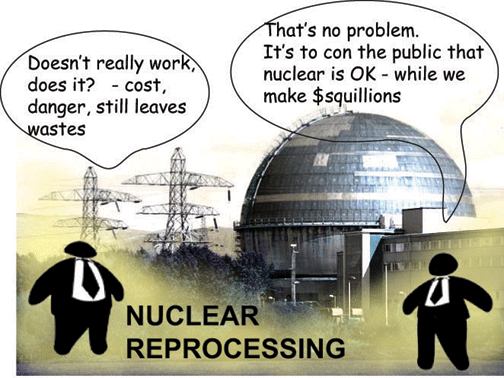
Only fast reactors can consume the plutonium. Many think that will ultimately be the UK choice. If so, the PRISM plant would take five years to license, five years to build, and could destroy probably the world’s most dangerous stockpile of plutonium by the end of the 2020s. GEH has not publicly put a cost on building the plant, but it says it will foot the bill, with the British government only paying by results, as the plutonium is destroyed.
The idea of fast breeders as the ultimate goal of nuclear power engineering goes back to the 1950s, when experts predicted that fast-breeders would generate all Britain’s electricity by the 1970s. But the Clinton administration eventually shut down the U.S.’s research program in 1994. Britain followed soon after, shutting its Dounreay fast-breeder reactor on the north coast of Scotland in 1995. Other countries have continued with fast-breeder research programs, including France, China, Japan, India, South Korea, and Russia, which has been running a plant at Sverdlovsk for 32 years…..
Proponents of fast reactors see them as the nuclear application of one of the totems of environmentalism: recycling. But many technologists, and most environmentalists, are more skeptical.
The skeptics include Adrian Simper, the strategy director of the UK’s Nuclear Decommissioning Authority, which will be among those organizations deciding whether to back the PRISM plan. Simper warned last November in an internal memorandum that fast reactors were “not credible” as a solution to Britain’s plutonium problem because they had “still to be demonstrated commercially” and could not be deployed within 25 years.
The technical challenges include the fact that it would require converting the plutonium powder into a metal alloy, with uranium and zirconium. This would be a large-scale industrial activity on its own that would create “a likely large amount of plutonium-contaminated salt waste,” Simper said.
Simper is also concerned that the plutonium metal, once prepared for the reactor, would be even more vulnerable to theft for making bombs than the powdered oxide. This view is shared by the Union of Concerned Scientists in the U.S., which argues that plutonium liberated from spent fuel in preparation for recycling “would be dangerously vulnerable to theft or misuse.”….
Another criticism is the more general one that the nuclear industry has a track record of delivering late and wildly over budget — and often not delivering at all.
John Sauven, director of Greenpeace UK, and Paul Dorfman, British nuclear policy analyst at the University of Warwick, England, argued recently that this made all nuclear options a poor alternative to renewables in delivering low-carbon energy. “Even if these latest plans could be made to work, PRISM reactors do nothing to solve the main problems with nuclear: the industry’s repeated failure to build reactors on time and to budget,” they wrote in a letter to the Guardian newspaper. “We are being asked to wait while an industry that has a track record for very costly failures researches yet another much-hyped but still theoretical new technology.”
Have a look…this report was done for Rokkasho:
http://www.greenpeace.or.jp/campaign/nuclear/images/n0800206_en.pdf
So are you proposing a technology that will leave us with more dangerous waste than we have already?
No comments yet.
1 This Month

of the week – Shut Down Drone Warfare!


Tell the Ukrainian Government to Drop Prosecution of Peace Activist Yurii Sheliazhenko

Petition to revoke the licensing of the Near Surface Nuclear Disposal Facility (NSDF) at Chalk River. https://www.ourcommons.ca/petitions/en/Petition/Details?Petition=e-7247
To see nuclear-related stories in greater depth and intensity – go to https://nuclearinformation.wordpress.com
-
Archives
- March 2026 (222)
- February 2026 (268)
- January 2026 (308)
- December 2025 (358)
- November 2025 (359)
- October 2025 (376)
- September 2025 (258)
- August 2025 (319)
- July 2025 (230)
- June 2025 (348)
- May 2025 (261)
- April 2025 (305)
-
Categories
- 1
- 1 NUCLEAR ISSUES
- business and costs
- climate change
- culture and arts
- ENERGY
- environment
- health
- history
- indigenous issues
- Legal
- marketing of nuclear
- media
- opposition to nuclear
- PERSONAL STORIES
- politics
- politics international
- Religion and ethics
- safety
- secrets,lies and civil liberties
- spinbuster
- technology
- Uranium
- wastes
- weapons and war
- Women
- 2 WORLD
- ACTION
- AFRICA
- Atrocities
- AUSTRALIA
- Christina's notes
- Christina's themes
- culture and arts
- Events
- Fuk 2022
- Fuk 2023
- Fukushima 2017
- Fukushima 2018
- fukushima 2019
- Fukushima 2020
- Fukushima 2021
- general
- global warming
- Humour (God we need it)
- Nuclear
- RARE EARTHS
- Reference
- resources – print
- Resources -audiovicual
- Weekly Newsletter
- World
- World Nuclear
- YouTube
-
RSS
Entries RSS
Comments RSS
 nuclear-news
Leave a comment