Shoddy way that India’s government overrides anti nuclear villagrers
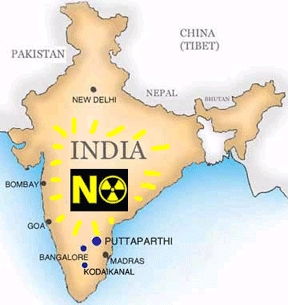
 Nuclear showdown in Delhi’s neighbourhood Rediff, 26 July 12, 2012 Gopal Krishna Plans to build India’s biggest indigenous nuclear power plant have failed to impress villagers in Haryana’s Fatehabad district, who fear a Fukushima-type disaster. The shoddy way in which the government agencies have handled the issue has not helped matters either. Gopal Krishna reports.
The angry protest by Haryana villagers against the proposed nuclear plant 210 km from Delhi on July 17 — a day after biggest rally in
Tokyo demanded an end to nuclear power — signifies the unity of the
struggle against nuclear power.
In Fatehabad, a big dharna and conference is planned on August 17, 2012 against the Gorakhpur nuclear power project.
This programme is planned in the backdrop of the phase out of nuclear
power in countries such as Australia, Austria, Denmark, Greece,
Ireland, Italy, Latvia, Liechtenstein, Luxembourg, Malta, Portugal,
Israel, Malaysia, New Zealand, Norway, Germany, Spain and others who
are opposed to nuclear power.
India has 20 nuclear reactors operating in six nuclear power plants, 7
reactors under construction, and is planning an additional 24 such
reactors, including the one at Fatehabad.
sregarding global movement against nuclear power, Haryana State
Pollution Control Board attempted to hold a fake public hearing for
the proposed 2800 MW nuclear power plant at Gorakhpur village in
Fatehabad district by central government’s Nuclear Power Corporation
of India Limited without the Environment Impact Assessment (EIA)
report on July 17, 2012 at Sahid-e-Azam Bhagat Singh Stadium in
Gorakhpur.
Villagers’ bitter protest against the plant in the backdrop of
man-made disaster of Fukushima compelled the officials to huddle
together and leave the venue abruptly.
The collusion between the administration and the NPCIL was quite manifest.
The villagers underlined that such plants should not be set up. A
total 1503.5 acres of agricultural land is required for the project.
The Gorakhpur Nuclear Power Project will create 4 heavy water nuclear
power plants of indigenous design, with a capacity of 700 MWs each.
Out of the four two will be constructed in the first phase. This will
be the biggest indigenous nuclear power plants built in the country.
The land is being acquired from Gorakhpur, Badopal and Kajal Heri villages.
The notification for this acquisition was issued in 2011under ‘urgency
clause’ the Land Acquisition Act, 1894. This is unmindful of the fact
that the proposed Land Acquisition Bill, Land Acquisition,
Rehabilitation and Resettlement Bill, 2011 has a provision for not
acquiring irrigated and multi-cropped land for non-agricultural
purposes.
The proposal of the nuclear plant violates Atomic Energy Regulatory
Board’s own rules.
The site is in the midst of a region, which has high population
density. Small towns like Fatehabad, Ratiya and Tohana are almost 30
km away.
Sensing imminent danger, villagers turned up in huge numbers to
denounce the nuclear power plant amidst massive police presence.
The activities at the Sahid-e-Azam Bhagat Singh Stadium demonstrated
the veracity of what has been stated in a paper ‘The environmental
impact assessment process for nuclear facilities: An examination of
the Indian experience’ by M V Ramana wherein he has rightly argued
that “the EIA process with regard to nuclear projects in India is of
dubious quality.”……
public hearing due to massive opposition from thousands of villagers
who are against the setting of the hazardous plant in their fertile
agricultural land, Member of Parliament from Hisar, Kuldip Bishnoi
reached and assured his support against the nuclear power plant.Abhay Chautala, the MLA from Ellenabad, also entered the venue and
promised to stop the construction of the proposed nuclear plant in the
way it has been done in developed countries like Germany.Both Bishnoi and Chautala expressed their solidarity with the
protesting farmers. Both leaders challenged Haryana Chief Minister
Bhupinder Singh Hooda to locate the plant in his own village instead
of endangering the villages of Fatehabad.
Such a stance by members of legislature was in complete contrast with
the conspicuously deferential approach of the district administration
towards the project proponents.
Authorities illustrated the fake nature of the public hearing process,
as they left without reading out the minutes of the proceedings and
seeking consent of the villagers who were there as is mandatory under
Environment Impact Assessment Notification, 2006.
It is noteworthy that the distance between Fukushima and Tokyo is 238
km. Despite this, after the nuclear disaster on March 11, 2011,
Tokyo’s population was forced to evacuate.
The distance between Delhi and Fatehabad is 210 km. It is high time
residents of Delhi engaged with the imminent nuclear radiation threat
from the proposed atomic power plant and prepared for emergency
evacuation if the Fatehabad facility comes up.
he EIA report has been prepared by Ranchi-based MECON Limited,
formerly known as (Metallurgical & Engineering Consultants (India)
Limited, a public sector undertaking under the ministry of steel.
The people’s movement has long been demanding that Mecon should be
blacklisted for continuously producing low quality and misleading
reports for uranium mines.
The EIA report prepared by Mecon was leaked one day ahead of the
farcical public hearing. As per the Environment Impact Assessment
Notification, 2006 the EIA report is a public document, which must be
made available to people as a pre-condition for public hearing.
The fact that it got leaked reveals that it was not shared with the
public in advance.
The six panchayats of Fatehabad district who will be worst-affected by
the project did not get the copies of the EIA before the staged public
hearing.
At the site of the hearing, heavily-armed state and paramilitary
forces, water-cannon vehicles and tear-gas etc riot-control gears were
visible. The dais of the officials who were pressing was surrounded by
barbed wires.
Prior to this staged hearing security personnel were injured during a
rehearsal to manage huge public presence with tear gas etc. The venue
resembled a battled ground surrounded by armed policemen.
Farmers referred to their land as mother and pledged to save it from
the proposed nuclear power project.
Farmers in Fatehabad are aware that the West Bengal government has
refused permission to a proposed 6000 MW facility near the town of
Haripur that intended to host six Russian reactors.
India has drawn up a plan to reach a nuclear power capacity of 63,000
MW in 2032 under the influence of nuclear technology companies.
Claims of the Department of Atomic Energy are not credible. As per
DAE’s plans, India should have had a nuclear power capacity of 8,000
MW by 1980, but its actual installed capacity was 540 MW. It set a
target of 43,500 MW for 2000. But the installed capacity in that year
was only 2,720 MW. The current installed capacity of nuclear power is
just 2.32 per cent at 4,780 MW. The actual production requires
rigorous examination.
Meanwhile, governments of Russia and India signed a protocol for
financing the Kundankulam Nuclear Power Project in Tamil Nadu in the
teeth of bitter opposition of villagers against the project.
While environmental and health concerns of the present and future
generations due to adverse effects of nuclear radiation merit
attention, the security concerns that emerge from nuclear reactors
also deserve consideration since nuclear installation have become the
preferred targets during military conflict and, over the past three
decades, have been repeatedly attacked during military air strikes,
occupations, invasions and campaigns.
In September 1980, Iran bombed the Al Tuwaitha nuclear complex in
Iraq. In June 1981, an Israeli air strike completely destroyed Iraq’s
Osirak nuclear research facility. Between 1984 and 1987, Iraq bombed
Iran’s Bushehr nuclear plant six times. In Iraq in 1991, the U.S.
bombed three nuclear reactors and an enrichment pilot facility. In
1991, Iraq launched Scud missiles at Israel’s Dimona nuclear power
plant. In September 2007, Israel bombed a Syrian reactor under
construction.
Observations of G K Pillai, the then secretary in the ministry of home
affairs, before the parliamentary standing committee on science and
technology, environment and forests in 2010 illustrate how conditions
in which the operator of a nuclear power plant, who could be made
liable for nuclear damage in armed conflict, hostilities, civil war,
insurrection or an act of terrorism, have wide meanings but they have
not been defined in the liability act.
These concerns underline that India’s nuclear installations are
vulnerable to such assaults as well.
As to health impact, K Sujata Rao, the then secretary in the ministry
of health and family welfare while deposing before the parliamentary
committee in the matter of nuclear emergency mentioned, “Since the
response system to deal with any kind of emergency of such type, the
hospitals are not well-equipped, it is natural that mortality and
morbidity due to multiple burn, blasts, radiation injuries and
psycho-social impact could be on very high scale and medical tackling
of such a large emergency could have enough repercussions in the
nearby areas of radioactive fallout…”
She suggested while setting up nuclear plants consideration may also
be given to the fact that there should be hospital having trained
doctors near such establishments and arrangements should also be made
for free treatment of people who are affected by serious nuclear
fallout.”
This has been revealed in the committee’s report presented to the
Parliament. She confessed that Union health ministry is nowhere to
meet an eventuality that may arise out of nuclear and radiological
emergencies.
Admittedly, there is no provision and infrastructure for health care
during radiological emergencies in the country.
Despite this, questionable proposals for nuclear plants like the one
at Fatehabad need to be revisited to convey that although belated
unlearnt lessons of institutional failures in the case of industrial
disaster of Bhopal and Fukushima are being internalized.
The 1,000-page special report on renewable energy sources and climate
change mitigation has found that renewable energy could account for
almost 80 per cent of the world’s energy supply within four decades.
In India, it can account for a higher share if people’s felt need for
energy is prioritized over the needs of companies addicted to ‘profit
at any cost’.
It is time a referendum was held in Haryana and elsewhere in India too
to decide whether or not renewable energy is the preferred choice.
Will our government pursue the policies needed to travel on
alternative power route by resisting the vice like grip of nuclear
power companies?
http://www.rediff.com/news/slide-show/slide-show-1-nuclear-showdown-in-delhi-s-neighbourhood-fatehabad/20120726.htm
No comments yet.
1 This Month

of the week – Shut Down Drone Warfare!


Tell the Ukrainian Government to Drop Prosecution of Peace Activist Yurii Sheliazhenko

Petition to revoke the licensing of the Near Surface Nuclear Disposal Facility (NSDF) at Chalk River. https://www.ourcommons.ca/petitions/en/Petition/Details?Petition=e-7247
To see nuclear-related stories in greater depth and intensity – go to https://nuclearinformation.wordpress.com
-
Archives
- April 2026 (68)
- March 2026 (251)
- February 2026 (268)
- January 2026 (308)
- December 2025 (358)
- November 2025 (359)
- October 2025 (376)
- September 2025 (257)
- August 2025 (319)
- July 2025 (230)
- June 2025 (348)
- May 2025 (261)
-
Categories
- 1
- 1 NUCLEAR ISSUES
- business and costs
- climate change
- culture and arts
- ENERGY
- environment
- health
- history
- indigenous issues
- Legal
- marketing of nuclear
- media
- opposition to nuclear
- PERSONAL STORIES
- politics
- politics international
- Religion and ethics
- safety
- secrets,lies and civil liberties
- spinbuster
- technology
- Uranium
- wastes
- weapons and war
- Women
- 2 WORLD
- ACTION
- AFRICA
- Atrocities
- AUSTRALIA
- Christina's notes
- Christina's themes
- culture and arts
- Events
- Fuk 2022
- Fuk 2023
- Fukushima 2017
- Fukushima 2018
- fukushima 2019
- Fukushima 2020
- Fukushima 2021
- general
- global warming
- Humour (God we need it)
- Nuclear
- RARE EARTHS
- Reference
- resources – print
- Resources -audiovicual
- Weekly Newsletter
- World
- World Nuclear
- YouTube
-
RSS
Entries RSS
Comments RSS
 nuclear-news
Leave a comment