Scientists not happy with dangerous pool storage of spent nuclear fuel
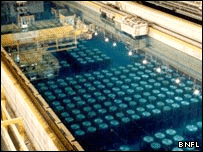 An accident or terrorist attack resulting in a rapid loss of cooling water from a pool could lead to a self-sustaining fire and release of a massive quantity of highly radioactive Cesium-137 into the environment.
NRC Report States That Storing Spent Nuclear Fuel In Wet Pools Is ‘Adequate’ To Protect Public http://www.ucsusa.org/news/media_alerts/nrc-report-adequate-not-enough-0380.html
Transferring It to Dry Casks Would Be Significantly Safer, Science Group Says
WASHINGTON (July 27, 2012) – The Nuclear Regulatory Commission (NRC) today issued a staff paper evaluating recommendations based on lessons learned from the Fukushima nuclear accident in Japan in March 2011.
The paper reiterated the NRC’s position that storing spent nuclear fuel in wet pools at commercial nuclear power plants provides “adequate” protection for public health and safety and the environment. The NRC also stated that it will continue to study spent fuel storage issues for up to five more years.
Below is a statement by Edwin Lyman, senior scientist with UCS’s Global Security Program:
“‘Adequate’ is not good enough, especially when there is a safer alternative.
“Nuclear plant owners are currently storing some 55,000 tons of spent fuel—which remains dangerously radioactive for hundreds of thousands of years—in overcrowded cooling pools that require active safety measures to prevent overheating. These pools contain, on average, much more spent fuel and are more densely packed than the spent fuel pools at the Fukushima reactors. An accident or terrorist attack resulting in a rapid loss of cooling water from a pool could lead to a self-sustaining fire and release of a massive quantity of highly radioactive Cesium-137 into the environment.
“However, 80 percent of that stored spent fuel has been in the pools for more than five years and can be moved to dry casks, which do not require power for cooling and are passively safe. Given the potential consequences from a severe accident or terrorist attack on a spent fuel pool, it makes sense to transfer to casks as soon as it is safe to do so. “While NRC studies find that spent fuel pool storage provides ‘adequate protection,’ the uncertainties in those studies are large enough that it is prudent to move the fuel to dry casks, which are safer. For example, just today the NRC and the Nuclear Energy Institute discussed the need for further work to evaluate the seismic vulnerability of spent fuel pools. While the NRC encourages new reactor designs to have passive safety features, it appears unwilling to take steps to increase passive safety measures, like dry casks, for existing reactors.”
No comments yet.
1 This Month

of the week – Shut Down Drone Warfare!


Tell the Ukrainian Government to Drop Prosecution of Peace Activist Yurii Sheliazhenko

Petition to revoke the licensing of the Near Surface Nuclear Disposal Facility (NSDF) at Chalk River. https://www.ourcommons.ca/petitions/en/Petition/Details?Petition=e-7247
To see nuclear-related stories in greater depth and intensity – go to https://nuclearinformation.wordpress.com
-
Archives
- April 2026 (79)
- March 2026 (251)
- February 2026 (268)
- January 2026 (308)
- December 2025 (358)
- November 2025 (359)
- October 2025 (376)
- September 2025 (257)
- August 2025 (319)
- July 2025 (230)
- June 2025 (348)
- May 2025 (261)
-
Categories
- 1
- 1 NUCLEAR ISSUES
- business and costs
- climate change
- culture and arts
- ENERGY
- environment
- health
- history
- indigenous issues
- Legal
- marketing of nuclear
- media
- opposition to nuclear
- PERSONAL STORIES
- politics
- politics international
- Religion and ethics
- safety
- secrets,lies and civil liberties
- spinbuster
- technology
- Uranium
- wastes
- weapons and war
- Women
- 2 WORLD
- ACTION
- AFRICA
- Atrocities
- AUSTRALIA
- Christina's notes
- Christina's themes
- culture and arts
- Events
- Fuk 2022
- Fuk 2023
- Fukushima 2017
- Fukushima 2018
- fukushima 2019
- Fukushima 2020
- Fukushima 2021
- general
- global warming
- Humour (God we need it)
- Nuclear
- RARE EARTHS
- Reference
- resources – print
- Resources -audiovicual
- Weekly Newsletter
- World
- World Nuclear
- YouTube
-
RSS
Entries RSS
Comments RSS
 nuclear-news
Leave a comment