That magic phrase again – Fukushima – “just a SPEED HUMP”
Report: Fukushima a “Speed Bump” on the Road to Massive Nuclear Power Expansion IEEE Spectrum BY: DAVE LEVITAN, JULY 26, 2012 “….. According to the UN’s Nuclear Energy Agency and the International Atomic Energy Agency nuclear power will expand between 44 and 99 percent by 2035, with a total added capacity between 165 and 371 gigawatts.

To be sure, some countries, notably Germany, which has pledged to shut down all of its 17 reactors by 2022, are headed in the opposite direction. Even if they follow through, however, this might not make a dent in the industry overall growth. The report, known informally as
the Red Book, predicts nuclear will expand between 125 and 185 percent in East Asia, with heavy construction in China, South Korea, India, and Russia. (Notably though, the low end of that prediction does not include the possibility that Japan will fully disavow the use of
nuclear in Fukushima’s wake.)
It seems striking that a disaster that captured the world’s full attention might have so little lingering effect. Gary Dyck, the head of nuclear fuel cycle and materials at IAEA, told Reuters that “we see [Fukushima] as a speed bump. We still expect huge growth in China.” That’s a hell of a speed bump; after Chernobyl in 1986, global nuclear capacity growth did slowfairly dramatically, though this could be attributed to a number of factors.
Mihama reactor 2 turns 40 years; future uncertain, Japan Times, Kyodo TSURUGA, Fukui Pref. 27 July 12 — Reactor 2 at the Mihama nuclear power plant in Fukui Prefecture marked its 40th year in operation Wednesday, while the government weighs allowing the now-idled unit to keep running longer than originally planned.
The Nuclear and Industrial Safety Agency last week approved changes in safety regulations to permit reactors to keep running for more than 40 years.
All but two of Japan’s 50 commercial nuclear reactors are now shut down due to safety concerns in the wake of the meltdowns at the Fukushima No. 1 plant in March 2011. Before they can be restarted, the reactors must pass “stress tests” to check their ability to withstand
earthquakes and tsunami.
The 500,000-kw reactor 2 at the Mihama plant, operated by Kansai Electric Power Co., is the third-oldest commercially run reactor in Japan. The two older are reactor 1 at Japan Atomic Power Co.’s Tsuruga plant, also in Fukui, and reactor 1 at the Mihama plant….. http://www.japantimes.co.jp/text/nn20120726a9.html
Peace event on atom bomb anniversary to reflect on nuclear power ‘From Hiroshima to Fukushima’ The Republic EVANSTON, Ill. — A peace event called “From Hiroshima to Fukushima” will be held in Evanston next month, and will feature two experts on nuclear power.
Norma Field is the Robert S. Ingersoll Distinguished Professor in Japanese Studies, who is retiring from the University of Chicago this year after a career as a scholar, teacher and activist.
Yasuteru Yamada is co-founder of the Skilled Veterans Corps for Fukushima. It’s a group of Japanese retirees who volunteered to do cleanup work after the Fukushima nuclear power plant disaster to spare younger people exposure to radiation.
The conference on nuclear power will take place at the Unitarian Church of Evanston on Aug. 5, the 67th anniversary of the atomic bombing of Hiroshima during World War II.
Online: http://www.chipeaceaction.org http://www.therepublic.com/view/story/c9ffd948cb284c29825a2cc92f0f6d52/IL–Hiroshima-Remembrance
Switzerland to switch from nuclear energy to renewables
 SWITZERLAND LOOKING TO REPLACE NUCLEAR ENERGY WITH SOLAR REVMODO, DAVID QUILTY | 24 JULY, 2012 In 2011, the Swiss parliament decided not to build any more nuclear power plants after the Fukushima disaster in Japan. As nuclear currently supplies some 40 percent of the country’s energy needs, they are in search of ways to replace the energy source with cleaner alternatives. Solar is being debated as the front-runner to use as a replacement and plans are in the works to use the technology to replace at least one half the nuclear power used now. Representatives from the solar and the electricity industries are at odds as to whether it is viable, with solar industry insiders saying they can meet 20 percent of needs by 2025 and electric companies saying gas-fired plants are the way to go. However, the government doesn’t want to go with gas-fired plants as it won’t allow it to meet carbon emission reduction goals.
Also up for debate is whether solar power should be fully subsidized by the government in order to expedite installations or if electricity providers should play a wait and watch game to see if prices of photovoltaics come down anytime soon. Germany is heavily subsidizing renewables and have so far succeeded in setting a world record for solar power production, generating nearly 50 percent of the nation’s midday electricity demand in May. That’s the energy equivalent of 20 nuclear power plants operating at full capacity…… it is some very welcome news that Switzerland wants to replace nuclear energy with clean renewables.
China Leads The World In Renewable Energy Investment Forbes, 27 July
12, According to a recently released United Nations report, global
investment in renewable energy reached a record $257 billion in 2011,
a 17 percent increase from the amount invested in 2010. Globally,
renewable energy covers approximately 16.7 percent of energy
consumption…. China was responsible for almost one-fifth of total
global investment, spending $52 billion on renewable energy last year.
The United States was close behind with investments of $51 billion, as
developers sought to benefit from government incentive programs before
they expired. Germany, Italy and India rounded out the list of the top
five countries.
According to China’s 12th Five-Year Plan for Economic and Social
Development (2011-2015), the country will spend $473.1 billion on
clean energy investments over the next five years. China’s goal is to
have 20 percent of its total energy demand sourced from renewable
energy by 2020.
In 2011, solar led the way as far as global investment in renewable
energy, with investment surging to $147 billion, a year-on-year
increase of 52 percent, due to strong demand for rooftop photovoltaic
installations in Germany, Italy, China and Britain. Large-scale solar
thermal installations in Spain and the United States also contributed
to growth during the year.
Scientists not happy with dangerous pool storage of spent nuclear fuel
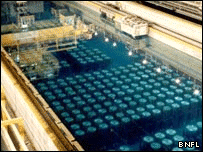 An accident or terrorist attack resulting in a rapid loss of cooling water from a pool could lead to a self-sustaining fire and release of a massive quantity of highly radioactive Cesium-137 into the environment.
NRC Report States That Storing Spent Nuclear Fuel In Wet Pools Is ‘Adequate’ To Protect Public http://www.ucsusa.org/news/media_alerts/nrc-report-adequate-not-enough-0380.html
Transferring It to Dry Casks Would Be Significantly Safer, Science Group Says Continue reading
Cameco uranium company – profit loss with low sales and prices
Cameco profit hit by lower sales, prices Mining Peter Koven Jul 27, 2012 Second quarter profit dropped sharply at Cameco Corp. as the uranium giant’s sales volumes declined and it faced lower realized prices and higher costs.
Adjusted net income came in at $34-million, or 9 cents a share, down from 18 cents a year ago. The numbers fell short of analyst expectations.
Uranium sales volumes in the quarter were 5.3 million pounds, well down from 5.8 million pounds in the second quarter of 2011. Saskatoon-based Cameco’s realized price also dropped 8% year-over-year to US$42.08 a pound because of lower U.S.-dollar prices under
fixed-price contracts. Uranium production dropped 7%….
Corrosion at Hamaoka nuclear power station

 Corrosion confirmed at Japan nuke plant — Seawater flowed into reactor pressure vessel — Years before prospects will be known http://enenews.com/corrosion-confirmed-at-japan-nuke-plant-seawater-flowed-into-reactor-years-before-prospects-for-reactor-will-be-known
July 26th, 2012 By ENENews In a fresh development adding to local worries, Chubu
Electric Power Co. said Wednesday that many parts of reactor 5 at its Hamaoka nuclear power station in Shizuoka Prefecture have been confirmed corroded. Continue reading
NHK: International nuclear experts turning attention to Onagawa nuke plant — Intensity of 3/11 quake exceeded maximum limit (VIDEO) http://enenews.com/nhk-nuclear-experts-turning-attention-to-onagawa-nuclear-plant-intensity-of-311-quake-exceeded-maximum-limit-video July 26th, 2012
By ENENews Title: IAEA to assess quake resistance at Onagawa plant Source: NHK World
Data at some nuclear plants in northern and eastern Japan show that the intensity of the quake exceeded the maximum level assumed by the plants’ designers.
Officials from the IAEA and foreign experts will visit the Onagawa nuclear plant in Miyagi Prefecture on Monday for an on-site assessment.
Japan’s Nuclear and Industrial Safety Agency says the team will enter the plant’s No.1 through No.3 reactors to examine piping and the cooling system. They will also check the condition of the nuclear fuel pools.
But this is the first time since last year’s disaster that it will assess quake resistance at a nuclear plant in Japan.
Bulgarian opposition demands vote on nuclear plans SOFIA, July 27 Jul 27, 2012 (Reuters) – Bulgaria’s opposition Socialists on Friday demanded a referendum to challenge the government’s decision to abandon construction of a nuclear power plant, an increasingly divisive issue in the run up to next year’s parliamentary election.
The Socialists submitted more than 770,000 signatures to parliament
calling for the referendum – well above the half million they need to
force a plebiscite.
But analysts said the government would likely resist efforts to revive
a national debate on the fate of the planned Russian-built 2,000
megawatt Belene plant.
The centre-right cabinet cancelled the project in March saying it was
too costly and had failed to attract serious interest from Western
investors.
But the Socialists have argued the country had already sunk too much
money into the project to abandon it. “We do not want important issues
like this – (whether) to develop nuclear energy in Bulgaria or not –
to be decided behind closed doors,” Socialist Party leader Sergei
Stanishev said after lodging the signatures in the parliament……
http://www.reuters.com/article/2012/07/27/bulgaria-nuclear-idUSL6E8IR9BU20120727
The sorry state of Japanese democracy
AS IF NOTHING HAPPENED, JAPAN GOES NUCLEAR AGAIN LE MONDE 27 JULY 12 Although 80 percent of the population would like to see the end of nuclear power in Japan, electrical companies are gradually reopening their plants. “………The nuclear lobby makes a comeback
According to polls, 80 percent of Japanese people would like a quick closure of all nuclear power plants, a demand that is starting to be made heard by citizens. Regardless of the opposition, the nuclear lobby is currently claiming back the approval of an indecisive and weakened government, and closing in on the conservative opposition following the recent departure of around 50 of its members. This political crisis marks the demise of the first change in government in half a century, when the Democratic Party came to power in 2009, says political scientist Jiro Yamaguchi. Inexperience, clumsiness, procrastination, and a confused and ill-advised management were the causes of the catastrophe on March 11 2011: in three years, the Democratic Party has lost all credit and disappointed many. Continue reading
Learning Fukushima’s lessons http://www.greenpeace.org/international/en/news/Blogs/nuclear-reaction/learning-fukushimas-lessons/blog/41579/ by Justin McKeating – July 27, 2012 A series of startling investigative reports into the Fukushima disaster have made it clear the crisis was both human-made and could have been avoided.
The question is, will the Japanese government and the wider world take heed?
A report released earlier this week from Japan’s Investigation Committee on the Accident at the Fukushima Nuclear Power Stations was especially scathing in its findings. Continue reading
Fukushima casual workers got 4 times as much radiation as employees
Radiation doses 4 times larger for ‘outside workers’ at nuclear plants , Asahi Shimbun, July 26, 2012 By TOSHIHIRO OKUYAMA/ Staff Writer Nuclear plant workers not employed by the operating utilities were exposed to nearly four times the radiation doses received by utility employees, indicating that “outside workers” are often assigned the dangerous tasks, statistics showed....subscription only .
http://ajw.asahi.com/article/0311disaster/fukushima/AJ201207260071
Nuclear Regulatory Commission to refuse licensing for Calvert Cliffs nuclear reactor
Experts: NRC Licensing Board Expected Friday To Strike Down Calvert
Cliffs Nuclear Reactor Project, Market Watch, WASHINGTON, July 26, 2012 — End to Former “Flagships” of Sputtering U.S. “Nuclear Renaissance”: Foreign Ownership Rules to Block Licensing of Calvert Cliffs 3 in MD, Nine Mile Point 3 in NY, and South Texas Project. Continue reading
Japan government names radiation physicist as new atomic regulator head By Tetsushi Kajimoto TOKYO | Thu Jul 26, 2012 (Reuters) – Japan’s government on Thursday nominated Shunichi Tanaka, an expert in radiation physics, to head a new safety regulator,… But it is uncertain whether confidence can be restored with public feeling running high against the “nuclear village” –
– industry officials, politicians and utility operators seen as failing to avert the
disaster…..
The government hopes that the new safety body, to be launched in September, will instill more confidence than two current regulatory bodies, both heavily criticized for their cozy ties with the power industry.
Tanaka, 67, a former deputy head of the Cabinet Office’s Atomic Energy Commission, was nominated for the new safety watchdog along with four other candidates….. Critics see some nominees, including Tanaka, as closely linked to the “nuclear village”. ….
http://in.reuters.com/article/2012/07/26/us-japan-nuclear-watchdog-idINBRE86P0LH20120726
1 This Month



Tell the Ukrainian Government to Drop Prosecution of Peace Activist Yurii Sheliazhenko

Petition to revoke the licensing of the Near Surface Nuclear Disposal Facility (NSDF) at Chalk River. https://www.ourcommons.ca/petitions/en/Petition/Details?Petition=e-7247


of the week – STOP SMALL MODULAR REACTORS IN CANADA
To see nuclear-related stories in greater depth and intensity – go to https://nuclearinformation.wordpress.com
-
Archives
- March 2026 (222)
- February 2026 (268)
- January 2026 (308)
- December 2025 (358)
- November 2025 (359)
- October 2025 (376)
- September 2025 (258)
- August 2025 (319)
- July 2025 (230)
- June 2025 (348)
- May 2025 (261)
- April 2025 (305)
-
Categories
- 1
- 1 NUCLEAR ISSUES
- business and costs
- climate change
- culture and arts
- ENERGY
- environment
- health
- history
- indigenous issues
- Legal
- marketing of nuclear
- media
- opposition to nuclear
- PERSONAL STORIES
- politics
- politics international
- Religion and ethics
- safety
- secrets,lies and civil liberties
- spinbuster
- technology
- Uranium
- wastes
- weapons and war
- Women
- 2 WORLD
- ACTION
- AFRICA
- Atrocities
- AUSTRALIA
- Christina's notes
- Christina's themes
- culture and arts
- Events
- Fuk 2022
- Fuk 2023
- Fukushima 2017
- Fukushima 2018
- fukushima 2019
- Fukushima 2020
- Fukushima 2021
- general
- global warming
- Humour (God we need it)
- Nuclear
- RARE EARTHS
- Reference
- resources – print
- Resources -audiovicual
- Weekly Newsletter
- World
- World Nuclear
- YouTube
-
RSS
Entries RSS
Comments RSS
 nuclear-news