Japanese government out of step with public on nuclear power
“the demonstrations started out with 500, then several thousand and have now even reached 150,000. Each week, they have grown.”
The dissent on the issue of nuclear energy is bringing to the fore tensions between the political establishment and public will.
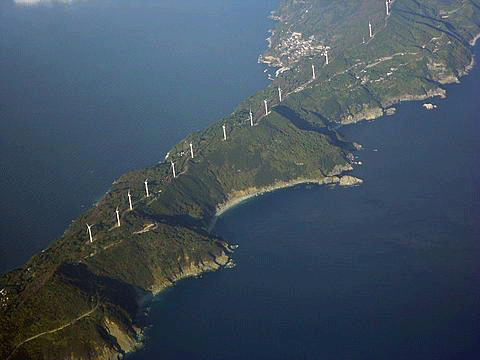
“Japan could easily end its reliance on the nuclear energy. From May 5 to July 5, Japan was nuclear free. No single power plant operated and there were no black outs…Japan is the most ideal country for renewable energy. We have sun. We have wind everywhere. What is missing is the political will.”.
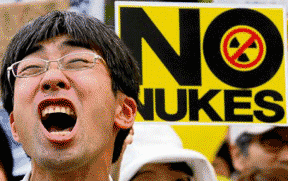 After Fukushima, Nuclear Power on Collision Course With Japanese Public The Indypendent, BY TINA GERHARDTJULY 25, 2012 “….. in May, Japanese Prime Minister Yoshihiko Noda, in the face of overwhelming public opposition, decided to restart Japan’s nuclear power plants. Now, a growing movement is protesting the decision.
Weekly demonstrations, with turnout initially numbering in the hundreds, have been taking place on Friday evenings in front of the Prime Minister’s office. People show up after work and school. And their numbers have been swelling, reaching into the thousands in recent weeks.
Japan is the third-largest consumer of nuclear energy, after the U.S.
and France, and is followed by Russia and Germany. Japan is also the
world’s third largest economy. Nuclear power plants generate about 30%
of Japan’s energy needs. During the shutdown of its nuclear power
plants, utility companies have turned to coal, oil and gas to supply
electricity to industries and households.
Additionally, Japan, already the world’s biggest importer of liquefied
natural gas (LNG) bought record amounts of LNG last year to replace
the nuclear energy…… the public remains staunchly opposed to
nuclear energy in Japan. Since March, weekly demonstrations have taken
place on Fridays at 6pm in front of the Prime Minister’s office.
According to Aileen Mioko Smith of Green Action, a Japan-based
organization working to end nuclear power, “the demonstrations started out with 500, then several thousand and have now even reached 150,000. Each week, they have grown.”
The first reactor at the Oi nuclear power plant was restarted on July
9. Thousands of people across Japan marched against the country’s
nuclear restart.
The second reactor was restarted July 18, and came two days after one
of the largest protests against nuclear power in Japan since the
Fukushima disaster, as tens of thousands protested in Tokyo….
The dissent on the issue of nuclear energy is bringing to the fore tensions between the political establishment and public will. Ex-Prime
Minister Yukio Hatoyama, who preceded Kan, joined the July 20 rally,
saying, “I regret that politics has strayed so far from the people’s
wishes.” Kan resigned last August and was succeeded by Prime Minister
Noda.
The turnover also speaks to a crisis in the government, which has seen
six ministers in five years and has largely lost the voters’
confidence. On the upside, Japan’s Minister of Economy, Trade and
Industry Yukio Edano approved the introduction of feed-in-tariffs on
June 18, 2012. This system has proven very beneficial in Germany,
employing a percentage of energy use fees to subsidize renewable
energy.
Japan hopes to ramp up its renewable energy to the point where it
constitutes 25% to 35% of its energy source by 2030. Kazue Suzuki from
Greenpeace says, “Japan could easily end its reliance on the nuclear
energy. From May 5 to July 5, Japan was nuclear free. No single power
plant operated and there were no black outs…Japan is the most ideal
country for renewable energy. We have sun. We have wind everywhere.
What is missing is the political will.”…. with the government
increasingly in crisis and at odds with the public and with
demonstrations rising, it looks like it will have to be the people’s
voice that forces a shift away from nuclear power.
http://www.indypendent.org/2012/07/25/after-fukushima-nuclear-power-collision-course-japanese-public
No comments yet.
1 This Month

5 March -Online – Reversing nuclearization:
From nuclear weapons in Belarus and NATO host countries to a European-Nuclear-Weapon Free Zone
11am-12:30pm Eastern Time USA / 5pm-6:30pm CET

of the week – Advocating for a
nuclear free beach – https://www.samuellawrencefoundation.org/
The Samuel Lawrence Foundation advocates for a Nuclear Waste Free Beach at San Onofre, join us and take action!

10 March A LIVE WEBINAR THE REAL EFFECTS OF NUCLEAR POWER
What the Industry Isn’t Telling Us
1:00 PM Mountain, 2 pm Central, 3 pm Eastern. Live on the Keepers of the Water Facebook page


18 March Webinar @ 1 PM EST: An Assessment of SMR Projects: The Case of Canada
register for the zoom:
https://us02web.zoom.us/webinar/register/WN_o8BIIOUvQ2ONJR1nta65DQ#/registration

of the week – STOP SMALL MODULAR REACTORS IN CANADA
To see nuclear-related stories in greater depth and intensity – go to https://nuclearinformation.wordpress.com
-
Archives
- March 2026 (38)
- February 2026 (268)
- January 2026 (308)
- December 2025 (358)
- November 2025 (359)
- October 2025 (376)
- September 2025 (258)
- August 2025 (319)
- July 2025 (230)
- June 2025 (348)
- May 2025 (261)
- April 2025 (305)
-
Categories
- 1
- 1 NUCLEAR ISSUES
- business and costs
- climate change
- culture and arts
- ENERGY
- environment
- health
- history
- indigenous issues
- Legal
- marketing of nuclear
- media
- opposition to nuclear
- PERSONAL STORIES
- politics
- politics international
- Religion and ethics
- safety
- secrets,lies and civil liberties
- spinbuster
- technology
- Uranium
- wastes
- weapons and war
- Women
- 2 WORLD
- ACTION
- AFRICA
- Atrocities
- AUSTRALIA
- Christina's notes
- Christina's themes
- culture and arts
- Events
- Fuk 2022
- Fuk 2023
- Fukushima 2017
- Fukushima 2018
- fukushima 2019
- Fukushima 2020
- Fukushima 2021
- general
- global warming
- Humour (God we need it)
- Nuclear
- RARE EARTHS
- Reference
- resources – print
- Resources -audiovicual
- Weekly Newsletter
- World
- World Nuclear
- YouTube
-
RSS
Entries RSS
Comments RSS
 nuclear-news
Leave a comment