Failure of Mixed Oxide Fuel (MOX) reprocessing projects
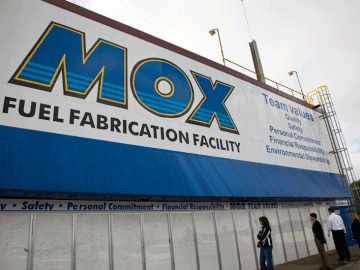 The government would be crazy to consider building another MOX plant. MOX cannot be recycled.”….
The Bomb Plant: A MOX White Elephant?, DC Bureau By Joseph Trento, on October 20th, 2011 The National Nuclear Security Administration may have a $10 billion taxpayer-financed white elephant on its hands based on Britain’s experience with a similar plant that has been shuttered after a decade of failed operations.
NNSA is building a French-designed plant to convert plutonium warheads into mixed oxide (MOX) reactor fuel at the Department of Energy’s Savannah River Site near Aiken, South Carolina. The United States’ MOX Fuel Fabrication Facility is over budget – already double the estimated costs – behind schedule and still has no commercial customers for the fuel. But the DOE is pushing ahead with construction at a time when international nuclear utilities are shuttering their failed MOX programs.
In Britain, the Sellafield MOX plant was a complete fiasco. Opened in 2001, it was vastly bigger than the DOE plant, designed to manufacture 560 tons of MOX fuel over ten years. (DOE’s MOX plant is supposed to process 34 tons in 15 years.) In reality, Sellafield produced 13 tons in eight years at a cost of $2.3 billion.
Just like the SRS MOX construction project, Sellafield was plagued by engineering failures. Britain’s Nuclear Decommissioning Authority (NDA) finally halted the MOX production line at Sellafield in August.
A decade ago, British authorities said that Sellafield would convert most of its 100 tons of plutonium to reactor fuel. That never happened. (The British government refuses to disclose just how much it has invested in the plutonium.)
In 2010, the British press reported that Sellafield had reached an agreement with ten Japanese electrical utilities to buy MOX fuel produced from Japanese plutonium stored at Sellafield. The Japanese utilities agreed to pay for extensive upgrades. Chubu Electric Power in Nagoya was to buy the first consignment of fuel for its Hamaoka power station, and TEPCO, the Tokyo-based utility company that operated the Fukushima Daiichi reactors, was to take half of all the rest.
Then came the March 2011 earthquake, tidal wave and reactor meltdowns that destroyed nuclear power’s credibility in Japan, and Britain’s promises of salvaging Sellafield.
When Reactor Number Three at Fukushima exploded, it spewed plutonium from MOX fuel which had been loaded into the reactor the previous fall. Highly toxic plutonium particles were found as far away as 45 miles from the reactor site.
MOX is made by combining uranium with plutonium extracted from spent reactor fuel or recycled from unused nuclear weapons. The reactor meltdown eliminated customers for the fuel. Japanese plutonium stored at Sellafield appears to have little future as reactor fuel for that country. Prior to Fukushima, MOX was used in about two percent of the fuel burned in reactors…..
Britain finds itself with the largest single stockpile of plutonium in the world after decades of reprocessing.
Once Sellafield is closed, the only MOX plant operating will be the huge French government subsidized AREVA facility at La Hague, which has produced 1,500 tons of MOX fuel since 1995.
If it ever opens, the MOX plant at the Savannah River Site will be the only MOX fuel facility in the world outside France.
Test failures in a Duke Energy nuclear reactor of a weapons grade fuel array that would be like the fuel produced at Savannah River resulted in the company giving up its share in the Savannah River MOX plant. Professor Allison Macfarlane, a member of the Blue Ribbon Commission on America’s Nuclear Future, said last week that MOX fuel rods burn three times hotter than fuel rods currently stored in spent fuel pools at civilian reactors……
Some British scientists have been quoted in the media as saying that over time, plutonium-241 decays to americium-241, which will result in intense gamma radiation that would make storing the plutonium stockpile at Sellafield more complicated.
No comments yet.
1 This Month



Tell the Ukrainian Government to Drop Prosecution of Peace Activist Yurii Sheliazhenko

Petition to revoke the licensing of the Near Surface Nuclear Disposal Facility (NSDF) at Chalk River. https://www.ourcommons.ca/petitions/en/Petition/Details?Petition=e-7247


of the week – STOP SMALL MODULAR REACTORS IN CANADA
To see nuclear-related stories in greater depth and intensity – go to https://nuclearinformation.wordpress.com
-
Archives
- March 2026 (222)
- February 2026 (268)
- January 2026 (308)
- December 2025 (358)
- November 2025 (359)
- October 2025 (376)
- September 2025 (258)
- August 2025 (319)
- July 2025 (230)
- June 2025 (348)
- May 2025 (261)
- April 2025 (305)
-
Categories
- 1
- 1 NUCLEAR ISSUES
- business and costs
- climate change
- culture and arts
- ENERGY
- environment
- health
- history
- indigenous issues
- Legal
- marketing of nuclear
- media
- opposition to nuclear
- PERSONAL STORIES
- politics
- politics international
- Religion and ethics
- safety
- secrets,lies and civil liberties
- spinbuster
- technology
- Uranium
- wastes
- weapons and war
- Women
- 2 WORLD
- ACTION
- AFRICA
- Atrocities
- AUSTRALIA
- Christina's notes
- Christina's themes
- culture and arts
- Events
- Fuk 2022
- Fuk 2023
- Fukushima 2017
- Fukushima 2018
- fukushima 2019
- Fukushima 2020
- Fukushima 2021
- general
- global warming
- Humour (God we need it)
- Nuclear
- RARE EARTHS
- Reference
- resources – print
- Resources -audiovicual
- Weekly Newsletter
- World
- World Nuclear
- YouTube
-
RSS
Entries RSS
Comments RSS
 nuclear-news
Leave a comment