Failure of Mixed Oxide Fuel (MOX) reprocessing projects
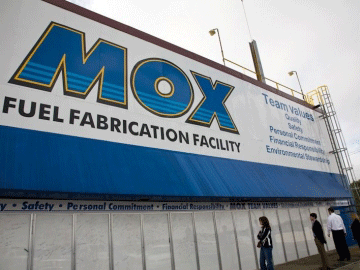 The government would be crazy to consider building another MOX plant. MOX cannot be recycled.”….
The Bomb Plant: A MOX White Elephant?, DC Bureau By Joseph Trento, on October 20th, 2011 The National Nuclear Security Administration may have a $10 billion taxpayer-financed white elephant on its hands based on Britain’s experience with a similar plant that has been shuttered after a decade of failed operations.
NNSA is building a French-designed plant to convert plutonium warheads into mixed oxide (MOX) reactor fuel at the Department of Energy’s Savannah River Site near Aiken, South Carolina. The United States’ MOX Fuel Fabrication Facility is over budget – already double the estimated costs – behind schedule and still has no commercial customers for the fuel. But the DOE is pushing ahead with construction at a time when international nuclear utilities are shuttering their failed MOX programs. Continue reading
Nuclear reprocessing is not the answer to the nuclear waste problem
“No currently available or reasonably foreseeable reactor and fuel cycle technology developments — including advances in reprocess and recycle technologies — have the potential to fundamentally alter the waste management challenge this nation confronts over at least the next several decades, if not longer,’’ the report said…..
A Long, Long Road to Recycling Nuclear Fuel, NYT, By MATTHEW L. WALD, 15 Nov 11, The question of what to do with spent nuclear fuel from civilian power reactors has stirred renewed interest in reprocessing — that is, chopping up the fuel, retrieving materials that can power a reactor and possibly recovering the most troublesome waste products so they can be broken up in the reactor into easier-to-handle elements.
But the Energy Department, which is supposed to is evaluate different ways that the used fuel could be recycled, has a long way to go, according to the Government Accountability Office. In a report released on Wednesday, the auditors noted that the Department of Energy had listed a huge number of potential ways to do the job and classified the methods according to the degree of promise that each held. Still, the department’s evaluation does not indicate the state
of technical progress for the many technologies that would be needed, the report said. Continue reading
Japanese experts say nuclear reprocessing is not viable
Fast-breeder said realistic no more, Japan Times, 25 Feb 12, Kyodo A panel of experts reviewing the nuclear fuel cycle policy in light of the Fukushima crisis has agreed that while a fast-breeder reactor has advantages, from a technology viewpoint it can’t be considered a realistic option for the next 20 to 30 years. The nuclear fuel policy involves reprocessing spent fuel to produce plutonium that can be reused to produce electricity.
The subcommittee of the Japan Atomic Energy Commission said in a draft document summarizing its discussions that two viable options during the next few decades would be to not reprocess spent nuclear fuel, and to recycle plutonium-uranium mixed oxide fuel, or MOX fuel.
The former option is called the “once-through” cycle, in which uranium fuel is used in nuclear reactors just one time and disposed of by burying it in the ground. In the latter option, MOX fuel is manufactured from plutonium recovered from spent nuclear fuel and used in ordinary reactors. Continue reading
Japan’s massive nuclear waste problem, and reprocessing is a failed solution
The amount of spent fuel stored at power stations has continued to surge, standing at around 14,200 tons across 17 facilities as of last September, including the wrecked Fukushima No. 1 nuclear plant.
Japan Nuclear Fuel Ltd.’s storage facilities are already almost full and contained a total of 2,800 tons as of February, while several power stations are expected to reach maximum capacity over the next three years if their currently idled reactors are restarted, industry
sources said.
Policy of recycling all spent nuclear fuel may be axed, Japan Times, 22 June 12, Kyodo, Jiji The Japan Atomic Energy Commission has proposed both reprocessing and directly disposing of spent nuclear fuel if Japan’s atomic energy reliance is cut to 15 percent, a departure from the current policy of total reprocessing…
.. The changed tack comes as massive amounts of spent fuel are accumulating at nuclear plants nationwide and as decades-long efforts to activate reprocessing facilities remain mired in technical difficulties, sources said. Continue reading
After one MOX nuclear reprocessing disaster, is Britain about to start another one?
Pete Wilkinson, an independent environmental consultant, said it “beggared belief” that ministers were going down this path after losing an estimated £600m from operating an original MOX plant.
“It would be interesting to see the commercial arrangements which justify turning Britain into a nuclear waste dump for plutonium that no-one else wants.”
 UK nuclear authority takes ownership of German plutonium UK risks becoming a ‘nuclear laundry’ looking after unwanted waste from other countries, warns industry expert Terry Macalister guardian.co.uk, 13 July 2012 Britain risks being turned into a “nuclear laundry” by taking ownership of German plutonium in return for cash, the government was warned on Friday.
The move came along with confirmation that ministers were moving towards a controversial decision to build a new mixed oxide fuel (MOX) plant despite having just agreed to close an existing one which lost millions of pounds. Continue reading
MOX nuclear reprocessing plant at Savannah River Site
NRC holding public meeting over MOX plant http://www.sacbee.com/2012/07/24/4654152/nrc-holding-public-meeting-over.html The Associated Press, Jul. 24, 2012 COLUMBIA, S.C. — Federal regulators are holding a public meeting to discuss a project to create mixed-oxide fuel at a former nuclear weapons site in South Carolina.
The U.S. Nuclear Regulatory Commission is having the open session on Tuesday at the Savannah River Research Campus in New Ellenton.
Construction on the MOX facility began at the Savannah River Site in 2007. Officials say the plant will be used to convert weapons grade plutonium into fuel that will be sold to run commercial power reactors.
The SRS complex once produced plutonium and tritium for atomic bombs. Officials say the nearly $5 billion MOX facility is on schedule and should be running in 2016.
MOX plutonium nuclear reprocessing plants for Tennessee and Alabama?
TVA considering fuel made from nuclear weapons http://www.kfoxtv.com/news/ap/energy/tva-considering-fuel-made-from-nuclear-weapons/nP3m5/ CHATTANOOGA, Tenn. — The Department of Energy is preparing an environmental impact statement on the use of fuel made from surplus nuclear weapons to power Tennessee Valley Authority nuclear plants. TVA released a set of talking points on Tuesday about the environmental impact statement, which will appear as a draft this week in the Federal Register, TVA spokesman Ray Golden told The Chattanooga Times Free Press (http://bit.ly/MGUFrO ).
The mixed oxide fuel, also called MOX fuel, is a blend of plutonium and uranium, but the variety under consideration is made from retired nuclear weapons, according to the TVA.
The utility has tentatively agreed to consider using the fuel in its Sequoyah and Browns Ferry nuclear plants in Tennessee and Alabama, with a timetable set for 2018. Continue reading
Water continuing to rise in Fukushima Reactor No. 1 basement, after typhoon
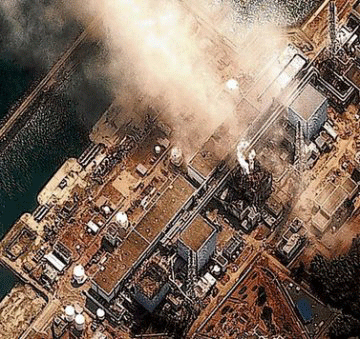 Typhoon increases level of radioactive water in Reactor No. 1 basement by 17 inches in a day — Likely to continue rising http://enenews.com/typhoon-increases-level-of-radioactive-water-in-reactor-no-1-basment-by-almost-two-feet-in-a-day-likely-to-continue-rising July 21st, 2011 By ENENews Heavy rain brought by a tropical storm has increased the
level of radioactive contaminated water at the basements of the crippled Fukushima Daiichi nuclear power plant
Tokyo Electric Power Company or TEPCO, the plant’s operator, says that at 7 AM local time on Thursday, the level of contaminated water pooled at the basement of the building of the No. 1 reactor was 44 centimeters [17.3 inches] up from the previous day.
But it is likely that the level of water will continue to rise for the time being. TEPCO says they are monitoring the situation.
Radioactivity in Fukushima reactor No.2 ten times greater than in No.1
Unit 2 water 10 times more radioactive than Unit 1 — 47,000,000 becquerels per liter in turbine room basement July 25th, 2012 By ENENews Nuclides Analysis Result of the Accumulated Water in the Turbine BuildingBasement at Fukushima Daiichi Nuclear Power Station. Tepco Published July 23, 2012 Sample Taken: July 10, 2012
Cs-137 4,300,000 becquerels per liter (Bq/l) in water inside Unit 1 Turbine Building basement
47,000,000 Bq/l in water inside Unit 2 Turbine Building basement
Cs-134 2,700,000 Bq/l in water inside Unit 1 Turbine Building basement
29,000,000 Bq/l in water inside Unit 2 Turbine Building basement 1 cm³ = 1 milliliter…….
http://enenews.com/unit-2-water-10-times-more-radioactive-than-unit-1-47000000-becquerels-per-liter-in-turbine-room-basement
Pitfalls in building nuclear reactors underground
 Just build them underground! http://daryanenergyblog.wordpress.com/ca/part-10-smallreactors-mass-prod/10-2-2-just-build-them-underground/ There is a common misconception, that we could solve a lot of the problems with reactor construction, both large and small (though in particular the small ones) by building them in subsurface pits. I’m assuming the person who thought up this one has never dug a hole in his back garden! If you have, you’d know that digging a hole is not as easy as it seems. Firstly, the soil type has a big bearing on things. Depending on where you live you could be looking at thick sticky soil that difficult to shift, loose gravely soil that collapses easily or rocky earth, that rapidly turns into bedrock (so after a while you’re not digging any more but blasting!). As we need to put foundations down under out reactor to suit the soil type, and probably piling too (due to its weight), this means we essentially need to design each reactor’s containment vessel individually to suit local soil conditions, which increases costs.
Another problem is water intrusion, as anyone who’s ever dug a pit, then gone in for lunch, come back out and found it full of water will know all about! Our reactor “pit” needs to be designed like the hull of a boat to stop water leaking in and flooding it. Doing that with concrete, particularly thick section of it, is always difficult. The fact that the reactor will be generating heat complicates things as it raises the risk of subsidence or settlement cracking. While this can happen if the reactor is on the surface too, putting it under ground level “complicates things”.
In general with any construction project significant efforts are made to reduce the amount of earth movement required to start construction, not increase it, as lots of earth moving nearly always results in delays, hold-ups and ultimately higher costs (not the least of those being the cost of hiring out of earth moving equipment, those guys charge an arm and a leg!).
Overall, except in a small number of narrow cases building reactors this way will often work out as more expensive and slower than just putting the containment dome above ground.
Building nuclear reactors underground
FirstEnergy looking into building small nuclear reactor By John Funk, The Plain Dealer , July 25, 2012 FirstEnergy said today it had signed an agreement with a subsidiary of Babcock & Wilcox Co. to study the “potential deployment of the B&W mPower small modular reactor in FirstEnergy’s service territory.” The reactor would generate just 180 megawatts and be built in an underground containment structure, …..
Japanese turning to clean energy, and energy efficiency, in a big way

 The World’s Next Hot Solar Power Market May
  Be Japan HUFFINGTON POST: 07/25/2012 With its nuclear power plants virtually shuttered since the Fukushima disaster in March 2011, Japan is starting to turn to clean energy in a big way.
On July 1, one of the world’s most aggressive examples of a feed-in tariff (FIT) — a key government incentive for renewable energy — took effect in Japan. A FIT essentially requires utilities to buy kilowatt-hours of electricity from clean, renewable sources like solar, wind, and geothermal at a rate prescribed by the government. Such policies have been behind the rapid growth of solar energy in countries like Spain, Italy, and Germany. No one thinks of Germany for its sunshine, but it’s actually the largest solar energy market in the world, with 25 gigawatts of solar capacity installed (output comparable to about 20 large nuclear reactors) at the end of 2011…..
Japanese government out of step with public on nuclear power
“the demonstrations started out with 500, then several thousand and have now even reached 150,000. Each week, they have grown.”
The dissent on the issue of nuclear energy is bringing to the fore tensions between the political establishment and public will.
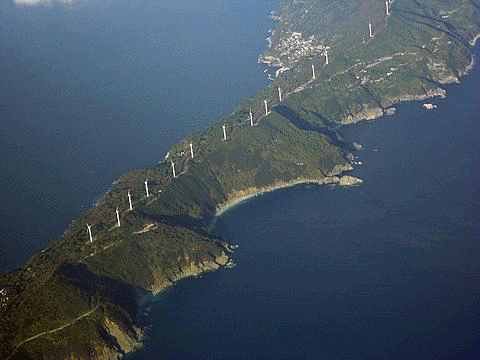
“Japan could easily end its reliance on the nuclear energy. From May 5 to July 5, Japan was nuclear free. No single power plant operated and there were no black outs…Japan is the most ideal country for renewable energy. We have sun. We have wind everywhere. What is missing is the political will.”.
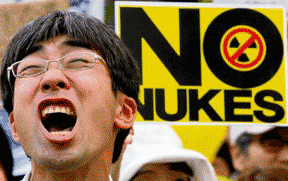 After Fukushima, Nuclear Power on Collision Course With Japanese Public The Indypendent, BY TINA GERHARDTJULY 25, 2012 “….. in May, Japanese Prime Minister Yoshihiko Noda, in the face of overwhelming public opposition, decided to restart Japan’s nuclear power plants. Now, a growing movement is protesting the decision.
Weekly demonstrations, with turnout initially numbering in the hundreds, have been taking place on Friday evenings in front of the Prime Minister’s office. People show up after work and school. And their numbers have been swelling, reaching into the thousands in recent weeks. Continue reading
Obama government’s solar energy project for public lands

 Roadmap for Solar Energy Development on Public Lands Released to Public Loan Safe.org, BY ALEX FERRERAS JULY 25, 2012 As part of President Obama’s all-of-the-above energy strategy, the Department of the Interior, in partnership with the Department of Energy, will publish the Final Programmatic Environmental Impact Statement (PEIS) for solar energy
development in six southwestern states—Arizona, California, Colorado, Nevada, New Mexico, and Utah.
The final Solar PEIS represents a major step forward in the permitting of utility-scale solar energy on public lands throughout the west. Continue reading
Time for USA to lead the retreat from the nuclear arms race
 It is in America’s best interest to further this nuclear downsizing……. We ushered in the nuclear era 67 years ago. Now we must do our part to help the world find a safe exit.
Let’s usher out the nuclear era JTA Globe News Service for the Jewish People, Op-Ed: On Tisha b’Av, By Sandy Pappas · July 25, 2012 MINNEAPOLIS (JTA) — As July ends and we wind down the Three Weeks before Tisha b’Av, we mourn the destruction of both Holy Temples.
Unfortunately, this is not the only destruction that bears remembrance. This August marks the 67th anniversary of the only time that nuclear weapons were ever used in warfare. The United States tested the first nuclear weapon in July 1945 and dropped atomic bombs on Hiroshima and Nagasaki on Aug. 6 and 9 that year.
These events spawned the nuclear race, Continue reading
1 This Month



Tell the Ukrainian Government to Drop Prosecution of Peace Activist Yurii Sheliazhenko

Petition to revoke the licensing of the Near Surface Nuclear Disposal Facility (NSDF) at Chalk River. https://www.ourcommons.ca/petitions/en/Petition/Details?Petition=e-7247


of the week – STOP SMALL MODULAR REACTORS IN CANADA
To see nuclear-related stories in greater depth and intensity – go to https://nuclearinformation.wordpress.com
-
Archives
- March 2026 (222)
- February 2026 (268)
- January 2026 (308)
- December 2025 (358)
- November 2025 (359)
- October 2025 (376)
- September 2025 (258)
- August 2025 (319)
- July 2025 (230)
- June 2025 (348)
- May 2025 (261)
- April 2025 (305)
-
Categories
- 1
- 1 NUCLEAR ISSUES
- business and costs
- climate change
- culture and arts
- ENERGY
- environment
- health
- history
- indigenous issues
- Legal
- marketing of nuclear
- media
- opposition to nuclear
- PERSONAL STORIES
- politics
- politics international
- Religion and ethics
- safety
- secrets,lies and civil liberties
- spinbuster
- technology
- Uranium
- wastes
- weapons and war
- Women
- 2 WORLD
- ACTION
- AFRICA
- Atrocities
- AUSTRALIA
- Christina's notes
- Christina's themes
- culture and arts
- Events
- Fuk 2022
- Fuk 2023
- Fukushima 2017
- Fukushima 2018
- fukushima 2019
- Fukushima 2020
- Fukushima 2021
- general
- global warming
- Humour (God we need it)
- Nuclear
- RARE EARTHS
- Reference
- resources – print
- Resources -audiovicual
- Weekly Newsletter
- World
- World Nuclear
- YouTube
-
RSS
Entries RSS
Comments RSS
 nuclear-news