Fukushima’s children: more than a third at risk of developing cancer
doctors are outraged that the results are not being sufficiently publicized.
The World Health Organization warns that young people are particularly prone to radiation poisoning in the thyroid gland. Infants face the direst consequences, as their cells divide at a higher rate.
Children who were under 18 when the nuclear disaster struck last year will be subject to continuous thyroid examinations every two years until they reach 20 years of age, and after that, every five years for the rest of their lives.
 Over a third of Fukushima children at risk of developing cancer http://www.rt.com/news/fukushima-children-radiation-exposure-abnormalities-632/ 20 July, 2012,Over a third of children in Japan’s Fukushima region could be prone to cancer if medics don’t apply more effort in treating their unusually overgrown thyroid glands and commit to international health aid and consultations, according to a new report.
The shocking new report shows that nearly 36 per cent of children in the nuclear disaster-affected Fukushima Prefecture have abnormal thyroid growths. This is an extremely large number of abnormalities – some of which, experts say, pose a risk of becoming cancerous.
After examining more than 38,000 children from the area, medics found that more than 13,000 have cysts or nodules as large as 5 millimeters on their thyroids, the Sixth Report of Fukushima Prefecture Health Management Survey states.
In comparison, a 2001 analysis by the Japan Thyroid Association found that fully zero per cent of children in the city of Nagasaki, which suffered a nuclear attack in August of 1945, had nodules, and only 0.8 per cent had cysts on their thyroids, reports the Telegraph.
Radiation enters the body and is distributed through soft tissue, especially in muscle, and then accumulates in the thyroid. It is this accumulation that can potentially lead to cancer. Continue reading
Japan’s ruling party ‘fracturing’ over nuclear power
Newspapers reported on Friday that the government had picked Shunichi Tanaka, 67, an expert in radiation physics and a former deputy head of the Cabinet Office’s Atomic Energy Commission, to head the new safety regulator.
some saying he represented Japan’s “nuclear village” — a nexus of politicians, utilities and regulators that experts say was a major factor in the failure to avert the Fukushima disaster. …..

 Ex-Japan PM joins anti-nuclear demo outside PM’s office
* Ex-PM Hatoyama at anti-nuclear rally bad news for PM Noda
* Efforts to pick new atomic safety commission members snags after media leak
* Nuclear energy becoming bigger part of political debate (Recasts with ex-PM Hatoyama joining anti-nuclear demo near)
By Mari Saito and Tetsushi Kajimoto TOKYO, July 20 (Reuters) – In a rare move by a former Japanese prime minister, Yukio Hatoyama joined a boisterous anti-nuclear demonstration outside his old office on Friday, a fresh sign that the ruling party he once led is fracturing over energy and other policies. Continue reading
Radioactive danger of Chernobyl forest fires
Chernobyl’s radioactive trees and the forest fire risk BBC News 7 July. (this article also describes the heroism of Ukraine’s firefighters.) By Patrick Evans Chernobyl, Ukraine Much of the 30km exclusion zone around the Chernobyl nuclear plant is pine forest, and some of it so badly contaminated that a forest fire could create a devastating radioactive smoke cloud.
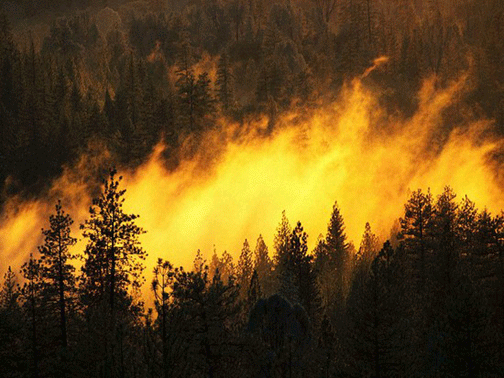
Heading north from Kiev in Ukraine, Continue reading
Nuclear and fossil fuel lobbies have conned Australia about wind energy
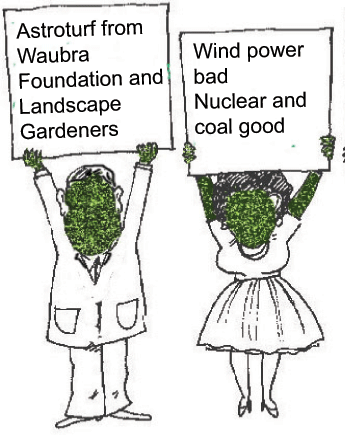 There are two main anti-wind farm groups in Australia busily fomenting anxiety and opposition. One is the Waubra Foundation, a group of mainly wealthy individuals, none of whom live in or near the town of Waubra, near Ballarat. Several of them, NIMBY style, have opposed turbines near their own properties elsewhere. They are led by an unregistered doctor, Sarah Laurie, and a wealthy mining investor, Peter Mitchell who also has connections to the Landscape Guardians. Despite their name, the Guardians have never attempted to guard our landscape from over-zealous residential developers, open cut coal or coal seam gas mining. They only target wind farm developments. All three – Waubra, the Guardians and Mitchell’s mining investment company share a South Melbourne post office box.
Wind turbine syndrome: a classic ‘communicated’ disease https://theconversation.edu.au/wind-turbine-syndrome-a-classic-communicated-disease-8318?utm_medium=email&utm_campaign=Latest+from+The+Conversation+for+20+July+2012&utm_content=Latest+from+The+Conversation+for+20+July+2012+CID_be7f8aff1000afd17cabaf558b629431&utm_source=campaign_monitor&utm_term=Simon+Chapman+investigates At the beginning of this year I started collecting examples of health problems some people were attributing to wind turbine exposure. I had noticed a growing number of such claims on the internet and was curious about how many I could find. Within an hour or two I had found nearly 50 and today the number has grown to an astonishing 155. Continue reading
20,000 cleanup workers not counted, in estimating Fukushima cancer risks

 Thousands More Radiation-Related Deaths Expected From Fukushima, Asian Scientist, Study By Rebecca Lim July 20, 2012 Thousands of deaths could still be expected from the Fukushima nuclear fallout in the years to come, according to the first estimate of the disaster’s worldwide impact AsianScientist (Jul. 20, 2012) –
The research, published in the latest edition of the journal Energy & Environmental Science, found that inhalation exposure, external exposure, and ingestion exposure of the public to radioactivity may result in up to 1,300 cancer mortalities and up to 2,500 cancer morbidities worldwide, mostly in Japan.
Stanford University researchers John Ten Hoeve and Mark Jacobson feel that the risk of a meltdown is not small, given that “modest to major radionuclide releases (occurred) in almost 1.5 percent of all reactors ever built.”….
Estimates in the paper do not account for the increased radiation risk to the roughly 20,000 workers at the plant in the months following the accident.
Psychological effects such as depression, anxiety, fear, and unexplained physical symptoms which were seen post-Chernobyl, are likely to be repeated in evacuees after Fukushima, they say….
Nuclear Disasters and Lessons Learned… A Mother’s Response
 Silence Deafening http://www.silencedeafening.com/index.html Fukushima Fallout … Nuclear Disasters and Lessons Learned… A Mother’s Response Facts are facts. There have been at least three major nuclear power disasters to date: Three Mile Island in 1979, Chernobyl in 1986, and now Fukushima Daiichi in 2011… and there are many more smaller nuclear accidents and near misses every year. Do we wait for another catastrophic event, or do we act now?
Nuclear fallout is a harmful and mysterious tragedy that we can’t see, taste, hear, smell or feel. Rather than recoil in fear from Fukushima Daiichi, it really only serves to empower us into further action. This book is a mother’s account of dealing with radioactive fallout from the Fukushima Daiichi disaster, the worst in world history. This book speaks to the urgent need for food monitoring, conservation and renewable energy, as radiation from nuclear power is now migrating into our homes and kitchens.
India’s farmers opposing nuclear power, and politicians taking up their fight
Nuclear power or not? Leaders fight it out (Haryana Newsletter) India Daily News, Chandigarh, July 20 — Leaders of all political hues in Haryana are fighting a nuclear war these days. The leaders have gone ballistic with their positioning over the issue of setting up a nuclear power plant in southwest Haryana. Continue reading
Australia’s anti uranium protestors were no bludgers, as BHP would call them
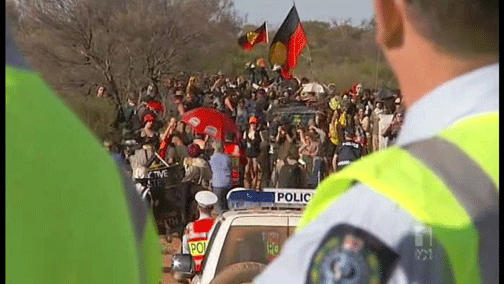 many of the group.. had taken leave without pay to travel to Roxby Downs to spread their message.
“There are other alternatives (to uranium for power) and I think an event like this can bring that more into discussion.”
We’re no bludgers, say mine protesters, Ben Hyde, The Advertiser July 20, 2012 THEY came from interstate and even overseas to protest against uranium mining, and some could be camped on the doorstep of BHP Billiton’s Olympic Dam mine for another two weeks. The group of Lizard’s Revenge protesters, which peaked at about 400 activists last weekend, were an eclectic bunch, united in their anti-nuclear stance. Continue reading
Majority of Americans want renewable energy: petition launched
Today, EcoWatch.org is launching a petition that outlines a renewable energy policy that we believe everyone in the grassroots movement and fellow Americans can support. We are asking you to sign the petition directed to the U.S. Senate Committee on Energy & Natural Resources andHouse Energy & Commerce Committee. This petition can help serve as a basis for bipartisan legislation that members of Congress can introduce in their committees and ultimately on the House and Senate floor.
Congress: Expedite Renewable Energy HUFFINGTON POST, Stefanie Penn Spear, : 07/19/2012 In 2009 it seemed as though Congress was finally going to pass legislation that would transition our country to a renewable energy future. The American Clean Energy and Security Act of 2009, also known as the Waxman-Markey Bill, would have created a cap and trade system on greenhouse gases, required electric utilities through a renewable electricity standard (RES) to meet 20 percent of their electricity demand through renewable energy sources and energy efficiency by 2020, subsidized renewable energy and energy efficiency technologies, and financed modernization of the electrical grid, among many other provisions.
The bill was approved by the House of Representatives on June 26, 2009, by a vote of 219-212, but died in the Senate. Continue reading
Radioactive risks of ‘rust belt’ nuclear reactors
Resisting “Rust Belt” reactors’ radioactive risks! Beyond Nuclear 19 julyThe Great Lakes, which “host” 33 atomic reactors along its shores in the U.S. and Canada, is the drinking water supply for 40 million North AmericansAs if the closing steel mills and automobile manufacturing plants weren’t bad enough, some of the oldest, most risky atomic reactors in the U.S. are located in the Midwest. Worse still, they are on the shores of the Great Lakes, putting at risk the drinking water supply for 40 million people downstream in the U.S., Canada, and a large number of Native American First Nations. Altogether, 33 atomic reactors are located on the shorelines of the Great Lakes.
Two of the most infamous of these radiologically risky “Rust Belt reactors” are Entergy Nuclear’s Palisades in southwest Michigan, and FirstEnergy’s Davis-Besse in northwest Ohio….. http://www.beyondnuclear.org/nuclear-power/2012/7/19/resisting-rust-belt-reactors-radioactive-risks.html
Stolen vehicle contained radioactive material
Nuclear material on stolen ute TVNZ July 21, 2012 Police fear radioactive material could be released from a nuclear density metre on a utility stolen in Christchurch. Continue reading
1 This Month


Tell the Ukrainian Government to Drop Prosecution of Peace Activist Yurii Sheliazhenko

Petition to revoke the licensing of the Near Surface Nuclear Disposal Facility (NSDF) at Chalk River. https://www.ourcommons.ca/petitions/en/Petition/Details?Petition=e-7247


of the week – STOP SMALL MODULAR REACTORS IN CANADA
To see nuclear-related stories in greater depth and intensity – go to https://nuclearinformation.wordpress.com
-
Archives
- March 2026 (212)
- February 2026 (268)
- January 2026 (308)
- December 2025 (358)
- November 2025 (359)
- October 2025 (376)
- September 2025 (258)
- August 2025 (319)
- July 2025 (230)
- June 2025 (348)
- May 2025 (261)
- April 2025 (305)
-
Categories
- 1
- 1 NUCLEAR ISSUES
- business and costs
- climate change
- culture and arts
- ENERGY
- environment
- health
- history
- indigenous issues
- Legal
- marketing of nuclear
- media
- opposition to nuclear
- PERSONAL STORIES
- politics
- politics international
- Religion and ethics
- safety
- secrets,lies and civil liberties
- spinbuster
- technology
- Uranium
- wastes
- weapons and war
- Women
- 2 WORLD
- ACTION
- AFRICA
- Atrocities
- AUSTRALIA
- Christina's notes
- Christina's themes
- culture and arts
- Events
- Fuk 2022
- Fuk 2023
- Fukushima 2017
- Fukushima 2018
- fukushima 2019
- Fukushima 2020
- Fukushima 2021
- general
- global warming
- Humour (God we need it)
- Nuclear
- RARE EARTHS
- Reference
- resources – print
- Resources -audiovicual
- Weekly Newsletter
- World
- World Nuclear
- YouTube
-
RSS
Entries RSS
Comments RSS
 nuclear-news