USA sparking ‘missile envy’ with expanding missile defence system
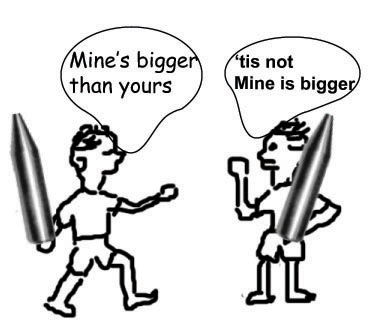 The United States is spending about $10 billion a year to develop, test and deploy missile defences, which would include a European shield as part of a layered system. The defences would also include ship-based interceptors that could be deployed in the Middle East and
Asia-Pacific – for instance as a hedge against North Korea – plus ground-based missile interceptors in silos in Alaska and California.
Missile defences, however benign they appear to the side building them, always force others nations to improve and increase their offensive weapons,”
Missile shield may spark China nuclear upgrade-officer http://in.reuters.com/article/2012/07/18/china-usa-nuclear-idINDEE86H0EY20120718 By Fredrik Dahl VIENNA Jul 19, 2012 (Reuters) – China may need to modernise its nuclear arsenal to respond to the destabilising effect of a planned U.S.-backed missile defence system, a senior Chinese military officer said on Wednesday.
“It undermines the strategic stability,” said Major General Zhu Chenghu of China’s National Defence University about the U.S.-led development of a missile shield, which has also alarmed Russia.
“We have to maintain the credibility of deterrence,” he told Reuters
on the sidelines of a panel discussion on nuclear disarmament,
referring to the military doctrine that an enemy will be deterred from
using atomic arms as long as he can be destroyed as a consequence.
The United States is spending about $10 billion a year to develop, test and deploy missile defences, which would include a European shield as part of a layered system. The defences would also include ship-based interceptors that could be deployed in the Middle East and
Asia-Pacific – for instance as a hedge against North Korea – plus ground-based missile interceptors in silos in Alaska and California.
he United States says the system in Europe – which is to be deployed
in four phases by about 2020 – is intended to counter a potential
threat from Iran and poses no risk to Russia.
But Moscow says the interceptors that the United States and NATO are
deploying will be able to destroy its own warheads in flight by about
2018, upsetting the post-Cold War balance of power.
The comments by Zhu – who stirred controversy in 2005 by suggesting
China could use nuclear weapons if the United States intervened
militarily in a conflict over Taiwan – indicated this is an argument
that also resonates in China.
FIRST STRIKE
China “will have to modernise its nuclear arsenal” because the
deployment of a missile defence system “may reduce the credibility of
its nuclear deterrence,” Zhu told the seminar.
“Therefore Beijing will have to improve its capabilities of survival,
penetration … otherwise it is very difficult for us to maintain the
credibility of nuclear deterrence.”
Joseph Cirincione, president of the Ploughshares Fund, a global
security foundation, said any American military planner in Zhu’s
position would say the same.
Planned anti-missile systems and other advanced weapons in the future
could “make it theoretically possible for the U.S. to launch a first
strike on China, knock out most of its 40 or so long-range missiles,
and intercept any left that were launched in response,” he said.
Missile defences, however benign they appear to the side building them, always force others nations to improve and increase their offensive weapons,” Cirincione, who also took part in Wednesday’s discussion in Vienna, said in an e-mail.
The European system is to include interceptor missile installations in
Poland and Romania and a radar in Turkey as well as interceptors and
radars on ships based in the Mediterranean Sea.
The United States and Russia hold the vast majority of the world’s
nuclear weapons. China, France and Britain are the three other
officially recognised nuclear-armed countries, but their arsenals are
much smaller.
China closely guards information about its nuclear weapons. However,
the U.S. Department of Defense has said that China has about 130-195
deployed nuclear-capable ballistic missiles.
(Additional reporting by Jim Wolf in Washington; Chris Buckley and Ben
Blanchard in Beijing; Editing by Andrew Heavens)
No comments yet.
1 This Month


Tell the Ukrainian Government to Drop Prosecution of Peace Activist Yurii Sheliazhenko

Petition to revoke the licensing of the Near Surface Nuclear Disposal Facility (NSDF) at Chalk River. https://www.ourcommons.ca/petitions/en/Petition/Details?Petition=e-7247


of the week – STOP SMALL MODULAR REACTORS IN CANADA
To see nuclear-related stories in greater depth and intensity – go to https://nuclearinformation.wordpress.com
-
Archives
- March 2026 (212)
- February 2026 (268)
- January 2026 (308)
- December 2025 (358)
- November 2025 (359)
- October 2025 (376)
- September 2025 (258)
- August 2025 (319)
- July 2025 (230)
- June 2025 (348)
- May 2025 (261)
- April 2025 (305)
-
Categories
- 1
- 1 NUCLEAR ISSUES
- business and costs
- climate change
- culture and arts
- ENERGY
- environment
- health
- history
- indigenous issues
- Legal
- marketing of nuclear
- media
- opposition to nuclear
- PERSONAL STORIES
- politics
- politics international
- Religion and ethics
- safety
- secrets,lies and civil liberties
- spinbuster
- technology
- Uranium
- wastes
- weapons and war
- Women
- 2 WORLD
- ACTION
- AFRICA
- Atrocities
- AUSTRALIA
- Christina's notes
- Christina's themes
- culture and arts
- Events
- Fuk 2022
- Fuk 2023
- Fukushima 2017
- Fukushima 2018
- fukushima 2019
- Fukushima 2020
- Fukushima 2021
- general
- global warming
- Humour (God we need it)
- Nuclear
- RARE EARTHS
- Reference
- resources – print
- Resources -audiovicual
- Weekly Newsletter
- World
- World Nuclear
- YouTube
-
RSS
Entries RSS
Comments RSS
 nuclear-news
Leave a comment