It’s already happening – solar hot water, and solar energy cooling systems
According to the International Energy Agency, solar heating and cooling (SHC) could make a dramatic impact on the world’s electricity grids, providing 17 per cent of all energy required for heating in buildings, industrial processes, swimming pools, and 17 per cent of cooling needs.
 Solar cooling technologies are relatively new, and not widely deployed – only 711 systems were deployed in the world in 2011, according to the IEA …..The IEA suggests that solar cooling particularly useful in handling electricity peaks, because it produces at the time of highest demand. It says the technology is already competitive in tropical regions with high electricity costs, including a 1.47MW capacity installation installed at a college in Singapore, was reportedly fully cost competitive without subsidies.
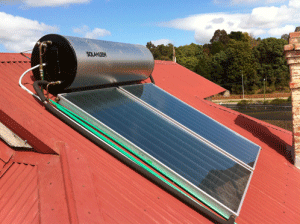 Solar Insights: Is solar hot water (and cooling) the next big thing? REneweconomy, By Giles Parkinson 19 July 2012 Amid the dramatic cost reductions and soaring demand for solar PV (photovoltaic) technologies in Australia and across the world, the long established idea of using the sun to heat water has taken a back seat. In Australia, where SHW once dominated the local rooftop industry, installations were outpointed by rooftop PV by a factor of 5 in the last year.
But now SHW it is tipped to make a return to centre stage, along with relatively new solar thermal technologies that use the sun to provide heating and cooling for office and building spaces, district heating and under-floor heating in cooler climates, as well as for industrial processes and in hybrid systems with solar PV (known at PV-T). At a larger scale, it could one day be used for water treatment and desalination.
According to the International Energy Agency, solar heating and cooling (SHC) could make a dramatic impact on the world’s electricity grids, providing 17 per cent of all energy required for heating in buildings, industrial processes, swimming pools, and 17 per cent of cooling needs. This amounts to 3,500GW of capacity for heating, 1,000GW of capacity for cooling, and a further 200GW of capacity for swimming pools (up from 20GW now).
The advantages are obvious. It reduces the need for new generation and cuts the burden on grids, particularly in peak demand. And it is cost effective. Solar hot water is already one quarter of the price of gas and electricity equivalents. The IEA estimates that on a global average, SHW installations cost around $US27/year over the life of the equipment, compared to around $US87 for gas-fired heaters and $US95 for electricity.
These technologies are being ramped up to district-scale installations. A recent boom in solar-challenged Denmark as brought the costs of large scale solar heating down to around $35-$40/MWh, vastly cheaper than sourcing electricity from the grid to do the job.
Solar cooling technologies are relatively new, and not widely deployed – only 711 systems were deployed in the world in 2011, according to the IEA (although Australia’s CSIRO and the Australian Solar Institute are two of many organizations leading research in the area and developing demonstration systems). The IEA suggests that solar cooling particularly useful in handling electricity peaks, because it produces at the time of highest demand. It says the technology is already competitive in tropical regions with high electricity costs, including a 1.47MW capacity installation installed at a college in Singapore, was reportedly fully cost competitive without subsidies.
China is by far the biggest user of solar hot water systems in the world (its line is actually cut because it doesn’t fit). It has installed SHW on more than 100 million homes, amounting to 117.6 GWth in 2010 (the equivalent of two Australian grids). It accounts for 60 per cent of the global capacity. The Chinese government’s latest five year plan requires this number to grow to 280GWth by 2015 and to double again to 560GWth by 2020.
China is also likely the biggest market for industrial scale solar heating – because many of its industries require low heat up to around 120C – as opposed to cement, aluminium and other industries which require much more heat). The IEA estimates that China could account for one third of all solar heating production by 2050…..http://reneweconomy.com.au/2012/solar-insights-is-solar-hot-water-and-cooling-the-next-big-thing-23890
No comments yet.
1 This Month



Tell the Ukrainian Government to Drop Prosecution of Peace Activist Yurii Sheliazhenko

Petition to revoke the licensing of the Near Surface Nuclear Disposal Facility (NSDF) at Chalk River. https://www.ourcommons.ca/petitions/en/Petition/Details?Petition=e-7247


of the week – STOP SMALL MODULAR REACTORS IN CANADA
To see nuclear-related stories in greater depth and intensity – go to https://nuclearinformation.wordpress.com
-
Archives
- March 2026 (212)
- February 2026 (268)
- January 2026 (308)
- December 2025 (358)
- November 2025 (359)
- October 2025 (376)
- September 2025 (258)
- August 2025 (319)
- July 2025 (230)
- June 2025 (348)
- May 2025 (261)
- April 2025 (305)
-
Categories
- 1
- 1 NUCLEAR ISSUES
- business and costs
- climate change
- culture and arts
- ENERGY
- environment
- health
- history
- indigenous issues
- Legal
- marketing of nuclear
- media
- opposition to nuclear
- PERSONAL STORIES
- politics
- politics international
- Religion and ethics
- safety
- secrets,lies and civil liberties
- spinbuster
- technology
- Uranium
- wastes
- weapons and war
- Women
- 2 WORLD
- ACTION
- AFRICA
- Atrocities
- AUSTRALIA
- Christina's notes
- Christina's themes
- culture and arts
- Events
- Fuk 2022
- Fuk 2023
- Fukushima 2017
- Fukushima 2018
- fukushima 2019
- Fukushima 2020
- Fukushima 2021
- general
- global warming
- Humour (God we need it)
- Nuclear
- RARE EARTHS
- Reference
- resources – print
- Resources -audiovicual
- Weekly Newsletter
- World
- World Nuclear
- YouTube
-
RSS
Entries RSS
Comments RSS
 nuclear-news
Leave a comment