Nuclear power not the fix for global warming: it’s the other way around!
Nationally, thousands of daily high temperature records and warm overnight low temperature records have been set this summer.
With global warming already increasing the odds of extreme heat events, the challenges faced at Braidwood and Browns Ferry are likely to become more common in the coming years. It’s an open question as to whether the nuclear industry is prepared for this. As the Union of Concerned Scientists‘ David Lochbaum told the Times, “Nuclear plants like Goldilocks weather — not too hot, not too cold, but just right.”
Such weather is getting harder and harder to come by.
 Heat and Drought Pose Risks for Nuclear Power Plants, Climate
  Central July 18th, 2012, By Andrew Freedman ”…….. it seems that climate change is increasingly causing problems for operators of nuclear plants. Like coal-fired power plants, nuclear facilities use large amounts of water for cooling purposes. After water has cycled through the plant, it is discharged back into a nearby waterway, usually a lake or a river, at a higher temperature. State regulations prohibit nuclear plants from operating once water temperatures go above a certain threshold, in part because it could compromise the safe operation of the facility, and also because discharging very warm water can kill fish and other marine life. Continue reading
Japan’s government on shaky ground as it promotes nuclear power
In another development that could fan public concerns about nuclear safety, Trade and industry minister Yukio Edano said the government would review seismological data for nuclear plants to assess whether any are built on active fault lines.
He was responding to media reports that a review by the nuclear watchdog indicated Hokuriku Electric Power Co’s Shika station northwest of Tokyo sits atop a faultline……
Nuclear issue puts increasing pressure on Japan government By Linda Sieg, additional reporting by Osamu Tsukimori and Risa Maeda TOKYO Jul 18, 2012 (Reuters) – Japan’s government came under fire on Tuesday over its handling of public hearings on nuclear energy policy, threatening to dent already sagging support for the 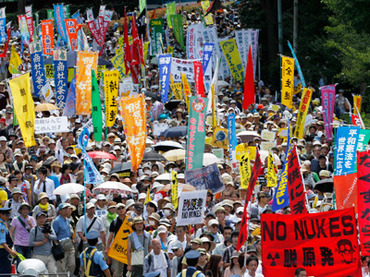 ruling party ahead of an election many expect to be this year.
The latest furor follows Monday’s massive rally in Tokyo against nuclear power in the wake of the Fukushima disaster, an issue now so contentious that lawmakers and analysts say it could trump taxes as the focus of lower house elections, which must be held by September 2013 but could come sooner.

“This gives the impression that they haven’t learned anything,” Continue reading
Youth climate movement for a carbon free, nuclear free world
 Working Together for a Nuclear Free, Carbon Free Energy Future Clean Energy Footprints July 18th, 2012 › Jacquie Ayala. At the end of June, in the blistering heat of Chattanooga, Tennessee, over 120 activists converged at the kNOw Nukes Y’all Summit to learn, strategize and build relationships across the South around nuclear issues. The summit was intergenerational – young people as well as activists who have been bravely fighting nuclear power since the first wave of the environmental movement in the 1960s, had a chance to meet, build relationships, and learn together. ….. Here’s some of what I learned: …….
Here’s what I think: as the youth climate movement, we have not addressed the nuclear issue directly. In our eagerness to stop Big Coal, we are letting the nuclear industry sneak its way back to the forefront. If we don’t engage our communities and our campuses for a carbon-free AND nuclear-free future NOW, I fear that we will be fighting the same fight again, just shifting from Big Coal over to Big Nuclear, and never getting anywhere with the renewables and energy efficiency advancements that we know can really create the clean energy economy we so desperately need.
I know we are smart enough and savvy enough to stop the nuclear industry from putting our communities at risk. We just have to work together. At the summit, conversations like this have already started. I was lucky enough to get the chance to participate in a movement-building breakout with about 15 other incredible activists – young and old alike. In the breakout, we discussed how we could work to build the nuclear movement by raising up communities at risk, and building momentum against new nuclear with abig push against Vogtle in Georgia, and coordinated actions across the country around other proposed plants. In Florida, for example, we’ll join in on a coordinated effort to take action against the four new proposed reactors in that state.
So, join the movement today to make our future a carbon-free, nuclear-free one. http://blog.cleanenergy.org/2012/07/18/working-for-a-nuclear-free-carbon-free-future/
“Waste Confidence Rule” allows nuclear waste keep growing, with no solution!
the NRC also stated that it ‘retains confidence that spent fuel can be safely stored with no significant environmental impact until a repository can reasonably be expected to be available and that the Commission has a target date for the availability of the repository in that circumstance’”
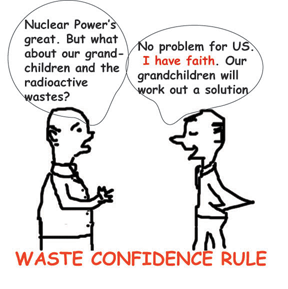
As a result of its confidence in the safety of spent fuel storage, NRC rules note that “no discussion of any environmental impact of spent fuel storage in reactor facility storage pools or independent spent fuel storage installations for the period following the term of the reactor operating license . . . is required in any environmental report, environmental impact statement, environmental assessment or other analysis prepared in connection with the issuance or amendment of an operating license for a nuclear reactor,”
 Group seeks to have spent fuel a factor in re-licensing Limerick plant The Mercury By Evan Brandt 07/17/12 LIMERICK “…….Spent fuel rods are what remains after the uranium pellets inside the fuel rods in a reactor no longer generate enough heat to create the steam that turns the turbines and generates electricity at a nuclear power plant.
Although cooler, this spent fuel remains radioactive to some extent for hundreds of years. For years, spent fuel was kept in concrete “spent fuel pools” located inside a nuclear plant and filled with water to keep it from overheating.
According to the NRDC filing, in 2008 NRC proposed “‘remov(ing) its expectation that a repository (for spent fuel) will be available by 2025’ and acknowledged that its previous finding that sufficient disposal capacity would be available within 30 years after any
reactor’s licensed life ‘is not supportable.’” Continue reading
“Uprating” – a cheap way to increase power from nuclear reactors, but is it safe?
nuclear watchdogs have warned that these bigger uprates also carry bigger risks.
“This trend is, in principle, detrimental to the stability characteristics of the reactor, inasmuch as it increases the probability of instability events and increases the severity of such events, if they were to occur,” the Advisory Committee on Reactor Safeguards, which is mandated by Congress to advise the NRC, has warned
 How to expand nuclear power without attracting (too much) attention
Washington Times, by Brad Plumer July 18, 2012 Since the 1970s, construction on new nuclear reactors in the United States has largely ground to a halt, thanks to public protests, regulatory obstacles and tight financing. Yet over that same period, U.S. utilities have managed to increase the amount of electricity they get from nuclear power. By quite a lot, in fact.
How is that possible? Through a process known as “uprating.” According to a new analysis by the U.S. Energy Information Administration, the operators of 98 of the country’s 104 commercial nuclear reactors have asked regulators for permission to boost capacity from their existing plants. All in all, the Nuclear Regulatory Commission has approved more than 6,500 megawatts worth of uprates since 1977. That’s the equivalent of building six entirely new nuclear reactors—and during a period when fresh plants were impossible to build.
Under the public radar, nuclear power is “uprated”, bringing safety concerns
nuclear watchdogs and the U.S. Nuclear Regulatory Commission’s own safety advisory panel have expressed concern over larger boosts — some by up to 20% — that the NRC began approving in 1998. Twenty of the nation’s 104 reactors have undergone these “extended power uprates.”
U.S. is increasing nuclear power through uprating Turning up the power is a little-publicized way of getting more electricity from existing nuclear plants. But scrutiny is likely to increase in the wake of Japan’s nuclear crisis. LA Times, April 17, 2011|By Alan Zarembo and Ben Welsh, Los Angeles Times
The U.S. nuclear industry is turning up the power on old reactors, spurring quiet debate over the safety of pushing aging equipment beyond its original specifications.
The little-publicized practice, known as uprating, has expanded the country’s nuclear capacity without the financial risks, public anxiety and political obstacles that have halted the construction of new plants for the last 15 years.
The power boosts come from more potent fuel rods in the reactor core and, sometimes, more highly enriched uranium. As a result, the nuclear reactions generate more heat, which boils more water into steam to drive the turbines that make electricity. Continue reading
It’s already happening – solar hot water, and solar energy cooling systems
According to the International Energy Agency, solar heating and cooling (SHC) could make a dramatic impact on the world’s electricity grids, providing 17 per cent of all energy required for heating in buildings, industrial processes, swimming pools, and 17 per cent of cooling needs.
Solar cooling technologies are relatively new, and not widely deployed – only 711 systems were deployed in the world in 2011, according to the IEA …..The IEA suggests that solar cooling particularly useful in handling electricity peaks, because it produces at the time of highest demand. It says the technology is already competitive in tropical regions with high electricity costs, including a 1.47MW capacity installation installed at a college in Singapore, was reportedly fully cost competitive without subsidies.
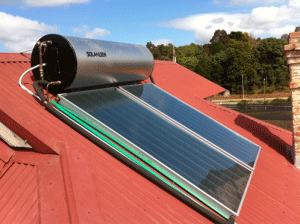 Solar Insights: Is solar hot water (and cooling) the next big thing? REneweconomy, By Giles Parkinson 19 July 2012 Amid the dramatic cost reductions and soaring demand for solar PV (photovoltaic) technologies in Australia and across the world, the long established idea of using the sun to heat water has taken a back seat. In Australia, where SHW once dominated the local rooftop industry, installations were outpointed by rooftop PV by a factor of 5 in the last year.
But now SHW it is tipped to make a return to centre stage, along with relatively new solar thermal technologies that use the sun to provide heating and cooling for office and building spaces, district heating and under-floor heating in cooler climates, as well as for industrial processes and in hybrid systems with solar PV (known at PV-T). At a larger scale, it could one day be used for water treatment and desalination. Continue reading
New Zealand art show a reminder of that country’s proud anti nuclear history
Her first-hand experiences and those of her fellow protesters feature in an anti-nuclear exhibition called Blast! Pat Hanly – The Painter and His Protests, on now at the Voyager New Zealand Maritime Museum….. Blast! is a travelling exhibition featuring the paintings
of anti-nuclear artist Pat Hanly and his wife Gil Hanly’s photographs.
 Memories of anti-nuclear era Western Leader, Auckland NZ NICOLA MURPHY 19 July 12, PEACE PROTESTER: Jody Lusk doesn’t regret participating in New Zealand’s anti-nuclear protests, despite getting injured after attacks by French police. Continue reading
Russia ahead in the race to sell off nuclear technology to South Africa
Russian nuclear group opens office in South Africa Engineering News, By: Keith Campbell 18th July 2012 South Africa has become only the third country to host a marketing office of Russia’s State-owned nuclear energy group Rosatom. The registration of the office was announced by the group on Wednesday….. Rusatom (spelt with a u) Overseas is a subsidiary of Rosatom (spelt with an o).

Another Rosatom subsidiary, Tenex, already supplies enriched uranium products for the production of nuclear fuel for South Africa. The country currently has one two-reactor NPP, at Koeberg near Cape Town, which has a capacity of 1 800 MWe. This started operation in 1984… http://www.engineeringnews.co.za/article/russian-nuclear-group-opens-office-in-south-africa-2012-07-18
No sign of restart to Fort Calhoun nuclear power plant, shut since April 2011
Nebraska nuclear plant not restarting soon Bloomberg, By Josh Funk July 18, 2012 OMAHA, Neb. (AP) — Utility workers continue inspecting the Fort Calhoun nuclear power plant, but it’s not clear whether the plant will be ready to restart in September as Omaha Public Power District officials hoped.
The nuclear plant about 20 miles north of Omaha is being scrutinized closely by regulators because it has been offline since April 2011 and several safety violations have been found…..
http://www.businessweek.com/ap/2012-07-18/nebraska-nuclear-plant-not-restarting-soon
Amid USA heatwave, loss of power to cooling equipment brings shutdown to Pennsylvania nuclear reactor
Exelon shuts Pa. Limerick 1 nuclear power reactor, Reuters Jul 19, 2012 By Scott DiSavino July 18 – Exelon Corp shut down the 1,130-megawatt (MW) Unit 1 at the Limerick nuclear power plant in Pennsylvania early Wednesday following an electrical disturbance on the non-nuclear side of the plant, the company said in a release.
The outage came at a bad time for the power grid: Homes and businesses in the U.S. Mid-Atlantic are cranking up their air conditioners amid a brutal heat wave blanketing the region.
The electrical disturbance caused a loss of power to generator cooling equipment, the company said. The unit will remain offline until repairs, inspections and testing are
completed, it said…. http://in.reuters.com/article/2012/07/18/utilities-operations-exelon-limerick-idINL2E8II8A620120718
USA’s heatwave contributes to nuclear power plant shutdowns
Limerick among four nuclear power reactors shut down Wednesday Leigh Valley Morning Call, 18 July Several nuclear plants on the U.S. East Coast, including Exelon’s Limerick nuclear plant, were shut down early Wednesday and New York’s Consolidated Edison power company reduced the voltage in parts of Manhattan as the obsessive heat wave stressed the region’s power system…..
Temperatures in New York City — the biggest metropolitan region in the United States — hit 91 degrees Fahrenheit (33 Celsius) on Monday, 96 F on Tuesday, and were expected to reach 96 F again on Wednesday before thunderstorms Wednesday night were likely to drive temperatures back to near-normal levels in the 80s F on Thursday, according to AccuWeather.com. Continue reading
For relicensing nuclear plants, Nuclear Regulatory Commission does not consider costs of spent fuel disposal
Paradoxically, while the NRC allows potential earnings from a re-licensed plant to be considered as a way to cover the costs of plant shut-down, it does not consider the potential for those added years of operation to generate additional spent fuel when calculating the cost of shutting the plant down.
Group seeks to have spent fuel a factor in re-licensing Limerick plant The Mercury By Evan Brandt 07/17/12 LIMERICK — Despite a recent federal court ruling invalidating a rule that would allow storage of radioactive spent nuclear fuel rods at nuclear power plants for 60 years after they’ve closed, the Nuclear Regulatory Commission has no plans to consider the issue when deciding on whether to re-license Exelon Nuclear’s Limerick Generating Station for an additional 20 years.
The National Resources Defense Council disagrees with that position and filed papers July 9 seeking to amend its challenge to Exelon’s re-licensing application Continue reading
1 This Month



Tell the Ukrainian Government to Drop Prosecution of Peace Activist Yurii Sheliazhenko

Petition to revoke the licensing of the Near Surface Nuclear Disposal Facility (NSDF) at Chalk River. https://www.ourcommons.ca/petitions/en/Petition/Details?Petition=e-7247


of the week – STOP SMALL MODULAR REACTORS IN CANADA
To see nuclear-related stories in greater depth and intensity – go to https://nuclearinformation.wordpress.com
-
Archives
- March 2026 (212)
- February 2026 (268)
- January 2026 (308)
- December 2025 (358)
- November 2025 (359)
- October 2025 (376)
- September 2025 (258)
- August 2025 (319)
- July 2025 (230)
- June 2025 (348)
- May 2025 (261)
- April 2025 (305)
-
Categories
- 1
- 1 NUCLEAR ISSUES
- business and costs
- climate change
- culture and arts
- ENERGY
- environment
- health
- history
- indigenous issues
- Legal
- marketing of nuclear
- media
- opposition to nuclear
- PERSONAL STORIES
- politics
- politics international
- Religion and ethics
- safety
- secrets,lies and civil liberties
- spinbuster
- technology
- Uranium
- wastes
- weapons and war
- Women
- 2 WORLD
- ACTION
- AFRICA
- Atrocities
- AUSTRALIA
- Christina's notes
- Christina's themes
- culture and arts
- Events
- Fuk 2022
- Fuk 2023
- Fukushima 2017
- Fukushima 2018
- fukushima 2019
- Fukushima 2020
- Fukushima 2021
- general
- global warming
- Humour (God we need it)
- Nuclear
- RARE EARTHS
- Reference
- resources – print
- Resources -audiovicual
- Weekly Newsletter
- World
- World Nuclear
- YouTube
-
RSS
Entries RSS
Comments RSS
 nuclear-news