Rundown on world’s nuclear energy situation, and I do mean DOWN
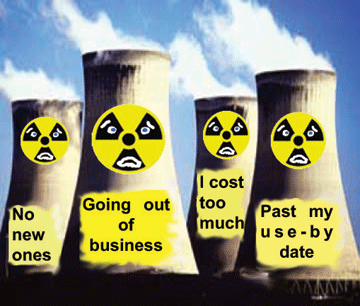 India’s nuclear march of folly http://wrd.mydigitalfc.com/op-ed/india%E2%80%99s-nuclear-march-folly-012 By Praful Bidwai, Jul 11 2012 HOLLOWMEN: Blind to the perils of nuclear reactors, India continues its ‘March of Folly’, even as it seeks untested reactors, with potentially dangerous consequences, such as the disaster in Fukushima.
All those, including Indian policymakers, who nurture the illusion that nuclear power is the energy source of the future and will flourish despite the Fukushima disaster, increasingly adverse atomic economics, and widespread social and political opposition, would do
well to read the just-released World Nuclear Industry Status Report (WNISR) 2012 (http://www.worldnuclearreport.org).
This annual
publication, with independent energy consultant Mycle Schneider as its
lead author, has over 20 years evolved into the most reliable,
strikingly original, comprehensive and penetrating assessment of the
global nuclear industry.
What WNISR depicts is an industry that has repeatedly failed to
deliver on its always-hyperbolic promises, and which is in deep crisis
thanks to the Great Recession, the triple meltdown at Fukushima,
formidable and growing competition (especially from renewable energy
sources), and “its own planning and management difficulties”. The
crisis could well become terminal in the industrialised countries,
nuclear power’s heartland. The OECD countries account for 70 per cent
of the world’s 429 reactors. The total rises to 80 per cent if Russia
and Ukraine are added.
Contrary to the illusion of a “nuclear renaissance”, the number of
operating reactors worldwide peaked 10 years ago at 444, and installed
capacity peaked in 2010 at 375 gw (or 1,000 megawatts). It’s now down
to 364 gw. Nuclear power’s share of global electricity generation has
declined relentlessly, from the peak of 17 per cent (1993) to about 11
per cent. In the past 18 months, only nine reactors started up, while
21 were shut down. Right now, only one of Japan’s 44 reactors is
operating despite unusually strong public protests. Ten reactors have
been definitively taken off the grid, and the fate of the others
remains uncertain.
Four countries have announced time-bound nuclear power phaseouts:
Germany, Belgium, Taiwan and Switzerland. At least five countries
(Egypt, Italy, Jordan, Kuwait and Thailand) have abandoned their
nuclear plans. Not one of the other countries in the “potential
newcomers” list (Bangladesh, Belarus, Indonesia, Poland, Saudi Arabia,
Turkey, the UAE and Vietnam) has put financing arrangements in place
for building reactors. Iran alone newly started commercial nuclear
generation — for the first time since Romania, in 1996. France, the
world’s most nuclear power-dependent country, is reeling under excess
capacity, and has only one reactor (a European pressurised reactor —
EPR) under construction, and that too plagued by numerous problems.
The average age of the world’s nuclear reactors is 27 years. Assuming
a 40-year lifespan, an additional 67 reactors, with a capacity of 35
gw, would have to be ordered, built and commissioned by 2020 just to
maintain the status quo. This is highly unlikely given that worldwide,
it took an average of 9.5 years to build the five reactors that began
operating in 2010. Construction time got lengthened to 13.8 years for
the seven units commissioned in 2011.
Only 13 countries are building nuclear plants, compared with 15 a year
ago. At least 18 of the world’s 59 reactors described as being “under
construction” have witnessed multi-year construction delays. The
situation of the remaining 41 projects is indeterminate. Nine of them
have been listed as “under construction” for 20 years, and another
four for 10 years or longer
Only China, Russia and India plan to expand nuclear power generation
significantly. They together have 43 of the world’s 59 reactors
described as “under construction”. But China is going slow on nuclear
expansion and lowering targets. It didn’t start any new construction
in 2011. Russia completed only three projects in the past 10 years,
with construction periods ranging from 20 to 27 years. Indian leaders
alone stand out for their zeal — or their ‘Nuclear March of Folly’.
Three other major trends have become apparent. First, reactor
construction costs are going through the roof, having globally risen
threefold or more over a decade. In the case of the now-notorious EPR,
designed by the French company Areva, estimated costs (adjusted for
inflation) have risen fourfold over 10 years. This is perhaps the most
troubled nuclear reactor design in the world, with serious problems
with its instrumentation and control systems. The world’s first EPR,
in Finland, is five years behind schedule and 100-120 per cent over
budget. Delays and cost overruns at France’s own EPR are increasing
even faster than in Finland. Yet India wants to import six EPRs.
Second, rating agencies consider nuclear power highly risky: A nuclear
project is liable to push a utility “over the edge”. Standard and
Poor’s has downgraded two-thirds of assessed nuclear companies and
utilities. All but one of a dozen nuclear companies assessed has
performed worse than the FTSE-100 index. Since 2007, Areva’s share
value has fallen by 88 per cent, EDF’s by 82 per cent, and Fukushima
operator Tepco’s by 96 per cent. The writing on the wall couldn’t be
clearer.
Third, global investment in renewable energy totalled $260 billion
last year, up fourfold since 2004. Cumulative investment in renewables
since then grossed $1 trillion, eight times higher than in nuclear
power. Renewable costs are falling dramatically — by one-half for
solar-photovoltaics over just one year. Last year, wind turbines alone
produced four times more electricity compared with nuclear reactors
worldwide. Renewables is where the future lies. But blind to it, India
continues its ‘March of Folly’, even as it seeks untested reactors,
with potentially dangerous consequences.
No comments yet.
1 This Month

of the week – Shut Down Drone Warfare!


Tell the Ukrainian Government to Drop Prosecution of Peace Activist Yurii Sheliazhenko

Petition to revoke the licensing of the Near Surface Nuclear Disposal Facility (NSDF) at Chalk River. https://www.ourcommons.ca/petitions/en/Petition/Details?Petition=e-7247
To see nuclear-related stories in greater depth and intensity – go to https://nuclearinformation.wordpress.com
-
Archives
- April 2026 (114)
- March 2026 (251)
- February 2026 (268)
- January 2026 (308)
- December 2025 (358)
- November 2025 (359)
- October 2025 (376)
- September 2025 (257)
- August 2025 (319)
- July 2025 (230)
- June 2025 (348)
- May 2025 (261)
-
Categories
- 1
- 1 NUCLEAR ISSUES
- business and costs
- climate change
- culture and arts
- ENERGY
- environment
- health
- history
- indigenous issues
- Legal
- marketing of nuclear
- media
- opposition to nuclear
- PERSONAL STORIES
- politics
- politics international
- Religion and ethics
- safety
- secrets,lies and civil liberties
- spinbuster
- technology
- Uranium
- wastes
- weapons and war
- Women
- 2 WORLD
- ACTION
- AFRICA
- Atrocities
- AUSTRALIA
- Christina's notes
- Christina's themes
- culture and arts
- Events
- Fuk 2022
- Fuk 2023
- Fukushima 2017
- Fukushima 2018
- fukushima 2019
- Fukushima 2020
- Fukushima 2021
- general
- global warming
- Humour (God we need it)
- Nuclear
- RARE EARTHS
- Reference
- resources – print
- Resources -audiovicual
- Weekly Newsletter
- World
- World Nuclear
- YouTube
-
RSS
Entries RSS
Comments RSS
 nuclear-news
Leave a comment