Recycling electronic wastes is the way of the future
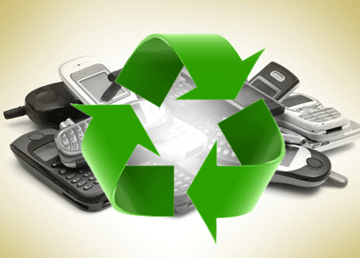 “We need to recover rare elements to continue manufacturing IT products, batteries for electric cars, solar panels, flat-screen televisions and other increasingly popular products,”
E-Waste: Annual Gold, Silver ‘Deposits’ in New High-Tech Goods Worth $21B; Less Than 15% Recovered Science Daily (July 6, 2012) — Urban mining’ deposits are 40 to 50 times richer than mined ore, experts tell 1st GeSI and StEP e-Waste Academy in Africa; New PCs, cell phones, tablets, other e-products now use 320 tons of gold, 7,500 tons of silver per year, and rising. A staggering 320 tons of gold and more than 7,500 tons of silver are now used annually to make PCs, cell phones, tablet computers and other new electronic and electrical products worldwide, adding more than $21 billion in value each year to the rich fortunes in metals eventually available through “urban mining” of e-waste, experts say.
Manufacturing these high-tech products requires more than $16 billion in gold and $5 billion in silver: a total of $21 billion — equal to the GDP of El Salvador — locked away annually in e-products. Most of those valuable metals will be squandered, however; just 15% or less is
recovered from e-waste today in developed and developing countries alike.
Electronic waste now contains precious metal “deposits” 40 to 50 times richer than ores mined from the ground, experts told participants from 12 countries at last week’s first-ever GeSI and StEP e-Waste Academy for policymakers and small businesses, co-organized in Accra, Ghana by the United Nations University and the Global e-Sustainability Initiative (GeSI)…….
“Efforts such as the GeSI and StEP e-Waste Academy help create
networks among policy-makers and other relevant stakeholders for
sharing information, ideas and best practices to foster real e-waste
solutions and enable the transition to a closed loop and green
economy,” said Luis Neves, Chairman of GeSI.
“More sustainable consumption patterns and material recycling are
essential if consumers continue to enjoy high-tech devices that
support everything from modern communications to smart transport,
intelligent buildings and more.”
“Rather than looking at e-waste as a burden, we need to see it as an
opportunity,” Alexis Vandendaelen of Belgium-based Umicore Precious
Metals Refining told the participants.
He recommended replacing notions of “waste management” with “resource
management,” to enlarge a focus on the mass and volume of used
materials to include the quality of certain waste fractions, and to
use solutions appropriate to local circumstances combined with
internationally available strengths to pursue efficient,
environmentally-sound recycling.
A “best of two worlds” approach is needed for domestically-generated
e-waste in developing countries: efficient local pre-processing
followed by maximum recovery of materials and proper treatment of
residual waste in countries with the best technologies for the job,
with proceeds shared fairly and equitably.
Chris Slijkhuis of MBA Polymers, a global firm specialised in
recycling plastics, noted that a ton of plastic created through
recycling requires one tenth as much water and energy as new plastic,
and produces one to three fewer tons of carbon dioxide (CO2), the
greenhouse gas largely blamed for climate change.
Recycling just half the plastics in e-waste from the European Union
alone would save 5 million kilowatt hours of energy, over 3 million
barrels of oil in feedstock and nearly 2 million tons of CO2
emissions.
“One day — likely sooner than later — people will look back on such
costly inefficiencies and wonder how we could be so short sighted and
wasteful of natural resources,” said Ruediger Kuehr, Executive
Secretary of the Solving the E-Waste Problem (StEP) Initiative.
“We need to recover rare elements to continue manufacturing IT products, batteries for electric cars, solar panels, flat-screen televisions and other increasingly popular products,” said Dr. Kuehr who is also head of the responsible Operating Unit of United Nations
University, based in Bonn, Germany.
Beyond the lost opportunity to recover valuable resources — which
also include copper, tin, cobalt, and palladium — discarded consumer
electronics that end up in landfills or are exported to developing
countries create potential health and environmental hazards, he added.
Said André Habets, head of research and development at the NVMP
Association in the Netherlands, a sponsor of the academy: “We commit a
lot of effort to trying to ensure that the e-waste generated in our
country remains here and is recycled here, and we advocate tough
measures against the illegal export of e-waste. Each of the parties
involved needs to take its responsibility to solve the e-waste
problem. If an actor doesn’t do this voluntarily, the relevant
responsibility needs to be established by law.”
http://www.sciencedaily.com/releases/2012/07/120706164159.htm
No comments yet.
1 This Month

of the week – Shut Down Drone Warfare!


Tell the Ukrainian Government to Drop Prosecution of Peace Activist Yurii Sheliazhenko

Petition to revoke the licensing of the Near Surface Nuclear Disposal Facility (NSDF) at Chalk River. https://www.ourcommons.ca/petitions/en/Petition/Details?Petition=e-7247
To see nuclear-related stories in greater depth and intensity – go to https://nuclearinformation.wordpress.com
-
Archives
- April 2026 (114)
- March 2026 (251)
- February 2026 (268)
- January 2026 (308)
- December 2025 (358)
- November 2025 (359)
- October 2025 (376)
- September 2025 (257)
- August 2025 (319)
- July 2025 (230)
- June 2025 (348)
- May 2025 (261)
-
Categories
- 1
- 1 NUCLEAR ISSUES
- business and costs
- climate change
- culture and arts
- ENERGY
- environment
- health
- history
- indigenous issues
- Legal
- marketing of nuclear
- media
- opposition to nuclear
- PERSONAL STORIES
- politics
- politics international
- Religion and ethics
- safety
- secrets,lies and civil liberties
- spinbuster
- technology
- Uranium
- wastes
- weapons and war
- Women
- 2 WORLD
- ACTION
- AFRICA
- Atrocities
- AUSTRALIA
- Christina's notes
- Christina's themes
- culture and arts
- Events
- Fuk 2022
- Fuk 2023
- Fukushima 2017
- Fukushima 2018
- fukushima 2019
- Fukushima 2020
- Fukushima 2021
- general
- global warming
- Humour (God we need it)
- Nuclear
- RARE EARTHS
- Reference
- resources – print
- Resources -audiovicual
- Weekly Newsletter
- World
- World Nuclear
- YouTube
-
RSS
Entries RSS
Comments RSS
 nuclear-news
Leave a comment