The past week in nuclear news

Christina Macpherson’s websites & blogs
USA. Nuclear Regulatory Commission “streamlines” nuclear licensing procedures, eliminating public participation. Safety conscious Gregory Jaczko cleared of any wrongdoing, (but he had been forced to resign from Nuclear Regulatory Commission). Southern California might go permanently nuclear free, as future of closed San Onofre nuclear plant in doubt.
France. Nuclear reactors ordered to present safety plans by June 30. Serious safety problems found in 8 French nuclear reactors. EDF must spend $10 billion on safety measures. French company GDF Suez moves out of nuclear technology export industry.
Japan: Fukushima nuclear plant directors and auditors move to lucrative jobs elsewhere. Japan’s seafood products banned in South Korea, due to radiation. Japan’s govt trying to save TEPCO from bankruptcy by a big restart of the nuclear industry. TEPCO now nationalised, plans to restart another nuclear plant. Japan’s utilities shareholders’ meetings demand an end to nuclear power. Group for Zero Nuclear Power is a new force in Japan’s Parliament.
New nuclear reactors. Integral Fast Reactors (IFRs) – expensive and dangerous. Thorium reactors not possible for decades to come. Fast nuclear reactors not succeeding either financially, nor as a solution to plutonium wastes. Anxiety oover Small Modular Reactors (SMRs) planned for South Carolina.
Rare earths. Lynas Corporation might have to send its radioactive wastes back from Malaysia to Australia
Renewable energy. Solar energy getting a big boost from USA govt. Scotland’s success. Huge solar centre opens in Japan.
Radioactive murder? Was Yassa Arafat, like Litvinenko, poisoned by radioactive polonium?
Integral Fast Reactors – let the public beware of these!
 In dispraise of Integral Fast Nuclear Reactors Independent Australia, 5 July 12, Can only nuclear technocrats discuss nuclear issues — leaving the great unwashed out of the debate? Noel Wauchope considers the latest – but not necessarily the greatest – nuclear gizmo — Integral Fast Reactors. “….. It must be reassuring to the nuclear lobby to know that the great unwashed, the hoi polloi, the peasantry, have no idea about the differences between the various types of nuclear reactors now in operation — the Generation 2 and Generation 3 reactors. Let alone the new developing blueprints of Generation IV: Integral Fast Reactors, Lead Cooled Fast Reactors, Molten Salt Reactors, Sodium Cooled Fast reactors, Thorium Liquid Fuel reactors; the peasant mind boggles! And wait, like those old TV commercials – there’s more! – Generation V is now in the minds and on some bits of paper of the nuclear boffins.
Well, the nuclear priesthood is pretty safe in all this. They keep the argument narrowly technical, with pages and pages on the various technicalities of cooling systems, reprocessing of fuel systems, passive safety systems and so on; in other words, they induce in the public a kind of mindless torpor as they dazzle us with science.
At the same time, the nuclear priesthood, like some gifted but autistic child with specialist knowledge in just one area, seems to have little grasp of other issues concerning nuclear power — blinkered as they are in their apparent view that the technicalities are the whole story. This is the case with their latest propaganda for the ‘Integral Fast Reactor’ or IFR.
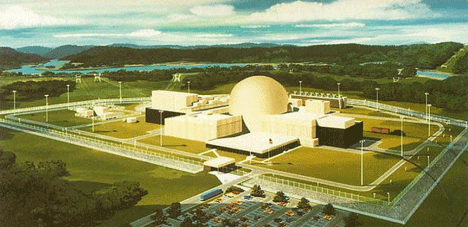
For instance, they ignore the fact that IFRs needs plutonium or enriched uranium as fuel. So, to have fast reactors, Australia would need to import these, or set up nuclear reprocessing or uranium enrichment here. This would also involve issues such as cost, politics, public opinion, issues concerning our growing renewable energy systems, radioactive waste storage — just to mention some of the more obvious of the considerable obstacles to Australia ever getting fast reactors. Nuclear lobbyists seem naively oblivious to the importance of these factors in the minds of the general public……
The Integral Fast Reactor is, after all, just another type of nuclear reactor — it runs on radioactive fuel, provides heat to make electricity and produces radioactive waste. It also uses reprocessed nuclear wastes for its fuel, therefore nuclear reprocessing plants would be needed. So far, all existing nuclear reprocessing has proved to be an expensive failure. For instance, the USA’s MOX reprocessing fuel plant is still under construction — it has cost billions of dollars, is over budget and also behind schedule. In Japan, the super expensive Monju prototype fast breeder reactor is costing 1,000 times more than conventional reactors to run………
As these fast reactors need to get the weapons grade plutonium and/or enriched uranium, these materials have to be procured from somewhere. The nuclear lobby portrays this as a benefit to the world, by using up the existing plutonium and so on. Now, I don’t know whether they say this out of naiveté or hypocrisy, but the obvious reality is that the old-fashioned Generation 3 and 4 reactors will have to be kept going – or uranium enrichment and reprocessing will have to keep going – to turn out more plutonium, which must then travel to the new IFRs. Of course, all this flies in the face of President Obama’s move to limit nuclear weapons proliferation, the New START treaty with Russia, which depends on confining the spread of uranium enrichment and weapons grade plutonium…….
there’s that final problem of the wastes.
David Biello from the Scientific American comments:
‘Ultimately, however, the core problem may be that such new reactors don’t eliminate the nuclear waste that has piled up, so much as transmute it. Even with a fleet of such fast reactors, nations would nonetheless require an ultimate home for radioactive waste, one reason that a 2010 M.I.T. report on spent nuclear fuel dismissed such fast reactors.’…..
http://www.independentaustralia.net/2012/environment/in-dispraise-of-integral-fast-nuclear-reactors/
Japanese govt caving in to “nuclear village”, but nuclear future uncertain
Many experts, though, say the nuclear interests are unlikely to win the longer-term battle given the hidden costs of atomic power exposed by Fukushima and a new set of forces pushing for a bigger role for renewable sources of energy such as solar power.
“They (the nuclear interests) are fighting with their backs to the wall”
Reactor restarts, but Japan’s energy policy in flux The Asahi Shimbun, July 04, 2012 Buffeted by industry worries about high electricity costs on one side and public safety fears about nuclear power on the other, Japan’s leaders are still struggling to craft a coherent energy policy more than a year after the Fukushima disaster.

Critics say Prime Minister Yoshihiko Noda, whose top priority is raising the sales tax to curb bulging public debt, is caving in to Japan’s “nuclear village” — a powerful nexus of utilities,
bureaucrats and businesses — by restarting the first of Japan’s 50 reactors to come back on line since the crisis. Continue reading
How nuclear radioactivity has killed Japan’s surfing industry
 AUDIO Japan’s surfers lament radioactive coast, Radio Australia 2 July 2012, Japan overnight restarted a nuclear reactor – the first time it’s done so since the Fukushima disaster. The move has polarised the country, with many fearing the reactor on the country’s west coast is just as vulnerable to earthquakes and tsunamis as the Fukushima plant.
And some of those fighting hardest against the restart of more nuclear
plants are Japan’s professional surfers, who say Fukushima’s coastline
was once regarded as one of the best surfing spots in the country. Continue reading
San Onofre nuclear plant: uneconomic, and a political burden?
Could the looming costs become so large that they would make operation of San Onofre financially unworkable?
“The decision for closing a nuclear plant is much above and beyond economics,” “Closing (San Onofre) really has a very heavy political burden.”
 San Onofre Costs: Could Economics Doom The Ailing California Nuclear Plant? HUFFINGTON POST, By MICHAEL R. BLOOD 07/04/12 LOS ANGELES — The
future of the troubled San Onofre nuclear power plant could balance on an inescapable question: Is it worth the money to fix it?
Engineers face a daunting task finding a solution for problems that knocked the seaside plant offline last winter. And even if they come up with a plan that fully addresses safety and operational issues, will it all make sense on a balance sheet?..
… Two decades ago, San Onofre’s Unit 1 reactor was shut down and then dismantled when owners faced the prospect of swallowing a $125 million bill for upgrades and repairs. Oregon’s Trojan nuclear plant closed its doors in 1993, rather than replace steam generators that had leaky tubes. Continue reading
Japan’s Fukushima Daini nuclear plant might never restart
 Doubts linger over Japan’s nuclear future, FT.com, By Mure Dickie, Tokyo, 4 July 12, When the world’s appalled gaze turned to Japan’s tsunami-crippled Fukushima Daiichi nuclear power station in March last year, few paid much attention to its sister atomic plant, , Fukushima Daini, , just 10 km south……
for all the seeming normality of the scene, Daini’s future is shrouded in doubt.
Work to fully restore safety systems damaged by the tsunami is expected to be completed by March. But even the new bosses of operator Tokyo Electric Power shy away from the question of whether Daini’s reactors will ever be turned back on. Continue reading
Solar energy a boon for Americans that rises above party politics
Politicians on both sides of the aisle should open their eyes to the fastest growing energy source in America, surging ahead against hard economic times. They should understand that solar affords Americans – at homes, workplaces and businesses – the ability to generate heat and power cleanly, safely and affordably. As they ready for debates and town hall meetings, they surely should know that solar now employs 100,000 Americans at more than 5,600 companies – the vast majority of them small businesses – across all 50 states.
 Solar: Life, Liberty And The Pursuit of Energy Independence, Forbes, 4 July 12, By General Wesley Clark (ret.) and Rhone Resch No energy source is more American than solar. Technologies to convert sunshine to electricity were pioneered in the U.S. half a century ago at Bell Labs, and quickly became a source of inspiration and imagination. In the last several years, solar energy has awoken from yesterday’s dream to today’s reality.
Last year, the U.S. solar energy market more than doubled in size, creating jobs in every state. You can harness solar energy in every city and county in the country, and even in every Congressional district – although you wouldn’t know that given the way candidates in this year’s elections have misconstrued and abused the facts about solar. Continue reading
Exhumation of Yassa Arafat’s body urged – probability of murder by radiation
 That debate was reignited after a Swiss lab said Wednesday it had discovered traces of polonium-210 in clothing and other belongings
Polonium-210 is best known for causing the death of Alexander Litvinenko, a one-time KGB agent turned critic of the Russian government,
Call to exhume Arafat after radiation find fuels ‘assassination’ theory SMH, July 5, 2012 The discovery of traces of a radioactive agent on a pair of underwear reportedly worn by Yasser Arafat in his final days reignited a cauldron of conspiracy theories Continue reading
Was Yassa Arafat murdered, by use of radioactive polonium?
French authorities refused to reveal the precise illness or cause of death, which only fuelled the rumours……. Polonium was used to kill Russian former spy turned Kremlin critic Alexander Litvinenko, who died in 2006 after drinking tea laced with the radioactive substance at a London hotel.
 Radioactive polonium found in Arafat’s clothes, Radio Australia, 4 July 2012, New radiation tests on the clothes and belongings of Palestinian leader Yasser Arafat have led to speculation he died from poisoning by polonium. Researchers at the Institute of Radiation Physics at Lausanne in Switzerland conducted tests on the clothing Mr Arafat was wearing when he died in 2004, as well as personal belongings, including a toothbrush. Continue reading
Radiation at Fukushima Daini nuclear plant, from Fukushima Daiichi nuclear plant
 Fukushima Watch: At Fukushima Daini, It’s Safer Inside Than Outside WSJ, July 4, 2012, That’s because Daini is just 10 kilometers south of Fukushima Daiichi, the site of Japan’s biggest nuclear accident. And since the area still receives lots of radioactive fallout from Fukushima Daiichi, radiation exposure is less inside the thick-walled reactor buildings than it is out in the compound.
JRT, which went on a media tour of Daini on Wednesday, found that background radiation levels in the plant compound were around 0.5 to 1.0 microsieverts per hour — some 16 to 33 times higher than prior to the March 2011 accident.
In Tokyo, radiation levels are about 0.05 microsieverts per hour, in most places….
http://blogs.wsj.com/japanrealtime/2012/07/04/fukushima-watch-at-fukushima-daini-its-safer-inside-than-outside/
Majority of Iranians willing to stop uranium enrichment
 Survey: 62% of Iranians willing to stop uranium enrichment YNet News 4 July 12, Iranian TV publishes two online surveys showing 60% of Iranians are willing to halt enrichment efforts; 89% opposed plan to close Strait of Hormuz. Poll quickly removed from station’s website Dudi Cohen
Two surveys about Iran’s nuclear program published a day ago on the Internet site of Islamic Republic‘s state-run television broadcaster, Khabar, were quickly taken offline after the responses failed to back up the government’s line.
The first survey asked Iranians how the nation should deal with the “unilateral sanctions imposed by the West?” Sixty-two percent responded that Iran should stop enriching uranium in return for the gradual removal of the sanctions. Another 21% responded that they would support “a response by Iran, in which the Strait of Hormuz was closed” and the rest responded “opposing sanctions to preserve Iran’s rights on the nuclear issue.”
This was the first time the Iranian broadcasting authority, considered a mouthpiece for the regime, posted its own poll that included a “stop uranium enrichment” response…… http://www.ynetnews.com/articles/0,7340,L-4251134,00.html
A summer reminder about UV radiation and danger to eyes
 Picking The Right Shades: How To Protect Your Peepers NPR, by JESSICA STOLLER-CONRAD, 4 JULY 12, “…. you need to protect your eyes from blasts of UV light. Though the effects aren’t immediately obvious, basking in the sun’s UV rays can cause permanent damage to your eyes. That’s where the right sunglasses come in.
“We know that people who have had a significant lifetime exposure to UV radiation very commonly develop eye surface problems that lead to discomfort later in life,” says Dr. Rachel Bishop, chief of consult services at the National Eye Institute. “You develop the cancers when you’re 80, but you’ve been accumulating the sun damage your whole life,” she says.
Sunglasses are a must-have to protect your eyes, and that goes for kids, too. But which ones are best at blocking the sun from your baby blues? These days, it’s pretty easy if you read the labels.
“The good news is that it is FDA-regulated, and if you buy [sunglasses] in a store, they should be labeled that they block 99 to 100 percent of UV radiation,” Bishop tells Shots, “and that’s what you want.”….. Add a light-blocking hat or cap with a wide brim for more UV protection….. http://www.npr.org/blogs/health/2012/07/04/156130436/picking-the-right-shades-how-to-protect-your-peepers?ps=sh_sthdl
UV rays can penetrate the internal structures of the eye, causing serious temporary and permanent vision disorders. Short term damage can range from bloodshot or sensitive eyes, to painful conditions like photokeratitis (sunburn of the eye). Meanwhile high doses of UV radiation can lead to long term health issues like cataracts, abnormal eye growths, cancer of the eye and surrounding skin, and macular degeneration.
New Report Outlines UV Danger to Eyes from Missing Sunglasses Market Watch, ALEXANDRIA, Va., May 17, 2012 /PRNewswire via COMTEX/ http://www.marketwatch.com/story/new-report-outlines-uv-danger-to-eyes-from-missing-sunglasses-2012-05-17
Opposition in UK Labour Party to Trident nuclear submarine programme
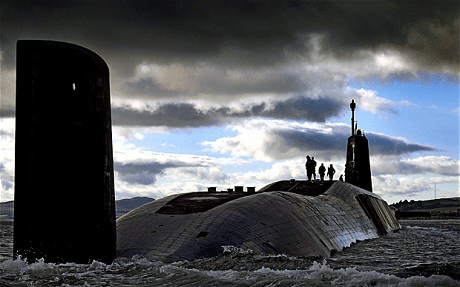
 Labour AM Mark Drakeford opposes Trident fleet in Wales BBC News Wales, 4 July 12, First Minister Carwyn Jones has been rebuked by a Labour backbencher after suggesting the UK’s nuclear submarine fleet would be welcome in Wales.
Cardiff West AM Mark Drakeford said he was “utterly opposed” to the siting of nuclear missiles in Wales.
It comes after Mr Jones raised the prospect of the Trident weapons system leaving its Scottish base and coming to Milford Haven….
.. Mark Drakeford was proud to align himself with the thousands of people “within my own party and beyond” who called for an immediate decommissioning of the Trident nuclear programme…. http://www.bbc.co.uk/news/uk-wales-politics-18707465
Nuclear Free Future Award to Dr Katsumi Furitsu
CBUW Science Team member wins Nuclear Free Future Award http://www.bandepleteduranium.org/en/icbuw-science-team-member-wins-nuclear-free-future International Coalition to Ban Uranium Weapons. ICBUW’s Dr Katsumi Furitsu is among the five winners of 2012’s Nuclear Free Future Awards for her work on publicising the impact of the Fukushima disaster. 4 July 2012 – ICBUW Continue reading
Earthquake risks under nuclear reactors at Tsuruga , Japan
 Reactor restarts, but Japan’s energy policy in flux, NISA calls for reviews of fault lines near Fukui nuclear reactors July 04, 2012, THE ASAHI SHIMBUN The Nuclear and Industrial Safety Agency said it will order reassessments of the seismic risk of geological fault lines that run near two nuclear facilities in Fukui Prefecture.
During a hearing session with expert seismologists on July 3, NISA said the potential damage from the fault lines should be studied further at the Mihama nuclear power plant, operated by Kansai Electric Power Co. (KEPCO), and the Monju prototype fast breeder reactor in Tsuruga, run by the Japan Atomic Energy Agency (JAEA).
The Shiraki-Nyu fault, which is recognized as active, runs north-south about 1 kilometer east of the Mihama nuclear plant and 500 meters west of the Monju reactor. In addition, the premises of the Mihama nuclear plant contain nine fault lines, while nine others run under the Monju reactor…. Japan Atomic Power Co., operator of the Tsuruga nuclear power plant in Tsuruga, Fukui Prefecture, is conducting re-investigations after NISA pointed out that sliding along the Urazoko active fault, which cuts through the plant’s premises, could lead to movements of a fault line directly beneath the No. 2 reactor….
1 This Month
10 March A LIVE WEBINAR THE REAL EFFECTS OF NUCLEAR POWER
What the Industry Isn’t Telling Us
1:00 PM Mountain, 2 pm Central, 3 pm Eastern. Live on the Keepers of the Water Facebook page



18 March Webinar @ 1 PM EST: An Assessment of SMR Projects: The Case of Canada
register for the zoom:
https://us02web.zoom.us/webinar/register/WN_o8BIIOUvQ2ONJR1nta65DQ#/registration


of the week – STOP SMALL MODULAR REACTORS IN CANADA
To see nuclear-related stories in greater depth and intensity – go to https://nuclearinformation.wordpress.com
-
Archives
- March 2026 (99)
- February 2026 (268)
- January 2026 (308)
- December 2025 (358)
- November 2025 (359)
- October 2025 (376)
- September 2025 (258)
- August 2025 (319)
- July 2025 (230)
- June 2025 (348)
- May 2025 (261)
- April 2025 (305)
-
Categories
- 1
- 1 NUCLEAR ISSUES
- business and costs
- climate change
- culture and arts
- ENERGY
- environment
- health
- history
- indigenous issues
- Legal
- marketing of nuclear
- media
- opposition to nuclear
- PERSONAL STORIES
- politics
- politics international
- Religion and ethics
- safety
- secrets,lies and civil liberties
- spinbuster
- technology
- Uranium
- wastes
- weapons and war
- Women
- 2 WORLD
- ACTION
- AFRICA
- Atrocities
- AUSTRALIA
- Christina's notes
- Christina's themes
- culture and arts
- Events
- Fuk 2022
- Fuk 2023
- Fukushima 2017
- Fukushima 2018
- fukushima 2019
- Fukushima 2020
- Fukushima 2021
- general
- global warming
- Humour (God we need it)
- Nuclear
- RARE EARTHS
- Reference
- resources – print
- Resources -audiovicual
- Weekly Newsletter
- World
- World Nuclear
- YouTube
-
RSS
Entries RSS
Comments RSS
 nuclear-news