Japanese protest against restart of nuclear reactors
 Japanese protest over planned restart of nuclear reactors Reuters TOKYO Jun 1, 2012 – Hundreds of Japanese anti-nuclear protesters gathered outside the prime minister’s office on Friday, beating drums and chanting slogans against the planned restart of reactors a year after the world’s worst nuclear disaster in 25 years.
“We oppose restarts,” the crowd of about 1,000, which stretched for around 200 meters down the block, shouted in the peaceful demonstration. Public mistrust of nuclear power has grown since the earthquake and tsunami on March 11 last year triggered the worst nuclear disaster since Chernobyl….. http://www.reuters.com/article/2012/06/01/us-japan-nuclear-protest-idUSBRE8500OE20120601
Japan – 37 tons of deadly plutonium, and planning to produce more
 Other countries, including the United States, have scaled back the separation of plutonium because it is a proliferation concern and is more expensive than other alternatives, including long-term storage of spent fuel.
Fuel reprocessing remains unreliable and it is questionable whether it is a viable way of reducing Japan’s massive amounts of spent fuel rods
Japan’s plutonium stockpile — most of which is stored in France and Britain — has swelled despite Tokyo’s promise to international regulators not to produce a plutonium surplus.

 Japan to make more plutonium despite big stockpile, Fox News June 01, 2012 Associated Press TOKYO – Last year’s tsunami disaster in Japan clouded the nation’s nuclear future, idled its reactors and rendered its huge stockpile of plutonium useless for now. So, the industry’s plan to produce even more has raised a red flag.
Nuclear industry officials say they hope to start producing a half-ton of plutonium within months, in addition to the more than 35 tons Japan already has stored around the world. That’s even though all the reactors that might use it are either inoperable or offline while the country rethinks its nuclear policy after the tsunami-generated Fukushima crisis. Continue reading
Wales would do better with renewables, tourism, than with nuclear power
 Anti-nuclear group Pawb’s Anglesey job creation plans, BBC New North Wales, 1 June 12, The existing Wylfa plant has permission to operate until 2014
One nuclear reactor to be closed
Talks to find Wylfa B investors
Firms drop new Wylfa nuclear plan
An anti-nuclear group has published plans on how it believes jobs can be created on Anglesey. People Against Wylfa B (Pawb) says the fact companies have pulled out of plans for a new nuclear power station shows the economic case is weak.
It proposes an offshore wind farm and the promotion of tourism instead……
At the time talks were continuing to find investors, after the company which was to build a new nuclear power station on Anglesey pulled out…..
Pawb says up to 3,000 jobs could be created on the island, and Dr Clowes said one plan being backed is a proposal for a massive offshore wind farm between Anglesey and the Isle of Man…..
The solar photovoltaic (using solar panels to convert sunlight into electricity) industry is increasing apace. These are seen as Cinderella-type industries… but they are real jobs, here today,” he added. Tourism could also be developed, he argued. He said the Welsh government had put “all its eggs in one basket” by backing Wylfa B and
saw it as the cure-all.
“Many opportunities have been lost,” he added…. http://www.bbc.co.uk/news/uk-wales-north-west-wales-18292401
Solar smart grid a Middle East first for Bahrain
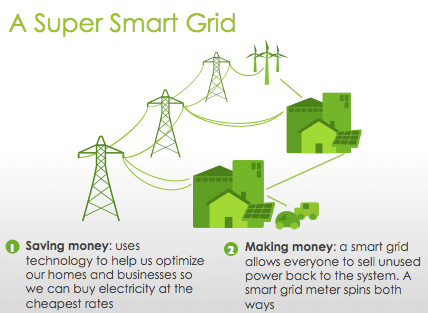 Bahrain Commits to Green Energy, Sacramento Bee, By Kingdom of Bahrain, Jun. 1, 2012 – MANAMA, Bahrain, — /PRNewswire-USNewswire/ –– In one of the first major solar energy projects in the Middle East, Bahrain yesterday announced plans to implement a solar smart grid in Awali, paving the way for future smart cities in Gulf.
“The Middle East has for some time evaluated the integration of solar energy for reduction
of reliance on non-renewable energy sources. However, Bahrain is among the first in the region to implement a project of this kind, demonstrating a serious commitment to long term solutions,” Marty Youssefiani, CEO of Caspian Energy Holdings, said.
Bahrain’s National Oil and Gas Authority (NOGA) is implementing five megawatt solar
capacity into a wireless smart grid network in cooperation with Petra Solar, Bahrain Petroleum Company (BAPCO) and Caspian Energy Holdings.
The grid circumvents common interconnection issues and costs of traditional solar systems because of its ability to install into the current transmission and distribution infrastructure. Bahrain intends to spread similar sustainable technology across the country in the future…… http://www.sacbee.com/2012/06/01/4531560/bahrain-commits-to-green-energy.html#storylink=cpy
Indian Point still USA’s most dangerous nuclear plant
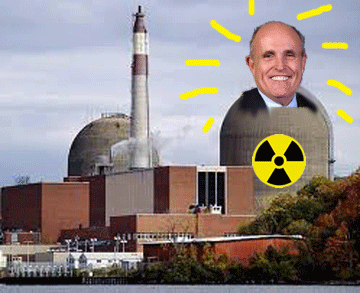 There is no protection for those fuel pools…You couldn’t see the fuel rods in fuel pool 2 because the water was so murky… it is so densely crowded with fuel rods, you can’t even get equipment in to fully inspect it …”
“There’s enough surplus power in this region to turn off Indian Point tomorrow and we won’t have any kind of shortage if we don’t do another thing until 2020,” “In the meantime, you can build two Indian Point’s worth of replacement power. You can save 30 percent of our power needs just by energy efficiency… We do not need the power —
they want to fool you into believing we do.”
Why the “Shut It Down” Crowd Won’t be Silenced Indian Point: Still America’s Most Dangerous Nuclear Plant? Counter Punch, by JOHN RAYMOND, 31 May 12 “Shut it down! Shut it down! Shut it down!” rang through the cavernous grand ballroom of the Doubletree Hotel in Tarrytown, NY, last week when the Nuclear Regulatory Commission staged an Orwellian charade promoted as an “open house” held to reassure the public that the Indian Point nuclear power plant was, as the New York Post headlined the following day, “Still Safe!”
The NRC’s annual “safety assessment” of the plant, which sits on the Hudson River 30 miles north of New York City, was based on 11,000 hours of ”inspection activities.” It found that Indian Point performed “within expected regulatory bounds” and the 25 matters that do require attention but “no additional NRC oversight,” are ‘low risk’, or have “very low safety significance.”
“So,” the Post mused, “will this finally silence the ‘shut it down’
crowd? …Don’t hold your breath.”
But do keep your fingers crossed…if you’re one of the 17.5 million
people living within 50 miles of the plant… Continue reading
USA legal fuss over Nuclear Waste Fund, as no waste solution found
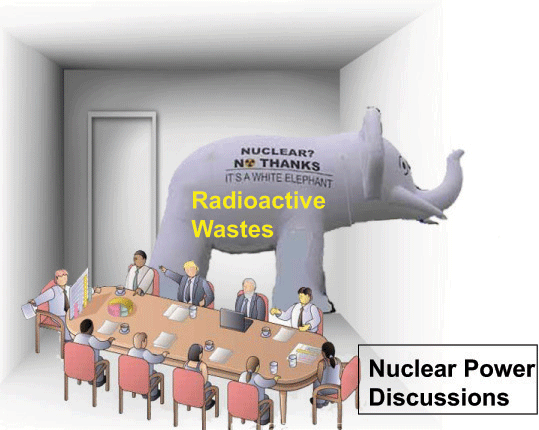 Appeals courts criticizes Energy Department over billions paid into nuclear waste fund Washington Post, By Associated Press, June 1 WASHINGTON — A federal appeals court says the Energy Department did not complete a review required to continue collecting $750 million a year in fees from operators of nuclear power plants.
Bu the U.S. Court of Appeals for the District of Columbia did not order the fee collection suspended. Instead, officials were given six more months to complete the review.
More than $26 billion has been paid into the federal Nuclear Waste Fund for long-term storage and disposal of nuclear waste from the nation’s 104 commercial nuclear reactors. The money has sat idle for decades amid disputes about how to dispose of the waste….
http://www.washingtonpost.com/politics/appeals-courts-criticizes-energy-department-over-billions-paid-into-nuclear-waste-fund/2012/06/01/gJQA5ALe7U_story.html
India’s Nuclear Safety Regulatory Authority (NSRA) Bill aims to hide information

 Aruna Roy to Sonia: Nuclear Safety bill is anti-transparency First Post India, by FP Staff Jun 1, 2012 Refusal by the Nuclear Corporation of India (NPCIL) to abide by the Central Information Commission’s order to make public the Kudankulam nuclear plant’s safety report has been strongly criticized by leading RTI activist and national advisory council (NAC) member Aruna Roy.
NPCIL is constructing the Koodankulam Nuclear Power Plant in Tamil Nadu in collaboration with Russia.
In a strongly worded letter to NAC chairperson and Congress president Sonia Gandhi, Roy has also brought up issue of the Nuclear Safety Regulatory Authority (NSRA) Bill 2011, which seeks to amend the Right to Information Act.
“It (referring to the Bill) also permits the creation of special nuclear safety regulatory authorities which will be born vaccinated from the RTI Act. There is no rationale for safety and regulatory authorities to be outside the purview of the RTI,” says Roy in her letter. (Read full letter here ) The NSRA, 2011, which was introduced in the Lok Sabha in September, proposes two amendments to the RTI Act.
The first seeks to remove from the scope of the RTI Act sensitive information relating to nuclear and radiation safety issues. And the second seeks to shield regulatory bodies that oversee nuclear facilities established for strategic and defence purposes.
It may be recalled that earlier this year, information commissioner Shailesh Gandhi had written to the Prime Minister expressing ‘serious concern’ on the government’s proposal to amend RTI act through the Nuclear Safety Bill. PMANE to move Supreme Court
The SP Udayakumar-led People’s Movement Against Nuclear Energy (PMANE) , which has been leading the struggle against the Kudankulam nuclear plant from neighbouring Idinthakarrai village since September last year, has in a press statement today condemned the NPCIL’s refusal to follow the CIC order.
As per the CIC order NPCIL was directed to “provide an attested photocopy of the Safety Analysis Report and Site Evaluation Report after severing any proprietary details of designs provided by the suppliers to the appellant before 25 May, 2012.” The NPCIL was also directed to upload the two reports on its site by May 30.
PMANE has said that it will now “intensify our struggle to get all the relevant information about the KKNPP for our safety and well being and we will also take all possible legal steps to that effect.”
Pusparayan, one of the leading members of the PMANE, told Firspost they had begun the process to move Supreme Court….. Pusparayan, meanwhile, has appealed to the government to “be democratic and genuine in sharing information with the public.” http://www.firstpost.com/india/aruna-roy-to-sonia-nuclear-safety-bill-is-anti-transparency-329280.html
Nuclear disaster’s effect on humans has been underestimated
 WHO statistics and studies on how the Fukushima disaster may have already, and will continue to affect human beings must be re estimated. The outcome based on the new information will obviously be much worse.
Germany’s Solar Success and Fukushima’s Crisis: Intelligent Energy Priorities, HUFFINGTONPOST, Vivian Norris 06/01/2012 “…….Fukushima is far from over, and to emphasize this, new information coming from testimony from Japanese leaders who were making decisions during the early days of the crisis, force us to accept that virtually no one had correct information, no one was in control, and the
situation was far worse than the public was told.
Yet nuclear physicists, engineers and safety specialists were at work on the internet trying to tell anyone who would listen that the situation at Fukushima was bordering on a worldwide catastrophe.
The amounts of radiation which flowed into the Pacific, the weather patterns which carried radioactive particles across the Pacific, and frankly around the world, were far higher than TEPCO admitted. This has led to a mistrust not only of the industry, but of the mainstream media and regulators as the Japanese government appeared to put saving face before informing the public. Continue reading
Most nuclear reviews don’t meet Harper’s two-year limit Montreal Gazette, By Mike De Souza, Postmedia News June 1, 2012 OTTAWA — Two-thirds of recent environmental assessments by the Canadian Nuclear Safety Commission, including those involving storage of radioactive waste, have taken more than two years to complete, say new numbers released by the agency. Continue reading
USA devised Stuxnet computer worm to attack Iran’s nukes, says new book

 Obama ‘gave full backing to Stuxnet attack on Iran’ http://www.newscientist.com/blogs/onepercent/2012/06/obama-gave-full-backing-to-stu.html 1 June 2012 When George W Bush handed over the presidential reins to Barack Obama in 2008, he asked that the incoming man continue running what he regarded as two of his administration’s most promising security programs: the remotely-piloted drone war against Al Qaeda in Afghanistan – and the development of a cyberweapon nicknamed ‘the bug’, aimed at destroying Iran’s nascent nuclear capability.
Obama agreed – but we have now come to know that bug by another name: Stuxnet.
This revelation is at the heart of an apparently impeccably-sourced book due to be  published in the US on 5 June. In Confront and Conceal: Obama’s Secret Wars and Surprising Use of American Power, author David Sanger alleges that Stuxnet, which eventually wrecked hundreds of uranium centrifuges in Iran in 2010, was created by cyberweapons experts at the US National Security Agency in collaboration with ‘Unit 8200’, a cyber operation of Israeli intelligence. Continue reading
China not such a nuclear threat to USA

 China nuclear no ‘direct threat’: US commander http://www.brecorder.com/general-news/172/1195339/, MAY 31, 2012 China’s nuclear weapons do not pose a “direct threat” to the United States, the man in charge of America’s arsenal said Wednesday in calling for greater dialogue with the Chinese military. “We would like to have routine contact and conversations with China’s military,” said General Robert Kehler, head of Strategic Command or STRATCOM, which oversees America’s nuclear deterrence operations around the globe.
“We think there would be tremendous benefit to that in both China and the United States, in particular to help us avoid some misunderstanding or some tension in the future.” Kehler said that although the United States and Russia account for roughly 90 percent of the world’s nuclear weapons, dealing with the Chinese on the matter will become increasingly important. “I do not see the Chinese strategic deterrent as a direct threat to the United States. We are not enemies,” he said. “Could it be? I suppose if we were enemies it could be and therefore we at least have to be aware of that.”
Distributed solar power for millions of the world’s poor
Barefoot Power’s products are brightening up the lives of those with limited or no access to grid power. Products range from single desk lamps to complete kits for use by homes, clinics and schools. With good links to microfinance organisations and exceptional customer care, Barefoot has sold more than 400,000 lanterns and lighting kits to two million rural poor in Africa,Asia Pacific, India and the Americas.
 Solar power pioneer wins global green energy award, PR Wire 1 June 12, A company specialising in providing affordable solar power products to remote rural communities has won a coveted Ashden Award for its work in Africa.
Barefoot Power was awarded some £20,000 in prize money at a prestigious ceremony in London this evening after joining other Award winners at a meeting with His Royal Highness the Prince of Wales at Clarence House in the morning.
The Ashden judges said: “With its astonishing sales figures, Barefoot is a fantastic example of a market-led solution to bringing renewable electricity to Africa’s rural poor. Through its network of micro-entrepreneurs it is overcoming the barriers of how to access remote communities and how to make solar power affordable.” Continue reading
The safest management of nuclear plants is to close them – former Japanese P.M.
In his testimony, Mr Kan said Japan’s plant safety was inadequate because the energy policy had been hijacked by the ”nuclear village” – the power companies and pro-nuclear regulators and researchers that worked to promote the industry.
”Experiencing the accident convinced me that the best way to make nuclear plants safe is not to rely on them, but rather, to get rid of them.”

Nuclear plants ‘far too risky’ for Japan Tokyo http://www.smh.com.au/world/nuclear-plants-far-too-risky-for-japan-20120529-1zhak.html#ixzz1wbiceWvu May 30, 2012 IN AN unusually stark warning during last year’s nuclear crisis, Japan’s then prime minister told a parliamentary inquiry the country should discard nuclear power as being too dangerous, saying the Fukushima accident had pushed the country to the brink of ”national collapse”.
In testimony to a panel investigating the government’s handling of the nuclear disaster, Naoto Kan also warned that the powerful nuclear industry was trying to push Japan back towards nuclear power, despite ”showing no remorse” for the accident.
Mr Kan’s testimony was the most closely watched of the six-month inquiry, which was launched by lawmakers who felt an earlier investigation by the government had papered over problems. Continue reading
USA’s Nuclear Regulatory Commission’s real role is to PROMOTE nuclear power
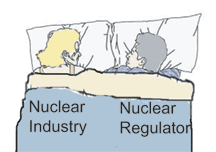
 Nuclear Rubberstamp Commission HUFFINGTON POST, Karl Grossman, 05/30/2012“… The resignation last week of the chairman of the U.S. Nuclear Regulatory Commission is another demonstration of the bankrupt basis of the NRC. Gregory Jaczko repeatedly called for the NRC to apply “lessons learned” from the Fukushima Daiichi nuclear plant disaster in Japan. And, for that, the nuclear industry — quite successfully — went after him fiercely.
The New York Times, in an editorial over the weekend , said that President Obama’s choice to replace Jaczko, Allison Macfarlane, “will need to be as independent and aggressive as Dr. Jaczko.”
That misses the institutional point.
The NRC was created in 1974 when Congress abolished the U.S. Atomic Energy Commission after deciding that the AEC’s dual missions of promoting and at the same time regulating nuclear power were deemed a conflict of interest. The AEC was replaced by the NRC, which was to regulate nuclear power, and a Department of Energy was later formed to advocate for it.
However, the same extreme pro-nuclear culture of the AEC continued on at the NRC. It has partnered with the DOE in promoting nuclear power.
Indeed, neither the AEC, in its more than 25 years, nor the NRC, in its nearly 30 years, ever denied an application for a construction or operating license for a nuclear power plant anywhere, anytime in the United States.
The NRC is a rubberstamp for the nuclear industry. “NRC stands for Nuclear Rubberstamp Commission,” says Kevin Kamps of the organization Beyond Nuclear. And it isn’t that Jaczko opposed nuclear power. “Greg is not anti-nuclear, but he’s pro-nuclear in a smart and considered way,” says Christopher Paine , director of the nuclear program at the Natural Resources Defense Council. Continue reading
Germany’s dazzling success with small scale solar energy
the really meaningful story starts with a different number: 189.24 GWh. That’s the amount of electrical energy generated from more than a million PV solar systems spread all over the country on that record day. Not only was this almost 14% of Friday’s total electricity consumption in Germany, it was also, actually, not that unusual.
For the last couple of weeks, the output of PV solar peaked within an inch of the 20 GW line several times, and it never peaked very low throughout the month. The lowest peak load was 8 GW, while the average peak load of PV solar was 16 GW. So, it seems that solar is not as unreliable as conventional wisdom and media outlets often lead people to believe. Because I can tell you that we didn’t have 4 weeks straight of sunshine here in Germany, that’s for sure.

 In-Depth: Germany’s 22 GW Solar Energy Record Clean Technica, MAY 31, 2012 BY THOMAS Last Friday, on the 25th of May 2012, Germany set a new world solar energy record in photovoltaic solar energy: 22.4 GW of photovoltaic energy on the grid covering over 30% of all energy demand! That’s the equivalent of 20 huge conventional fossil or nuclear power plants. This is clearly amazing news that made headlines around the world and was accompanied by either praise or the typical anti-solar bickering that is rather dominant in big media outlets even today (or especially today).
The latter didn’t mind even using this incredible clean energy accomplishment to repeat the usual ignorant talking points, disinformation, or flat out lies. Unfortunately, those news pieces and early articles praising the event didn’t fully exploit the opportunity to explain the true significance of having so much solar energy in the energy mix, especially when looking at the technological developments and opportunities of the coming years. Continue reading
1 This Month

Protect Sazan Island from the Trump family! https://secure.avaaz.org/campaign/en/protect_sazan_island_from_the_trump_family_loc/?bqFCVab&v=174511&cl=22707147157&_checksum=5e9dde668860e8231c33699735e16a1fbf22ab2cb01da50c999fe8732b9775ef&utm_source=email&utm_medium=blast_email&utm_campaign=174511


Cuba Is Not a Failed State – It Is a Besieged State
PETITION: “Global Appeal to Endorse Palestinian Right of Return of Refugees”
To see nuclear-related stories in greater depth and intensity – go to https://nuclearinformation.wordpress.com
-
Archives
- June 2026 (129)
- May 2026 (306)
- April 2026 (356)
- March 2026 (251)
- February 2026 (268)
- January 2026 (308)
- December 2025 (358)
- November 2025 (359)
- October 2025 (376)
- September 2025 (257)
- August 2025 (319)
- July 2025 (230)
-
Categories
- 1
- 1 NUCLEAR ISSUES
- business and costs
- climate change
- culture and arts
- ENERGY
- environment
- health
- history
- indigenous issues
- Legal
- marketing of nuclear
- media
- opposition to nuclear
- PERSONAL STORIES
- politics
- politics international
- Religion and ethics
- safety
- secrets,lies and civil liberties
- spinbuster
- technology
- Uranium
- wastes
- weapons and war
- Women
- 2 WORLD
- ACTION
- AFRICA
- Atrocities
- AUSTRALIA
- Christina's notes
- Christina's themes
- culture and arts
- Events
- Fuk 2022
- Fuk 2023
- Fukushima 2017
- Fukushima 2018
- fukushima 2019
- Fukushima 2020
- Fukushima 2021
- general
- global warming
- Humour (God we need it)
- Nuclear
- RARE EARTHS
- Reference
- resources – print
- Resources -audiovicual
- Weekly Newsletter
- World
- World Nuclear
- YouTube
-
RSS
Entries RSS
Comments RSS
 nuclear-news