More costs, more delays for cleanup of USA’s most radioactive nuclear waste site
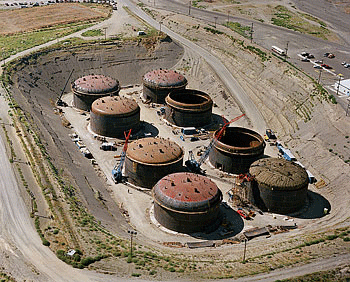 Today, it is the nation’s most contaminated nuclear site, with cleanup expected to last decades.
In March, the Defense Nuclear Facilities Safety Board ruled that the agency lacks necessary information to resolve some problems and establish a complete safety plan.
Hanford waste plant sees new costs, delays USA Today, By Shannon Dininny, 26 June 12, KENNEWICK, Wash. (AP) — A new cost estimate and construction schedule for a massive waste plant being built at the nation’s most contaminated nuclear site will be delayed at least a year as workers try to resolve serious technical problems raised by whistleblowers about design and safety, the U.S. Department of Energy said Tuesday.
The $12.3 billion plant at south-central Washington’s Hanford nuclear reservation is being built to convert highly radioactive waste into a stable glass form for permanent disposal underground.
The plant is currently scheduled to begin operating in 2019, but several workers have raised concerns about safety, particularly about erosion and corrosion in tanks and piping inside the plant.
The issues are significant because the problem areas are inside so-called black cells, which will be closed off and inaccessible due to high radioactivity after the plant begins operating.
-
MORE: Problems plague cleanup at Hanford nuclear waste site
-
PHOTOS: Cleaning up a radioactive mess
….. The federal government created Hanford in the 1940s as part of the top-secret project to build the atomic bomb. The site produced plutonium for the world’s first atomic blast and for the bomb that was dropped on Nagasaki, Japan, to end World War II.
Today, it is the nation’s most contaminated nuclear site, with cleanup expected to last decades.
Central to that cleanup is 53 million gallons of highly radioactive waste left from decades of plutonium production for the nation’s nuclear weapons arsenal. The waste is stored in 177 aging, underground tanks, many of which have leaked, threatening the groundwater and nearby Columbia River.
Building a plant to convert that waste into a solid, stable form has been among the most challenging tasks at the site. The project has involved numerous technical problems, delays and cost increases. More recently, several workers raised safety concerns and two filed a lawsuit as whistleblowers, saying they were targeted for reprisals for raising questions.
In addition to erosion and corrosion, problems remain unresolved with adequate mixing of the waste……
In March, the Defense Nuclear Facilities Safety Board ruled that the agency lacks necessary information to resolve some problems and establish a complete safety plan.
Design of the plant is 85 percent complete, and construction is more than 50 percent finished. http://www.usatoday.com/news/nation/environment/story/2012-06-26/hanford-nuclear-waste-plant/55845012/1
No comments yet.
1 This Month

of the week – Shut Down Drone Warfare!


Tell the Ukrainian Government to Drop Prosecution of Peace Activist Yurii Sheliazhenko

Petition to revoke the licensing of the Near Surface Nuclear Disposal Facility (NSDF) at Chalk River. https://www.ourcommons.ca/petitions/en/Petition/Details?Petition=e-7247
To see nuclear-related stories in greater depth and intensity – go to https://nuclearinformation.wordpress.com
-
Archives
- March 2026 (237)
- February 2026 (268)
- January 2026 (308)
- December 2025 (358)
- November 2025 (359)
- October 2025 (376)
- September 2025 (257)
- August 2025 (319)
- July 2025 (230)
- June 2025 (348)
- May 2025 (261)
- April 2025 (305)
-
Categories
- 1
- 1 NUCLEAR ISSUES
- business and costs
- climate change
- culture and arts
- ENERGY
- environment
- health
- history
- indigenous issues
- Legal
- marketing of nuclear
- media
- opposition to nuclear
- PERSONAL STORIES
- politics
- politics international
- Religion and ethics
- safety
- secrets,lies and civil liberties
- spinbuster
- technology
- Uranium
- wastes
- weapons and war
- Women
- 2 WORLD
- ACTION
- AFRICA
- Atrocities
- AUSTRALIA
- Christina's notes
- Christina's themes
- culture and arts
- Events
- Fuk 2022
- Fuk 2023
- Fukushima 2017
- Fukushima 2018
- fukushima 2019
- Fukushima 2020
- Fukushima 2021
- general
- global warming
- Humour (God we need it)
- Nuclear
- RARE EARTHS
- Reference
- resources – print
- Resources -audiovicual
- Weekly Newsletter
- World
- World Nuclear
- YouTube
-
RSS
Entries RSS
Comments RSS
 nuclear-news
Leave a comment