Nuclear news for the past week

Christina Macpherson’s websites & blogs
Renewable energy. Lots happening. Desertec’s grand plan to renewably power Europe. Solar plant for Fukushima area. A second long distance solar-powered flight. Rio conference – UN’s Sustainable Energy For
All” initiative, with private sector committing over $50 billion. Clean energy pledges, especially from Pacific Island nations.
India – the power generating arm of India’s largest conglomerate, the Tata Group, announced that it was shifting its investment strategy from coal-fired thermal plants to wind and solar renewable projects. Solar-powered scheme for in Obulapuram and surrounding villages.
Japan Fukushima nuclear plant – in danger of a new catastrophe. Thousands protest against restarting of Oi nuclear reactors. Seismologists warn of earthquake danger if nuclear reactors restarted in Japan. Radiation hotspots in Tokyo park.Little chance for Fukushima nuclear victims to get legal redress. High levels of radiation in Fukushima area’s fish.
USA. conflict of interest as DOE researches radiation effects. Hanford nuclear waste site – more costs, more safety problems. Vermont State loses court case to stop relicensing of Vermont Yankee nuclear plant. San Onofre nuclear plant closed for months, might never re-open.
Uranium price stays on its downward slide. In Central Africa, rebels attack AREVA’s uranium site.
Iran. USA hawks and Israel want military approach to Iran. Russia warns against attacking Iran.
Powering Europe with Sunshine from Africa and Middle East
 How To Power A Continent With Wind And Solar http://www.energymatters.com.au/index.php?main_page=news_article&article_id=3271 by Giles Parkinson, editor of RenewEconomy.com.au, 27 June 12 Of all the most ambitious renewable energy projects around the world, the European Desertec Industrial Initiative ranks right at the top- some would say fantastic in both the true and the modern sense of the word.The basic plan of Desertec is to harness the wind and solar power from north Africa and the Middle East and use it- along with similar resources from southern Europe- to help Europe cut 95 per cent of its emissions from its electricity grid by 2050, and to have renewables provide 90 per cent of its power needs.
A new report released by the initiative- which is a consortium of 21 industrial giants such as Siemens, E.ON, Deutsche Bank, Morgan Stanley, Enel, and Shell- says this can be done, at the same time as reducing electricity costs and making the grid more stable than it would otherwise be.
The 2050 Desert Power report released late last week, co-authored by the Fraunhofer Institute, says that by importing 20 per cent of its energy needs from the Middle East and north Africa (MENA), Europe can save €33 billion a year, or €30 for each megawatt hour of imported electricity. Continue reading
VIDEO: Fukushima nuclear plant at risk of an even greater nuclear disaster

 VIDEO http://www.abc.net.au/7.30/content/2012/s3532725.htm Experts warn of another disaster awaiting at Fukushima Australian Broadcasting Corporation 7.30 report Broadcast: 25/06/2012 Reporter: Mark Willacy Japanese and US nuclear experts warn that another earthquake hitting Fukushima could spark a disaster worse than Chernobyl….
Legal action not an option for vast majority of Fukushima’s nuclear victims
Victims and lawyers in Japan say the dearth of nuclear-related suits reflects both a national mindset — a distaste for confrontation — and a stunted judicial system that doesn’t allow for class-action cases or punitive damages. Japanese speak of the court system as more likely to deliver frustration than vengeance, and jobless evacuees who urgentlyneed money have little appetite for long trials with uncertain outcomes.
Without the threat of legal action, ……”the state and companies can take advantage of victims.”

 Nuclear redress will never approximate losses, By CHICO HARLAN, The Washington Post, 26 June 12, It was 15 months ago that the Fukushima No. 1 nuclear plant suffered three meltdowns and contaminated a broad circle of countryside and left hundreds of thousands of people without homes, jobs or both. But for all the damage and despair it wrought, the disaster so far has unfolded without one conventional element: a widespread and contentious legal fight by those who say they should be compensated for their losses.
Victims of the worst nuclear crisis in a quarter-century have filed roughly 20 lawsuits against Tokyo Electric Power Co., according to the utility. That compares with the several hundred suits filed against BP within weeks of the 2010 Gulf oil spill, including the near-finalized settlement of a class-action suit that will pay 120,000 plaintiffs upward of $7.8 billion. BP also paid out some $6.2 billion to victims via a neutral claims settlement process, administered by a lawyer appointed by the Obama administration. Continue reading
Conflict of interest, USA’s Department of Energy funds research into radiation
 The Energy Department is also the main source of funding for radiation health research — much like having the tobacco industry determine the safety of smoking. This conflict-of interest is not new. Several prominent scientists on the nuclear payroll in the 1950’s and 60’s vigorously claimed that radioactive fallout from atmospheric nuclear weapons tests was harmless. Some went so far as to assert that fallout might be beneficial because increased radiation-induced genetic mutations could weed out the weak.
A Radioactive Conflict of Interest http://www.huffingtonpost.com/robert-alvarez/mit-radiation-study_b_1623899.html HUFFINGTON POST, Robert Alvarez, 06/25/2012 Having the Energy Department control radiation health research makes as much sense as giving tobacco companies the authority to see if smoking is bad for you.
VIDEO http://www.youtube.com/watch?v=e8YFe6Q08M8 MIT No-Evacuations Study Debunked Last month, the Massachusetts Institute of Technology (MIT) heralded an Energy Department funded study indicating that evacuation zones around nuclear power stations might not be needed after a major nuclear accident. The study, which exposed mice to radiation levels comparable to those near the Fukushima nuclear disaster, found no evidence of genetic harm. “There are no data that say that’s a dangerous level,” says Jacquelyn Yanch, a leader of the study.
According to theMIT press release “current U.S. regulations require that residents of any area that reaches radiation levels eight times higher than background should be evacuated. However, the financial and emotional cost of such relocation may not be worthwhile, the researchers say.”
Dangerous to restart Japan’s nuclear reactors, warn seismologists
 Seismic modelling by Japan’s nuclear regulator did not properly take into account active fault lines near the Ohi plant, Katsuhiko Ishibashi, a seismologist at Kobe University, told reporters.
“Instead of making standards more strict, they both represent a severe setback in safety standards.”
Seismologists warn Japan against nuclear restart http://af.reuters.com/article/energyOilNews/idAFL3E8HQ43L20120626 TOKYO, June 26 (Reuters) – Two prominent seismologists said on Tuesday that Japan is ignoring the safety lessons of last year’s Fukushima crisis and warned against restarting two reactors next month. Continue reading
The world cannot afford the dangerous distraction of nuclear power
The nuclear argument is a dangerous distraction that could direct resources and technical capacity away from more sensible responses. Nuclear power is certainly not a fast enough response to climate change. Even the pro-nuclear Switkoswki committee concluded that it would take 10 to 15 years to build one nuclear reactor.
Nuclear energy is a dangerous distraction, The Drum, Professor Ian Lowe, 26 June 12, No rational person without a financial interest in the industry would consider nuclear power for Australia. The only logical basis for contemplating its possible use arises from a recognition that climate change is a serious threat to our future.
At the turn of the century, nuclear power was seen as a failed technology. Originally touted as cheap, clean and safe, it was widely recognised as expensive, dirty and dangerous. The peak of installed nuclear power happened more than 20 years ago. Since then, cancellations and deferments have outnumbered new constructions. Continue reading
High radiation levels in Fukushima fish
Fukushima fish still hard to stomach http://www.radioaustralia.net.au/international/2012-06-25/fukushima-fish-still-hard-to-stomach/967258, 26 June 2012 Japanese fishermen are facing a struggle for their livelihoods.An ABC report shows that many fish caught in the oceans around Fukushima contain dangerous levels of radioactive material. Continue reading
Rain and mud bring radioactivity to areas in Tokyo park
 Radiation hotspots found in Tokyo park, June 26, 2012, THE ASAHI SHIMBUN Radiation levels exceeding official standards have been detected at a park in Tokyo, after a metropolitan government inspection carried out under pressure from the Japanese Communist Party.
The Tokyo metropolitan government said June 25 that it had detected a maximum radiation reading of 1.22 microsieverts per hour at Mizumoto Park in Katsushika Ward. Officials took readings at two points in the shrubbery in the parking areas. Both readings exceeded the central government standard for decontamination of 1 microsievert per hour above background radiation. The metropolitan government said it will decontaminate the area.
The cause of the high radiation levels is still being investigated, but officials say both spots are likely places where rainwater and mud build up….. http://ajw.asahi.com/article/0311disaster/fukushima/AJ201206260057
More costs, more delays for cleanup of USA’s most radioactive nuclear waste site
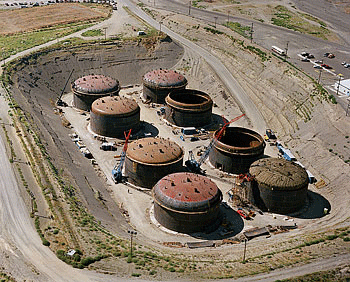 Today, it is the nation’s most contaminated nuclear site, with cleanup expected to last decades.
In March, the Defense Nuclear Facilities Safety Board ruled that the agency lacks necessary information to resolve some problems and establish a complete safety plan.
Hanford waste plant sees new costs, delays USA Today, By Shannon Dininny, 26 June 12, KENNEWICK, Wash. (AP) — A new cost estimate and construction schedule for a massive waste plant being built at the nation’s most contaminated nuclear site will be delayed at least a year as workers try to resolve serious technical problems raised by whistleblowers about design and safety, the U.S. Department of Energy said Tuesday.
The $12.3 billion plant at south-central Washington’s Hanford nuclear reservation is being built to convert highly radioactive waste into a stable glass form for permanent disposal underground.
The plant is currently scheduled to begin operating in 2019, but several workers have raised concerns about safety, particularly about erosion and corrosion in tanks and piping inside the plant.
The issues are significant because the problem areas are inside so-called black cells, which will be closed off and inaccessible due to high radioactivity after the plant begins operating. Continue reading
Same old price doldrums for the uranium industry
 Spot uranium price unchanged at $50.75/lb U3O8 in weak market, Washington (Platts)–26 Jun2012 The spot price for uranium was unchanged over the last week at about $50.75/lb U3O8, prompting one analyst to describe the market as”stuck” with few buyers or sellers anxious to make a deal.
TradeTech on Friday kept its weekly price at $50.75/lb, saying that spot uranium demand “continues to be dominated by highly price sensitive and discretionary demand, and while spot supplies are currently sufficient to meet demand [and] sellers are not actively seeking to push material to the market.”… http://www.platts.com/RSSFeedDetailedNews/RSSFeed/ElectricPower/8439315
Not a good look for the USA – Nuclear Regulatory Commission can override State’s wishes
Christina Macpherson’s websites & blogs
Not a good look for the USA.
It seems now that the Nuclear Regulatory Commission, and its friends, the nuclear industry, can now override any State in America that wants to get rid of dirty, dangerous nuclear energy – Christina Macpherson
“The New England Coalition, and all Vermonters, have now been deprived of the right that was guaranteed to them by Congress, to have a say in how this plant affects clean water,”
 State Loses Another Legal Round In Vt. Yankee Relicensing, Vermont Public Radio, 06/26/12, John Dillon A federal court has handed the state of Vermont another loss in its ongoing challenge to Vermont Yankee’s operating license.
The Circuit Court of Appeals in Washington rejected the state’s arguments that the new 20-year license was invalid because Entergy Vermont Yankee failed to get a new water quality permit.
The court found Vermont missed its chance to raise the issue before the Nuclear Regulator Commission. Continue reading
Conflicting reports about French nationals held by rebels in Central African Republic
 Bakouma lawmaker Alima Diarra said the rebels seized five French nationals and two locals. But there are conflicting reports over whether the seven were hostages……French authorities are talking with local authorities and Areva about what to do next.
Foreigners not held in Central African Republic, The Telegraph June 26, 2012 By HIPPOLYTE MARBOUA — Associated Press BANGUI, CENTRAL AFRICAN REPUBLIC — Authorities in the Central African Republic said that rebels had released the foreigners they were holding after attacking a French uranium exploration site, even though officials with the company in France denied that the expatriates had ever been kidnapped.
A military official in Bakouma, where the site is, said that a plane was sent to pick up five French nationals and two locals to take them to the capital, Bangui. Rebels on Sunday attacked the exploration site in Bakouma, operated by French company Areva. Continue reading
AREVA uranium site in Central Africa attacked by gunmen
Gunmen attack French uranium plant, Times Live, Sapa-AFP | 25 June, 2012 Gunmen have attacked a uranium plant operated by French nuclear power giant Areva at Bakouma in the southeast of the Central African Republic, army and French diplomatic sources said yesterday.
“A violent clash on Sunday afternoon pitted” Central African troops against “an unidentified group of armed men attempting to launch an assault on the site of mining company Areva,” a military statementsaid…. http://www.timeslive.co.za/thetimes/2012/06/25/gunmen-attack-french-uranium-plant
Japanese utility shareholders meetings – local governments will demand nuclear power shutdown
Local governments to demand change at utility shareholders’ meetings, June 26, 2012 THE ASAHI SHIMBUN Long seen as “silent” shareholders, local governments are expected to demand bold reforms, such as abolishing nuclear power plants, at the general shareholders’ meetings of electric utilities.
But they may not have enough voting power to force big changes in the industry. All 10 of Japan’s regional electric power companies, except for Okinawa Electric Power Co., are scheduled to hold their shareholders’ meetings on June 27.
At Kansai Electric Power Co.’s meeting, Osaka Mayor Toru Hashimoto is set to propose “the abolition of all of its nuclear power plants as soon as possible” in company’s articles of incorporation. The city of Osaka is the largest shareholder of Kansai Electric, with a 9.37-percent stake in terms of voting rights……
http://ajw.asahi.com/article/0311disaster/fukushima/AJ201206260079
1 This Month

of the week – Shut Down Drone Warfare!


Tell the Ukrainian Government to Drop Prosecution of Peace Activist Yurii Sheliazhenko

Petition to revoke the licensing of the Near Surface Nuclear Disposal Facility (NSDF) at Chalk River. https://www.ourcommons.ca/petitions/en/Petition/Details?Petition=e-7247
To see nuclear-related stories in greater depth and intensity – go to https://nuclearinformation.wordpress.com
-
Archives
- March 2026 (237)
- February 2026 (268)
- January 2026 (308)
- December 2025 (358)
- November 2025 (359)
- October 2025 (376)
- September 2025 (257)
- August 2025 (319)
- July 2025 (230)
- June 2025 (348)
- May 2025 (261)
- April 2025 (305)
-
Categories
- 1
- 1 NUCLEAR ISSUES
- business and costs
- climate change
- culture and arts
- ENERGY
- environment
- health
- history
- indigenous issues
- Legal
- marketing of nuclear
- media
- opposition to nuclear
- PERSONAL STORIES
- politics
- politics international
- Religion and ethics
- safety
- secrets,lies and civil liberties
- spinbuster
- technology
- Uranium
- wastes
- weapons and war
- Women
- 2 WORLD
- ACTION
- AFRICA
- Atrocities
- AUSTRALIA
- Christina's notes
- Christina's themes
- culture and arts
- Events
- Fuk 2022
- Fuk 2023
- Fukushima 2017
- Fukushima 2018
- fukushima 2019
- Fukushima 2020
- Fukushima 2021
- general
- global warming
- Humour (God we need it)
- Nuclear
- RARE EARTHS
- Reference
- resources – print
- Resources -audiovicual
- Weekly Newsletter
- World
- World Nuclear
- YouTube
-
RSS
Entries RSS
Comments RSS
 nuclear-news