Countering the cacophony of crap against renewable energy
Renewable Energy Industry Pushes Back Against Bad Press Fox News, June 20,  2012 A new informational website called energyfactcheck.org and launched Wednesday by one of the industry’s top Washington boosters will target reporters, political decision-makers, and anyone else willing to listen to the pitch that the industry is viable, despite some failures.
“The perception, because of the lack of fact-based information out there, is that we’re some fleeting, fly-by-night, government-dependent entity,” said Vice Admiral Dennis McGinn, a retired Navy officer and chief executive of the American Council on Renewable Energy, the nonprofit that is maintaining the new website.
“The fact is that we have real companies making real profits and making investments in renewable energy for all the right reasons.” Continue reading
Japan’s new nuclear regulator to be back in bed with the nuclear industry?
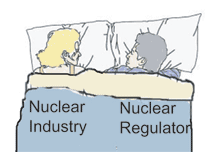 the regulator could have a nuclear-industry friendly stance if the pro-business opposition party, the Liberal Democratic Party, comes into power in the next general elections, which could take place as early as autumn, or by September 2013 at the latest.
Fukushima Watch: Back-Pedaling on Reactor  Age Limits? By Mitsuru Obe http://blogs.wsj.com/japanrealtime/2012/06/20/fukushima-watch-back-pedaling-on-reactor-age-limits/ While Japan was transfixed by the drama of restarting nuclear
reactors, another potentially big shift on the atomic-energy front was taking place quietly in the wings.
Japan’s ruling Democratic Party of Japan last week acceded to opposition party requests to retract a plan that would set an age limit of 40 years on nuclear reactors. The DPJ now says that the age limit, which had previously been included in the new nuclear safety bill under deliberation in parliament, will be decided instead by the country’s new regulator, which is to be established as early as this autumn.
The rule, which would limit the length of time a reactor could stay in operation to 40 years, was proposed in December, following concern that aged equipment contributed to the March 2011 meltdowns at the Fukushima Daiichi plant. The three reactors that spun out of control
were all built during the 1970s. Nuclear crisis minister Goshi Hosono said at the time the rule was proposed that “reactors will basically have to be decommissioned after 40 years of operation.” Extending the life beyond 40 years would be allowed in exceptional circumstances
only, he said.
The bill, with the 40-year age limit excised, swiftly cleared Japan’s lower house last Friday, and is expected to pass the opposition-dominated upper house on Wednesday. Industry minister Yukio Edano Friday bemoaned the change, saying “We wanted to have the bill
passed as was originally proposed by the government.” Continue reading
Japan’s new nuclear regulatory body – an uncertain quantity
Japan Adopts New Law For Nuclear Regulatory Body 6/20/2012 (RTTNews) – Japan’s Diet (Parliament) on Wednesday enacted a law to set up an independent nuclear regulatory body by September.
The new law was adopted following widespread criticism after last year’s accident at the Fukushima Daiichi nuclear power plant. Lawmakers have complained that the existing Nuclear and Industrial Safety Agency is controlled by the Ministry of Economy, Trade and
Industry, which promotes nuclear power.
The proposed nuclear regulatory commission is to be largely independent of the government and will have control over a nuclear regulatory agency. Appointees to the five-member commission will not to be allowed to return to work at their former Ministries or agencies. The legislation also provides for the setting up of a new Cabinet Office council to study nuclear disaster preparedness, Japanese media reported.
The new law limits the Prime Minister’s powers to give orders during emergencies, and tasks the commission with making decisions involving knowledge of reactor technology. It allows the Prime Minister to give instructions only when the commission is too slow in deciding. The commission is to review the current 40-year limit for operating nuclear plants….. http://www.rttnews.com/1909544/japan-adopts-new-law-for-nuclear-regulatory-body.aspx?type=gn&Node=B1
Nuclear Regulatory Commission’s blind faith that nuclear waste is safe
The NRC held that waste storage was safe for at least 60 years after a plant shuts down; they then proposed a rule to allow spent fuel storage at reactor sites for 200-300 years.
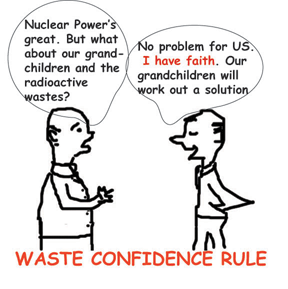
Wake Up and Smell the Radioactive Waste, OpEd News, 20 June 12, By Abby Luby Given that 2,000 tons of spent nuclear fuel is produced every year at nuclear reactors in the United States, and over 75,000 metric tons of nuclear waste is being temporarily stored in 39 states, it is surprising that the Nuclear Regulatory Commission (NRC) has emphatically said this amount of waste is safe. What’s even more surprising is that no one has disputed them. Until now.
Last week, in what New York State calls a landmark victory, a U.S. Appeals Court ruled that the NRC violated a federal act by neglecting to run in-depth studies on how storing radioactive waste at nuclear power plants impacts health and the environment. The lawsuit was spearheaded and won by New York Attorney General Eric Schneiderman, who was joined by state attorneys general from Connecticut, Vermont and New Jersey, and the Prairie Island Indian Community.
Court found that USA’s Nuclear Regulatory Commission could not just ignore nuclear wastes
In its ruling the court concluded that the NRC’s standard finding during the relicensing process that permanent nuclear-waste storage will be available “when necessary” did not calculate the environmental effects of failing to secure permanent storage – “a possibility that cannot be ignored.”
The court also found that the NRC’s finding that spent fuel could safely be stored on site at nuclear plants for 60 years after expiration of a plant’s license, “failed to properly examine future dangers and key consequences.”

 Nuclear waste: why environmentalists are pressing NRC on reactor licenses After a US appeals court ruled the NRC had not adequately evaluated nuclear waste provisions when licensing reactors, the groups are seeking to ensure the public has input on the process. Christian Science Monitor, By Mark Clayton, June 20, 2012 The nation’s top nuclear power plant regulator is being petitioned by environmental groups to halt all further license extensions for 35 power reactors nationwide until their on-site nuclear-waste storage systems undergo more in-depth environmental evaluation. The legal petition filed Monday followed a June 8 ruling by the US Circuit Court of Appeals for the District of Columbia, which found that the Nuclear Regulatory Commission (NRC) had failed to adequately evaluate on-site nuclear waste storage prior to granting license extensions. Continue reading
Global citizens’ monitoring of radiation data
Getting these devices out there — especially internationally — is a key to getting access to the world’s local radiation data.
The religious flag behind this project is the idea that this data should be accurate and open. Safecast uses open source and APIs and anyone can use the data to conduct research. For example a health researcher could use their radiation data to compare radiation levels against health information.
Local level radiation data is largely not available currently, or it’s owned by companies and not released.

 Using open source & grassroots to map the world’s radiation data http://gigaom.com/cleantech/using-open-source-grassroots-to-map-the-worlds-radiation-data/ By Katie Fehrenbacher Jun. 20, 2012, Mapping the world’s radiation and air pollution data, using one volunteer with one gadget at a time — that’s the goal of the Safecast project, which this week closed over $100,000 on Kickstarter to deliver a limited run of its open source geiger counters to interested buyers. “I don’t think it’s an unreasonable goal,” to create comprehensive maps of this data from all over the world, says Sean Bonner, co-founder of Safecast, in a phone interview shortly after his team’s project was funded.
Safecast originally focused on mapping radiation data just from Fukushima, Japan, in the wake of the nuclear disaster, and had a larger end goal to map the rest of Japan, too. But they realized that with enough eager volunteers in Japan, that mapping the entire country using geiger counters mounted on cars and held in the hands of regular citizens, was pretty doable. “It’s really only a matter of time before we’ve got all of Japan covered,” Continue reading
Wobbly words from USA, as it has no solution to its nuclear wastes
Solution to nuclear waste remains in limbo, Greenville Online, 20 June 12, “….. The nuclear industry has produced about 65,000 metric tons since its inception, and 2,000 more per year must be stored in deep pools of water and moved above ground to steel containers reinforced with concrete — all at the sites of the country’s 104 nuclear reactors…..
 the Blue Ribbon Commission on America’s Nuclear Future was created and tasked with finding a solution …
In discussions of how to dispose of nuclear waste, terms such as “temporary” and “interim” are defined in timelines extending more than 100 years.
In 1987, Congress dismissed two other options being studied to designate Yucca Mountain as the only site the Department of Energy could consider for a permanent repository. Nevada at the time lacked political clout, and the decision has long been described by the state as the “screw Nevada bill.”
Twenty five years later, the government is back where it started. The Blue Ribbon Commission on America’s Nuclear Future, in its long-anticipated report, said recently that just selecting a new site could take as long as 20 years…..
Two years ago, the Nuclear Regulatory Commission issued a “waste confidence decision” declaring that storage of spent fuel at reactors is safe despite the fact that the country has no place to store it permanently.
The fuel rods must cool in large pools near the reactor for several
years before they can be moved into “dry cask” containers.
Instead, the regulatory commission relies on the notion that a permanent site will be operating by the time it is necessary.
About the Flame computer virus
 Flame FAQ: All you need to know about the virus http://www.washingtonpost.com/blogs/blogpost/post/flame-faq-all-you-need-to-know-about-the-virus/2012/06/20/gJQAAlrTqV_blog.html By Benjamin Gottlieb
What is the Flame computer virus?
Flame is a sophisticated type of malware — short for malicious software — capable of infecting myriad computer networks for the purpose of gathering sensitive data. Once a network is infected by Flame, the virus can relay back massive amounts of information through a computer’s facilities. How does it work? Continue reading
Indian Point nuclear plant has three times the radioactivity of Fukushima’s spent fuel pools.
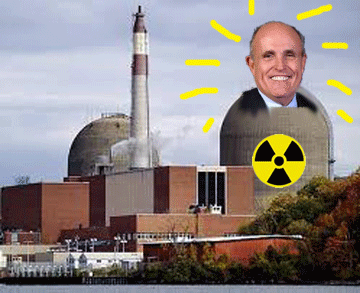 Wake Up and Smell the Radioactive Waste, OpEd News, 20 June 12, By Abby Luby“……Currently at Indian Point, 1,500 tons of high-level irradiated waste is stored in heavy steel and concrete casks on a tarmac a few hundred feet from the Hudson River. The Westchester-based plant produces about 30 tons of radioactive waste every 18 months, which is then crammed into two overcrowded, 40-foot deep spent fuel pools. Each pool holds about 1,000 tons of radioactive waste and has been leaking into the ground and river for years. However, the NRC has maintained that whatever leaches into the river is negligible, reiterating their catch phrase: “Dilution is the solution to pollution.”….
In a study by the Institute for Policy Studies, “Spent Nuclear Fuel Pools in the U.S.: Reducing the Deadly Risks of Storage,” Robert Alvarez, author and senior scholar for nuclear policy, said that Indian Point has three times the radioactivity of Fukushima’s spent fuel pools.
Indian Point is about 30 miles from Manhattan. A 1997 analysis, the Brookhaven National Laboratory [ http://pbadupws.nrc.gov/docs/ML0230/ML023040470.pdf – page 4] estimated a severe fire in a spent-fuel pool would release enough radioactive material to cause as many as 28,000 cancer deaths in a densely populated area and render 188 square miles uninhabitable.
In light of the Fukushima disaster and the potential for future leakage and catastrophic fires, the court ruled that the NRC’s analysis of the impacts of spent fuel storage was insufficient and is now requiring the agency to reassess the environmental impacts of the waste storage. Now it’s up to the NRC to heed the court and truly “protect the health and safety of the public.” http://www.opednews.com/articles/Wake-Up–Smell-the-Radioa-by-Abby-Luby-120614-180.html
1 This Month
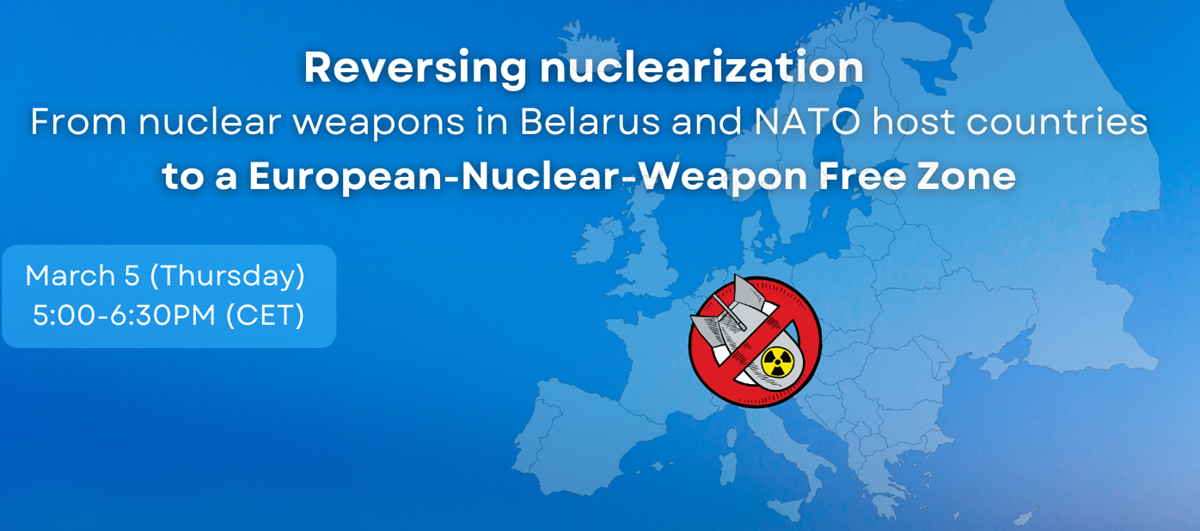
5 March -Online – Reversing nuclearization:
From nuclear weapons in Belarus and NATO host countries to a European-Nuclear-Weapon Free Zone
11am-12:30pm Eastern Time USA / 5pm-6:30pm CET

of the week – Advocating for a
nuclear free beach – https://www.samuellawrencefoundation.org/
The Samuel Lawrence Foundation advocates for a Nuclear Waste Free Beach at San Onofre, join us and take action!

10 March A LIVE WEBINAR THE REAL EFFECTS OF NUCLEAR POWER
What the Industry Isn’t Telling Us
1:00 PM Mountain, 2 pm Central, 3 pm Eastern. Live on the Keepers of the Water Facebook page

18 March Webinar @ 1 PM EST: An Assessment of SMR Projects: The Case of Canada
register for the zoom:
https://us02web.zoom.us/webinar/register/WN_o8BIIOUvQ2ONJR1nta65DQ#/registration

of the week – STOP SMALL MODULAR REACTORS IN CANADA
To see nuclear-related stories in greater depth and intensity – go to https://nuclearinformation.wordpress.com
-
Archives
- March 2026 (51)
- February 2026 (268)
- January 2026 (308)
- December 2025 (358)
- November 2025 (359)
- October 2025 (376)
- September 2025 (258)
- August 2025 (319)
- July 2025 (230)
- June 2025 (348)
- May 2025 (261)
- April 2025 (305)
-
Categories
- 1
- 1 NUCLEAR ISSUES
- business and costs
- climate change
- culture and arts
- ENERGY
- environment
- health
- history
- indigenous issues
- Legal
- marketing of nuclear
- media
- opposition to nuclear
- PERSONAL STORIES
- politics
- politics international
- Religion and ethics
- safety
- secrets,lies and civil liberties
- spinbuster
- technology
- Uranium
- wastes
- weapons and war
- Women
- 2 WORLD
- ACTION
- AFRICA
- Atrocities
- AUSTRALIA
- Christina's notes
- Christina's themes
- culture and arts
- Events
- Fuk 2022
- Fuk 2023
- Fukushima 2017
- Fukushima 2018
- fukushima 2019
- Fukushima 2020
- Fukushima 2021
- general
- global warming
- Humour (God we need it)
- Nuclear
- RARE EARTHS
- Reference
- resources – print
- Resources -audiovicual
- Weekly Newsletter
- World
- World Nuclear
- YouTube
-
RSS
Entries RSS
Comments RSS
 nuclear-news