Boost for solar power in Japan
Odawara, a city of 200,000 south of Tokyo, is setting up its own power company that will install solar panels at public facilities and sell electricity to Tokyo Electric Power Co
Residents who want to install panels on their homes will also get subsidies..
 Japan approves renewable subsidies in shift from nuclear power, Malaysian Insider, TOKYO, June 18 — Japan approved today incentives for renewable energy that
  could unleash billions of dollars in clean-energy investment and help the world’s third-biggest economy shift away from a reliance on nuclear power after the Fukushima disaster.
Industry Minister Yukio Edano approved the introduction of feed-in tariffs (FIT), which means higher rates will be paid for renewable energy. The move could expand revenue from renewable generation and related equipment to more than $30 billion (RM90 billion) by 2016, brokerage CLSA estimates. Continue reading
No relicensing of nuclear reactors until a permanent waste solution is found
Anti-nuclear activist Ben Davis Jr. is also pushing to get a proposition placed on the statewide ballot that would force both California facilities to go offline and remain shuttered until such time as a feasible plan for nuclear waste storage was actually developed.
 Nuclear Waste Must be Considered in Plant Relicensing, San Diego Reader, Dave Rice, June 19, 2012 A June 8 decision from the U.S. Court of Appeals in Washington, D.C. could impact the Nuclear Regulatory Commission’s decision on re-licensing California’s two nuclear plants, as well as dozens of others across the nation.
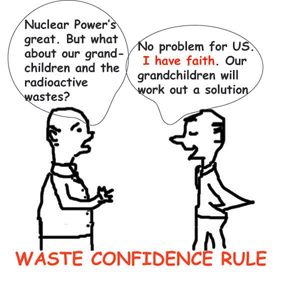
In a 2010 Waste Confidence Decision, the Commission ruled that permanent storage for highly radioactive spent fuel used in the reactors would be available “when necessary,” and said that it would be safe to store the spent fuel on the site of various power plants until a long-term repository became available…. Continue reading
National coalition of environmental groups calls for halt in nuclear plant relicensing
The amount of spent fuel in storage might reach 150,000 metric tons by the year 2050, the appeals court noted in its ruling.
The court case challenged a “Waste Confidence Decision” — essentially the NRC’s estimate of how well issues of spent fuel will be handled in the future.
The environmental groups are concerned because political and environmental concerns have prevented a solution to the issue of how to deal with spent fuel. “The continual, ‘We don’t know what we are going to do with it, but we know it will be all right’ is not sufficient,” said Ed Smith, safe energy director for the Missouri Coalition for the Environment…..
Group petitions for nuclear licensing halt, Columbia Daily Tribune By RUDI KELLER, June 19, 2012 A national coalition of environmental groups is asking that all nuclear licensing — including the Ameren Missouri request to extend the Callaway Nuclear Plant’s life for 20 years — be put on hold until a solution is found for storing nuclear waste. Continue reading
Rosatom, Russia’s secretive, Mafia style, nuclear corporation
In 2002, a Russian scientist, well aware of covert activities by Russian authorities, declared to the Boston Globe that Rosatom is a “super-Mafia.” Secrecy is omnipotent within the governmental organization.

 Russia’s Dangerous Nuclear Legacy – Analysis Eurasia Review, By: Richard Rousseau June 18, 2012“……The post-Cold War world has an elusive international structure. Powerful global corporations, as well as international terrorist organizations, can frustrate a search for clarity and efficiency in fighting illicit activities in finance, economy, the organized crime, or smuggling of nuclear material.
In Russia, the main culprit is Rosatom. This relic of the Soviet system still operates largely
without independent oversight, especially since June 23, 2010, when President Dmitry Medvedev signed a decree that stated that Rostekhnadzor (the Federal Service for Ecological, Technological and Nuclear Supervision) would be henceforth under the direct control of
the government. Rosatom reports to no one in justifying how hundreds of millions of dollars are spent. Continue reading
Japan’s nuclear authority did not pass on information on Fukushima radiation
 The information was passed to the Nuclear and Industrial Safety Agency (NISA) and the science and technology ministry by Japan’s Foreign Ministry but neither agency passed it to the prime minister’s office, which was overseeing the evacuations.
 thousands fled in the same direction as the radioactive material was drifting.
People fled towards Fukushima radiation Stuff.co.nz, 20 June 12 Japanese authorities failed to disclose US data about the spread of radiation spewing from a crippled nuclear plant last year, leaving some evacuees fleeing in the same direction as the radioactive emissions.
News that Japan’s nuclear watchdog and the science and technology ministry sat on the information collected by US military aircraft – another sign of the chaos at the time – is likely to add to mistrust of nuclear power just days after the government approved the restart
of two idled reactors…
.. US military aircraft gathered radiation data from March 17-19 over a 45km radius and found that people in an area about 25km northwest of the plant – where some people were moving – were exposed to the annual permissible level of radiation within eight hours, Japanese media said.
The information was passed to the Nuclear and Industrial Safety Agency (NISA) and the science and technology ministry by Japan’s Foreign Ministry but neither agency passed it to the prime minister’s office, which was overseeing the evacuations. Continue reading
Progress in renewable energy across Europe
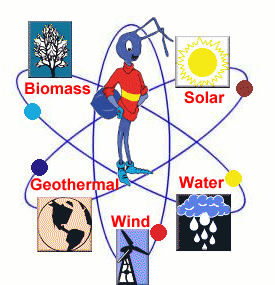 Renewable sources account for nearly 50 percent of energy consumption in Sweden, the overall EU leader in this field.
Latvia, Finland and Austria each use energy that is more than 30 percent renewable, and Portugal’s share is nearly 25 percent,according to Eurostat.
EU Is Embracing Green Energy, Report Shows http://www.courthousenews.com/2012/06/19/47606.htm By WILLIAM DOTINGA (CN) – More than 12 percent of the energy consumed in the European Union comes from renewable sources, a new report shows. The report from Eurostat, the EU’s statistical office, compiles data from 2006 to 2010, the latest year for which data is available.
Three of the EU’s 27 member states – Belgium, France and Hungary – did report 2010 data. Lawmakers passed a directive in 2009 to derive 20 percent of final energy consumption in the EU from renewable sources by 2020. Each member state received a target to reach the aggregate 20 percent target. The individual goals take into account each country’s different
starting points, renewable energy potential and economic performance, according to Eurostat. Continue reading
Uncertainty about the restart of Japan’s other nuclear reactors,
 Uncertain prospects loom for post-Oi reactors, Masayuki Takata / Yomiuri Shimbun 17 June 12, Now that the government has decided to reactivate the Nos. 3 and 4 reactors at the Oi nuclear power plant in Fukui Prefecture, attention has turned to which will be next among the nation’s other 48 idle reactors….
Which reactor will be reactivated next is expected to be left up to a new nuclear regulatory commission to be established in August at the earliest. However, there are no clear prospects for restarting more reactors because it has not been decided how the new organization will
confirm their safety.
At a press conference held Saturday after the four-minister meeting, Economy, Trade and Industry Minister Yukio Edano said the Cabinet would not decide on reactivating the 48 reactors.
“The new regulatory organization will make its own decisions [regarding the safety of the reactors] independently” from the government, Edano said. It is unclear, however, to what extent the nuclear regulatory commission will take the current safety standards into consideration when making its assessments. Continue reading
The “white male effect” – psychologists show that affluent white men are the most accepting of nuclear waste dumps
Where to put nuclear waste? e! science news, , June 19, 2012 Researchers in Finland have found that acceptance of the site of a spent nuclear fuel repository can depend on gender and economic background. Writing in the International Journal of Environmental Technology and Management, the team reports that affluent men more often have a positive opinion on the location of such facilities than women or disadvantaged people.
While the actual quantities of nuclear waste around the globe are relatively small, the disposal or storage of such materials remains a controversial and sensitive issue and one
that is likely to grow if more nuclear power plants are built. Matti Kojo of the University of Tampere and Mika Kari and Tapio Litmanen of the University of Jyväskylä have recently canvassed and analyzed local opinion on the siting of a nuclear waste repository in the
municipality of Eurajoki, Finland. They have demonstrated what they refer to as a “white male effect” associated with acceptance of such facilities close to a residential area…..
http://esciencenews.com/articles/2012/06/19/where.put.nuclear.waste
Nuclear power plants – very vulnerable to terrorism, and to human error
The destruction of a nuclear power plant has the potential to cause much more harm to a country than any other energy facilities.
Russia’s Dangerous Nuclear Legacy – Analysis Eurasia Review, By: Richard Rousseau June 18, 2012“……Of all known sources of energy, nuclear energy entails the highest destructive potential. In the age of terrorism, nuclear power plants are possible prime and high-profile targets for terrorist and transnational criminal groups.
The nuclear threat poses a very specific problem for the world, whether it is the acquisition of
plutonium and highly enriched uranium, acts of sabotage or attempted sabotage at a nuclear facility, or the intensive use of radioactive materials for the fabrication of “dirty” bombs. Continue reading
Design flaws cause safety problems in San Onofre nuclear reactors
An environmental group, Friends of the Earth, has claimed Edison misled the NRC about the changes that it has identified as the likely culprit in excessive tube wear. The federal agency previously disputed that charge, but Collins said that’s under review as part of the
investigation. The group on Monday filed a petition asking the NRC to keep the plant offline until the company amends its license to reflect the design changes……
The NRC has said there is no timetable to restart the reactors.
Feds: Design led to nuke plant woes, Fuel Fix June 18, 2012 by Associated Press CAPISTRANO BEACH, Calif. — After months of investigation, federal regulators have determined that design flaws appear to be the cause of excessive wear in tubing that carries radioactive water through California’s troubled San Onofre nuclear power plant, a top federal regulator said. Continue reading
Progress in Iran nuclear talks, but slight and slow
Some headway in Iran nuclear talks, SMH, Benedikt von Imhoff, Farshid Motahari and Albert Otti June 20, 2012, Iran and six world powers have finally begun making headway on Tehran’s nuclear program in talks in Moscow, but a wide divide remains between the two sides, EU foreign policy chief Catherine Ashton says. Continue reading
Majority of Japanese oppose restart of 2 Oi nuclear reactors
Opinion polls consistently show more than half of Japanese are opposed to nuclear power,
In the communities surrounding Oi, only 38% of residents support the restart of the reactors, the NHK survey found…..
Nuclear-Restart Plans Divide Japan Tokyo Aims to Get Economy Back on Track, but Local Leaders, Some Residents Oppose Atomic Power, WSJ. By MITSURU OBE And CHESTER DAWSON, June 17, 2012, TOKYO—Japan ordered a pair of reactors back online for the first time since last year’s nuclear accident, but the chaos and confusion surrounding the decision highlight how unready the country may still be to restart its atomic-energy engine….
.. the restart decision comes a month ahead of deliberations over a new energy plan, which could call for scrapping nuclear power for good. And the restarts would come a few months before the setup of a new Japanese nuclear regulator, which will craft new safety guidelines and is expected to take a harder line on vetting reactors. Continue reading
International protest at decision to restart 2 Japanese nuclear reactors
Oi decision draws international outcry http://www.japantimes.co.jp/text/nn20120617a4.html#.T9-KwxfZ7D8 Reactor restarts hit by protests from Europe, America, Asia By ERIC JOHNSTON, OSAKA — The decision to restart two reactors at the Oi nuclear plant has sparked international concern, with antinuclear activists and politicians in many countries sending letters of protest and holding rallies outside Japanese embassies and consulates over the past week. Politicians from green parties in Australia and Europe, as well as doctors, activists, and labor unions, have all formally opposed the restart, citing the Fukushima disaster. Continue reading
USA, Iran developed “Flame” computer virus against Iran’s nuclear program
Flame malware developed by US, Israel to slow Iranian nuclear efforts http://www.slashgear.com/flame-malware-developed-by-us-israel-to-slow-iranian-nuclear-efforts-19234747/ Rue Liu, Jun 19th 2012 It turns out that the massive Flame malware attack last month was a sophisticated computer virus developed by the US and Israel in an effort to sabotage Iran’s nuclear program. Citing unnamed Western officials with knowledge of the effort, the Washington Post reported that the attack involved the National Security Agency, the CIA, and Israel’s military as well as the use of the infamous Stuxnet virus. The Flame virus was first discovered last month when Iran detected a series of cyber attacks on its oil industry. Although the attacks were allegedly carried out by Israel alone, the software used was developed in collaboration with the US, adopting much of the same code as the Stuxnet virus.
The virus is said to be the most sophisticated malware discovered to date. Masquerading as a routine Microsoft software, Flame was able to replicate itself across even highly secure networks, control everyday computer functions, send back secret information, log keystrokes, control computer cameras and microphones, take screen shots, and even extract geolocation data from images. Story Timeline…… http://www.slashgear.com/flame-malware-developed-by-us-israel-to-slow-iranian-nuclear-efforts-19234747/
6.5 million petition against restarting Japan’s nuclear reactors
On Friday, Japan’s Nobel literature prize laureate Kenzaburo Oe visited the prime minister’s office and handed the signatures of 6.5 million opposed to the continued use of nuclear reactors.
Japan orders nuclear restart amid protests, Business Recorder, 16 JUNE 2012 TOKYO: Japan ordered nuclear reactors back online on Saturday, defying public sentiment against atomic power following last year’s meltdowns at Fukushima sparked by a huge quake-tsunami disaster. Continue reading
1 This Month

of the week – Shut Down Drone Warfare!


Tell the Ukrainian Government to Drop Prosecution of Peace Activist Yurii Sheliazhenko

Petition to revoke the licensing of the Near Surface Nuclear Disposal Facility (NSDF) at Chalk River. https://www.ourcommons.ca/petitions/en/Petition/Details?Petition=e-7247
To see nuclear-related stories in greater depth and intensity – go to https://nuclearinformation.wordpress.com
-
Archives
- April 2026 (57)
- March 2026 (251)
- February 2026 (268)
- January 2026 (308)
- December 2025 (358)
- November 2025 (359)
- October 2025 (376)
- September 2025 (257)
- August 2025 (319)
- July 2025 (230)
- June 2025 (348)
- May 2025 (261)
-
Categories
- 1
- 1 NUCLEAR ISSUES
- business and costs
- climate change
- culture and arts
- ENERGY
- environment
- health
- history
- indigenous issues
- Legal
- marketing of nuclear
- media
- opposition to nuclear
- PERSONAL STORIES
- politics
- politics international
- Religion and ethics
- safety
- secrets,lies and civil liberties
- spinbuster
- technology
- Uranium
- wastes
- weapons and war
- Women
- 2 WORLD
- ACTION
- AFRICA
- Atrocities
- AUSTRALIA
- Christina's notes
- Christina's themes
- culture and arts
- Events
- Fuk 2022
- Fuk 2023
- Fukushima 2017
- Fukushima 2018
- fukushima 2019
- Fukushima 2020
- Fukushima 2021
- general
- global warming
- Humour (God we need it)
- Nuclear
- RARE EARTHS
- Reference
- resources – print
- Resources -audiovicual
- Weekly Newsletter
- World
- World Nuclear
- YouTube
-
RSS
Entries RSS
Comments RSS
 nuclear-news