San Onofre nuclear plant, do we need its danger?
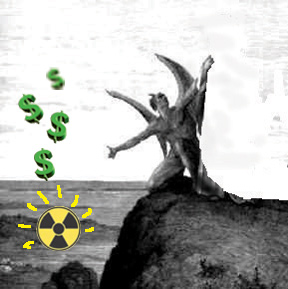 Pasadena is about 70 miles from San Onofre, but 8.5 million people in Orange and San Diego Counties live within 50 miles of the plant and would be in the greatest danger if a serious accident were to occur at San Onofre.
To a great extent, [Japan will implement] a drastic conservation program that will include minimal use of air conditioning and the turning off of all unnecessary lights. Japan has become a living laboratory that will test the feasibility of such a program.
If Japan is successful in eliminating nuclear power, perhaps we can eventually do the same.
Nuclear deals with the devil?, US could learn from Japanese example in reducing nuclear energy dependency, Fourth in a series on the performance of California utilities, Pasadena Weekly, By John Grula 06/14/2012, Southern California Edison (SCE), the investor-owned, for-profit utility that provides electricity to 14 million people in Southern, Central and Coastal California, can’t win for losing.
Only two months after SCE put in a dismal performance during and after the severe windstorm that struck the San Gabriel Valley on the night of Nov. 30-Dec. 1, a performance so bad it has led to an investigation of SCE by the California Public Utilities Commission (CPUC), disaster struck again. On Jan. 31, alarms warned the control room of SCE’s San OnofreNuclear Power Plant that a radiation leak was occurring in one of the
nearly 39,000 newly installed tubes that carry radioactive water in
the plant’s steam generators.
San Onofre, which is located on beachfront property near San Clemente,
is one of two nuclear power generating stations in California, the
other being Diablo Canyon near San Luis Obispo. Pasadena is about 70 miles from San Onofre, but 8.5 million people in Orange and San Diego Counties live within 50 miles of the plant and would be in the greatest danger if a serious accident were to occur at San Onofre.
Given its age (more than 30 years old) and location next to the ocean
in earthquake country, the possibility of a disaster cannot be easily
dismissed.
The discovery of the radiation leaks at San Onofre have led to an
unparalleled shutdown of the plant and several months of intense
investigations by SCE itself and the federal Nuclear Regulatory
Commission (NRC) to determine the extent and cause of the leaks. By
mid-May, about 1,300 tubes had been taken out of service because of
unexpected wear. The wear is dangerous, because tube ruptures could
release large amounts of radioactivity. In an extreme case, ruptures
could also lead to a breakdown in the cooling system for the plant’s
nuclear reactors, a recipe for the meltdown of its nuclear fuel.
Nuclear fuel meltdowns occurred in March 2011 at Japan’s Fukushima
nuclear plant, and huge amounts of radioactivity were released. On
April 4 of this year, the LA Times reported that radioactive iodine
from the Fukushima disaster has been detected in giant kelp growing
along our coast from Laguna Beach to as far north as Santa Cruz. This
clearly demonstrates the widespread distribution of the massive
radioactive leak from the Fukushima plant.
The NRC has forbidden Edison from restarting San Onofre until it
submits a detailed plan for preventing the excessive wear on the
plant’s tubes. When this will happen and when or if San Onofre will
fire up again is anybody’s guess. The problems could be very difficult
and expensive to fix. Several experts have suggested there is a
fundamental flaw in the design of the tubes and their support
structures, according to a story in the May 17 LA Times. And SCE’s
headaches may go well beyond the technical and financial. Within the
last several weeks, US Sen. Barbara Boxer (D-Calif.) has demanded
documentation from SCE and the NRC to see whether Edison fully
informed the NRC about changes in the design of its new generators,
including the flawed tubes and their support structures. …..
Because of the trauma caused by Fukushima, Japan switched off its last
operating nuclear reactor on May 5, leaving the country entirely
without nuclear power. It is not clear when or if any of Japan’s 50
functional reactors will be switched on again, and this is a nation
that once relied on nuclear power for 30 percent of its electricity
needs. How is Japan going to cope with this situation? To a great extent, it will do so by implementing a drastic conservation program that will include minimal use of air conditioning and the turning off of all unnecessary lights. Japan has become a living laboratory that will test the feasibility of such a program.
The US derives about 19 percent of its electricity from nuclear
sources. If Japan is successful in eliminating nuclear power, perhaps we can eventually do the same.
http://www.pasadenaweekly.com/cms/story/detail/nuclear_deals_with_the_devil/11293/
No comments yet.
1 This Month


Tell the Ukrainian Government to Drop Prosecution of Peace Activist Yurii Sheliazhenko

Petition to revoke the licensing of the Near Surface Nuclear Disposal Facility (NSDF) at Chalk River. https://www.ourcommons.ca/petitions/en/Petition/Details?Petition=e-7247


of the week – STOP SMALL MODULAR REACTORS IN CANADA
To see nuclear-related stories in greater depth and intensity – go to https://nuclearinformation.wordpress.com
-
Archives
- March 2026 (176)
- February 2026 (268)
- January 2026 (308)
- December 2025 (358)
- November 2025 (359)
- October 2025 (376)
- September 2025 (258)
- August 2025 (319)
- July 2025 (230)
- June 2025 (348)
- May 2025 (261)
- April 2025 (305)
-
Categories
- 1
- 1 NUCLEAR ISSUES
- business and costs
- climate change
- culture and arts
- ENERGY
- environment
- health
- history
- indigenous issues
- Legal
- marketing of nuclear
- media
- opposition to nuclear
- PERSONAL STORIES
- politics
- politics international
- Religion and ethics
- safety
- secrets,lies and civil liberties
- spinbuster
- technology
- Uranium
- wastes
- weapons and war
- Women
- 2 WORLD
- ACTION
- AFRICA
- Atrocities
- AUSTRALIA
- Christina's notes
- Christina's themes
- culture and arts
- Events
- Fuk 2022
- Fuk 2023
- Fukushima 2017
- Fukushima 2018
- fukushima 2019
- Fukushima 2020
- Fukushima 2021
- general
- global warming
- Humour (God we need it)
- Nuclear
- RARE EARTHS
- Reference
- resources – print
- Resources -audiovicual
- Weekly Newsletter
- World
- World Nuclear
- YouTube
-
RSS
Entries RSS
Comments RSS
 nuclear-news
Leave a comment