Taxpayers’ huge costs for nuclear power mishaps
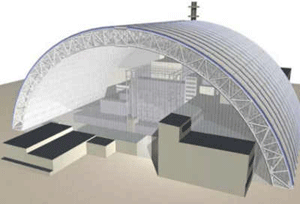 During a visit to Chernobyl in April, I learned about a new project to build, by 2015, a “shelter” to lock in the radiation still emanating from the reactor. The price tag is estimated at 1.5 billion euros ($1.9 billion). But this sarcophagus is no more than a wildly expensive Band-Aid, which will be ripped off a still-festering wound in 100 years.
Then there is the issue of who pays to build such facilities. In principle, private capital does not flow to nonprofit activities. In fact, it is flowing to renewable energy sources, not atomic.
It is governments—and thus taxpayers and bondholders—that finance nuclear plants. Moreover, the alleged “cost-savings” of nuclear power never include the price tag for direct and indirect governmental subsidies, decommissioning of aging facilities, and emergency cleanup and remediation of impacted communities when disasters occur—all, again, at taxpayers’ expense.

The road from Chernobyl, By: Alexander Likhotal, Philippine Daily Inquirer, June 11th, 2012 “……. While nuclear energy’s advocates often claim that there have been only two major calamities, a very different picture emerges if we consider other “accidents” that caused loss of human life or significant property damage.
Between 1952 and 2009, at least 99 nuclear accidents met this definition worldwide, at a cost of more than $20.5 billion, or more than one incident and $330 million in damage every year. This recurrence rate demonstrates that many risks are not being properly managed or regulated, which is worrying, to say the least, especially given the harm that even a single serious accident can cause.
The meltdown of a 500-megawatt reactor located 50 kilometers (31 miles) from a city would cause the immediate death of an estimated 45,000 people, injure roughly another 70,000, and cause $17 billion in property damage.
During a visit to Chernobyl in April, I learned about a new project to build, by 2015, a “shelter” to lock in the radiation still emanating from the reactor. The price tag is estimated at 1.5 billion euros ($1.9 billion). But this sarcophagus is no more than a wildly expensive Band-Aid, which will be ripped off a still-festering wound in 100 years, by which point, it is hoped, a permanent solution will have been found.
A 30-km exclusion zone still rings Chernobyl, leaving once-fertile
lands unable to be tended by local farmers. In Belarus alone, roughly
8,000 square kilometers of farmland, an area almost the same size as
all of Switzerland’s agricultural terrain, has been rendered by
radiation unusable for ages.
Then there is the issue of who pays to build such facilities. In principle, private capital does not flow to nonprofit activities. In fact, it is flowing to renewable energy sources, not atomic. According
to a 2012 Pew Charitable Trusts report, the United States, for
example, invested more than $48 billion in renewable energy in 2011,
up from $34 billion in 2010, regaining first place in the global
clean-energy investment rankings.
It is governments—and thus taxpayers and bondholders—that finance nuclear plants. Moreover, the alleged “cost-savings” of nuclear power never include the price tag for direct and indirect governmental subsidies, decommissioning of aging facilities, and emergency cleanup and remediation of impacted communities when disasters occur—all, again, at taxpayers’ expense.
At Fukushima, for example, the bill will include the costs of the
heroic efforts by hundreds of workers to cool down the plant’s
reactors; the protracted loss of economic output in the 20-km
exclusion zone (estimated at $128.5 billion by Roubini Global
Economics); decommissioning and cleanup costs; and the costs of
replacing 4.7 gigawatts of generating capacity. On top of that, there
is the possibility of health-care costs resulting from exposure to
radioactivity.
All of these hidden costs make the price of nuclear energy higher than
the price of shifting to renewable energies and improving energy
efficiency. Of course, with 15 countries relying on nuclear power for
25 percent or more of their electricity, we cannot abandon it
overnight. On the contrary, nuclear plants will be with us for years
to come…… http://opinion.inquirer.net/30395/the-road-from-chernobyl
No comments yet.
1 This Month

of the week – Shut Down Drone Warfare!


Tell the Ukrainian Government to Drop Prosecution of Peace Activist Yurii Sheliazhenko

Petition to revoke the licensing of the Near Surface Nuclear Disposal Facility (NSDF) at Chalk River. https://www.ourcommons.ca/petitions/en/Petition/Details?Petition=e-7247
To see nuclear-related stories in greater depth and intensity – go to https://nuclearinformation.wordpress.com
-
Archives
- April 2026 (103)
- March 2026 (251)
- February 2026 (268)
- January 2026 (308)
- December 2025 (358)
- November 2025 (359)
- October 2025 (376)
- September 2025 (257)
- August 2025 (319)
- July 2025 (230)
- June 2025 (348)
- May 2025 (261)
-
Categories
- 1
- 1 NUCLEAR ISSUES
- business and costs
- climate change
- culture and arts
- ENERGY
- environment
- health
- history
- indigenous issues
- Legal
- marketing of nuclear
- media
- opposition to nuclear
- PERSONAL STORIES
- politics
- politics international
- Religion and ethics
- safety
- secrets,lies and civil liberties
- spinbuster
- technology
- Uranium
- wastes
- weapons and war
- Women
- 2 WORLD
- ACTION
- AFRICA
- Atrocities
- AUSTRALIA
- Christina's notes
- Christina's themes
- culture and arts
- Events
- Fuk 2022
- Fuk 2023
- Fukushima 2017
- Fukushima 2018
- fukushima 2019
- Fukushima 2020
- Fukushima 2021
- general
- global warming
- Humour (God we need it)
- Nuclear
- RARE EARTHS
- Reference
- resources – print
- Resources -audiovicual
- Weekly Newsletter
- World
- World Nuclear
- YouTube
-
RSS
Entries RSS
Comments RSS
 nuclear-news
Leave a comment