Comparing USA nuclear reactors with Fukushima reactors
nuclear reactors in the United States were built during the same time period as the Fukushima reactor, before 1980. These reactors were all built using the same 80-year-old technology, which is to say they’re all just as outdated as Fukushima and the materials and equipment used are all beginning to show the same signs of wear and tear.
 What makes this scenario even more alarming is that Gundersen says the reactors in the United States hold 4-5 times more nuclear waste than the Fukushima reactor.
Fukushima forum: Arnie Gundersen compares U.S. and Japanese nuclear reactors http://www.examiner.com/article/fukushima-forum-arnie-gundersen-compares-u-s-and-japanese-nuclear-reactors by Donna Anderson, 10 June 12 John B. Wells was at the helm for the Fukushima forum on the Saturday, June 9, 2012 edition of Coast to  Coast AM . The first guest was Arnie Gundersen who appeared on the show to share his expertise in the area of nuclear engineering and to make the American public more aware of the potential danger hiding in their own backyard.
Gundersen, who holds a master’s degree in nuclear engineering, has manged and coordinated design efforts for 70 nuclear reactors in the United States and has more than 40 years experience in nuclear power engineering. He’s currently working on the AP1000 nuclear power generator being built in South Carolina.
According to Gundersen the nuclear reactors in the United States were built during the same time period as the Fukushima reactor, before 1980. These reactors were all built using the same 80-year-old technology, which is to say they’re all just as outdated as Fukushima and the materials and equipment used are all beginning to show the same signs of wear and tear.
Gundersen explained that the Fukushima reactor was built to withstand a 7.5 magnitude earthquake but that’s all it did, it survived. Tokyo Electric confirms that unit 4 is already wobbling and it has a bulge in the side. One more quake and over it goes, and that particular area of Japan is extremely prone to high magnitude earthquakes.
Gundersen revealed that there are currently 27 reactors in the United States that are in the same precarious position as Fukushima. These 27 reactors all lie in earthquake-prone areas of the eastern United States. The most volatile situation is with the reactor located in Indian Point, 25 miles outside of New York. There’s a fault located a couple of miles north of the plant that designers were unaware of at the time of construction.
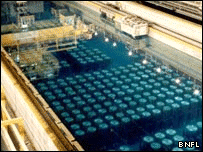
The spent fuel rods at Fukushima are being stored in a pool of water that’s 7 stories off the ground. As Gundersen said, “It’s very heavy, like putting a pool on top of a hotel.”
But it’s a cheap solution. The best solution, explained Gundersen, would be to encase the spent rods in some type of heavily shielded dry cast and bury them underground, but now it’s too late. Even if we were to make that decision it would take 10 years from the time you shut down a power plant until it’s safe to even open the fuel pool to remove the rods.
And then there’s the problem of transporting and trying to find somewhere to bury all of that nuclear waste. According to Gundersen, “The amount of radiation in the fuel pool at Fukushima’s Unit 4 is roughly equivalent to all of the cesium that was exploded in all of the 700 above ground nuclear tests we did in the 1950s, ’60s and ’70s.”
What makes this scenario even more alarming is that Gundersen says the reactors in the United States hold 4-5 times more nuclear waste than the Fukushima reactor.
When asked about a worst case scenario at Fukushima, Gundersen explained that another Richter 7 earthquake would crack the fuel pool and/or topple the entire building. The spent nuclear rods inside the pool are still so hot that they could ignite in the air. Initially, says Gundersen, “A fuel pool that’s a lot less full than Fukushima could cause 186,000 fatalities.” And that doesn’t take into consideration the long-term effects of radioactive fall-out.
No comments yet.
1 This Month

of the week – Shut Down Drone Warfare!


Tell the Ukrainian Government to Drop Prosecution of Peace Activist Yurii Sheliazhenko

Petition to revoke the licensing of the Near Surface Nuclear Disposal Facility (NSDF) at Chalk River. https://www.ourcommons.ca/petitions/en/Petition/Details?Petition=e-7247
To see nuclear-related stories in greater depth and intensity – go to https://nuclearinformation.wordpress.com
-
Archives
- April 2026 (103)
- March 2026 (251)
- February 2026 (268)
- January 2026 (308)
- December 2025 (358)
- November 2025 (359)
- October 2025 (376)
- September 2025 (257)
- August 2025 (319)
- July 2025 (230)
- June 2025 (348)
- May 2025 (261)
-
Categories
- 1
- 1 NUCLEAR ISSUES
- business and costs
- climate change
- culture and arts
- ENERGY
- environment
- health
- history
- indigenous issues
- Legal
- marketing of nuclear
- media
- opposition to nuclear
- PERSONAL STORIES
- politics
- politics international
- Religion and ethics
- safety
- secrets,lies and civil liberties
- spinbuster
- technology
- Uranium
- wastes
- weapons and war
- Women
- 2 WORLD
- ACTION
- AFRICA
- Atrocities
- AUSTRALIA
- Christina's notes
- Christina's themes
- culture and arts
- Events
- Fuk 2022
- Fuk 2023
- Fukushima 2017
- Fukushima 2018
- fukushima 2019
- Fukushima 2020
- Fukushima 2021
- general
- global warming
- Humour (God we need it)
- Nuclear
- RARE EARTHS
- Reference
- resources – print
- Resources -audiovicual
- Weekly Newsletter
- World
- World Nuclear
- YouTube
-
RSS
Entries RSS
Comments RSS
 nuclear-news
Leave a comment