The resuscitation of the nuclear industry is failing, because of costs
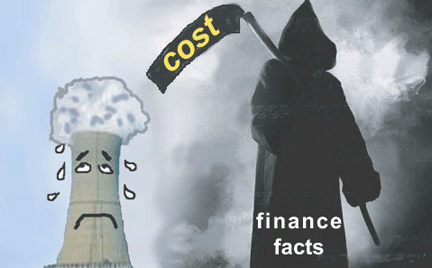 Nuclear Europe: a dream unwinding, China Dialogue, Steve Thomas June 06, 2012“…”…….If Europe’s governments have been jolted by the aftermath of Fukushima, the big energy companies have been violently shaken. Nuclear has long been an attractive option for the major operators because the massive demands placed on plant-builders effectively rule out entry by new competitors – unlike smaller-scale decentralised technologies, which allow scope for small companies to join in. ….
On cost, the promise was that these reactors could be built for US$1,000 (6,300 yuan) per kilowatt of capacity. That would bring a 1,700-megawatt EPR in at US$1.7 billion (10.8 billion yuan). At that price, it was claimed their power would be competitive with the cheapest option, natural gas. Today, even before any of these designs have entered service, the cost estimates are five to six times that level, and there is no sign that they have stopped rising.
On finance, the mandatory opening up of European electricity systems to competition has extinguished the assumption that consumers will underwrite whatever costs are incurred. That means the financial risk falls on the owner, not consumers. Financiers don’t like that equation, especially for a technology with as poor a record for being built to time and cost and operating reliably as nuclear power. Consumers always pay, but plant owners can go bankrupt losing money lent to them by banks.
It has become increasingly clear that a nuclear-power plant will struggle to find finance if destined to operate unprotected in a competitive market. The disastrous Olkiluoto and Flamanville projects suggest the promise of “buildability” was also fanciful – and will have made financiers even more sceptical…. . http://www.chinadialogue.net/article/show/single/en/4956
No comments yet.
1 This Month

of the week – Shut Down Drone Warfare!


Tell the Ukrainian Government to Drop Prosecution of Peace Activist Yurii Sheliazhenko

Petition to revoke the licensing of the Near Surface Nuclear Disposal Facility (NSDF) at Chalk River. https://www.ourcommons.ca/petitions/en/Petition/Details?Petition=e-7247
To see nuclear-related stories in greater depth and intensity – go to https://nuclearinformation.wordpress.com
-
Archives
- April 2026 (114)
- March 2026 (251)
- February 2026 (268)
- January 2026 (308)
- December 2025 (358)
- November 2025 (359)
- October 2025 (376)
- September 2025 (257)
- August 2025 (319)
- July 2025 (230)
- June 2025 (348)
- May 2025 (261)
-
Categories
- 1
- 1 NUCLEAR ISSUES
- business and costs
- climate change
- culture and arts
- ENERGY
- environment
- health
- history
- indigenous issues
- Legal
- marketing of nuclear
- media
- opposition to nuclear
- PERSONAL STORIES
- politics
- politics international
- Religion and ethics
- safety
- secrets,lies and civil liberties
- spinbuster
- technology
- Uranium
- wastes
- weapons and war
- Women
- 2 WORLD
- ACTION
- AFRICA
- Atrocities
- AUSTRALIA
- Christina's notes
- Christina's themes
- culture and arts
- Events
- Fuk 2022
- Fuk 2023
- Fukushima 2017
- Fukushima 2018
- fukushima 2019
- Fukushima 2020
- Fukushima 2021
- general
- global warming
- Humour (God we need it)
- Nuclear
- RARE EARTHS
- Reference
- resources – print
- Resources -audiovicual
- Weekly Newsletter
- World
- World Nuclear
- YouTube
-
RSS
Entries RSS
Comments RSS
 nuclear-news
Leave a comment