The week that was, in nuclear news

Christina Macpherson’s websites & blogs
Renewable energy is where it’s all happening – from IRENA’s report on rapidly falling costs, and increasing investment – to the solar-powered plane that made a transcontinental journey. In recent hot days, solar power delivering high levels of electricity in Germany, UK, and USA (Massachusets)
Climate change is affecting nuclear reactors – due to heating of river waters . A problem which is likely to get worse, and cause frequent shutdowns
Nuclear power’s financial crisis. Nuclear companies scrambling to compete for overseas sales are now offering prices below their costs. Nuclear ‘dumping’ going on in the market? European countries – some abandoning nuclear power, others – England struggling with finance. France has huge problem as so many aging reactors near to closing
Japan‘s government mulling over 4 future energy options – 3 of which contain little or even no, nuclear power. Government wants to restart 2 nuclear reactors, but public opposition to that is growing, including opposition from MP’s in Japan’s ruling party. Japanese govt planning controversial “wide area incineration” of radioactive debris.
USA. New Vogtle nuclear power plant is turning out to be a money pit, cost overruns about $1 billion already, and they’ve only just started the build. NRC considering relicensing nuclear reactors so that they can run for 80years!
China. With an organised anti nuclear group campaigning, and concerns over costs, China’s new nuclear build is not yet happening – and the global nuclear lobby is watching China, anxiously.
Spain. Antinuclear activists fly over a nuclear reactor, drop smoke bombs on it – to demonstrate security risks.
Falling costs of renewable energy – International Renewable Energy Agency
 Renewable energy costs falling: Agency http://finance.ninemsn.com.au/newsbusiness/aap/8479949/renewable-energy-costs-falling-agency 7 June 12, Power from renewable energy sources is getting cheaper every year, according to a newly-released study, challenging long-standing myths that clean energy technology is too expensive to adopt.According to the study by the Abu Dhabi-based International Renewable Energy Agency and released on Wednesday, the costs associated with extracting power from solar panels has fallen as much as 60 per cent in just the past few years.
The price of generating power from other renewables, including wind, hydro power, concentrating solar power and biomass, was also falling.
“One of the (myths) out there perpetuated by industry lobby groups is that renewable energy is too expensive,” said Adnan Amin, IRENA’s director general. The numbers tell a different story, however, as “costs are falling
exponentially … and will continue (to do so) in the future,” said Amin arguing that electricity generation “is now cost-competitive with many traditional fossil fuel technologies”.
According to Dolf Gielen, director of IRENA’s innovation and technology centre, investment in renewables is no longer a niche but rather represents the “bulk of investments in global power generation,” accounting for half of the total annual capacity additions worldwide. ”The markets are growing very fast… and further cost reductions are
very likely,” he said adding that in 2011, investments in the supply side of renewable energy sources reached about $US260 billion ($A267.70 billion).
A second IRENA study released on Wednesday estimates renewables will create a minimum of four million jobs just in the electricity sector in rural areas of the developing world. Today, there are five million jobs world-wide in the renewable energy sector and more than 1.3 billion people, mainly in Africa and Asia, who do not have access to electricity, according to IRENA. ”There is considerable employment potential,” said Amin.
Founded in 2009, IRENA is an intergovernmental organisation established to promote the widespread use of renewable energy sources. It has more than 155 member states and is headquartered in Abu Dhabi.
Japan’s energy future could be nuclear free
 Japan considers nuclear-free future Options require big boost for renewable energy sources. Nature, David Cyranoski 06 June 2012 It’s official: nuclear power will have a much smaller role in Japan’s energy future than was once thought. Since the meltdowns and gas explosions at the Fukushima Daiichi nuclear power station in March 2011, all of Japan’s remaining reactors have been shut down for inspections and maintenance.
Last week the government offered a glimpse of their future, and that of the country’s nuclear power in general, when it published an outline of four ways to satisfy Japan’s future energy demands. One scenario recommends using a market mechanism to determine the nuclear contribution. Under the other three, nuclear power would supply at most one-quarter of Japan’s energy by 2030 — and in one case, none at all. Continue reading
The unraveling of Europe’s nuclear dream
And, no doubt, new technologies will be proposed that promise to solve all the problems of the past, while utilities will fight tooth and nail to keep existing plants online long after their expected life-span is complete.
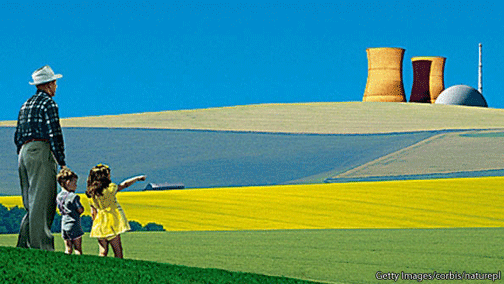
 Nuclear Europe: a dream unwinding, China Dialogue, Steve Thomas June 06, 2012“ Francois Hollande’s election victory is the latest blow to an industry struggling to revive the optimism of pre-Fukushima days. But the seeds of crisis were there well before Japan’s disaster, writes Steve Thomas. Prospects for nuclear power in post-Fukushima Europe are looking grim. Since the reactor meltdown in Japan last year, Germany, Switzerland and Italy have imposed phase-outs or abandoned attempts to start ordering new nuclear plants; the British programme has been delayed and one of the two remaining potential investors has dropped out; foreign investors are walking away from projects in eastern Europe, for example in Bulgaria and Romania; and France has elected a new president on an apparently anti-nuclear ticket.
With the leaders of Germany and France – two of Europe’s most powerful economies – now firmly in the “anti” camp, the outlook for nuclear power on the continent more widely is distinctly ropy. The Fukushima nuclear disaster of 2011, it seems on first glance, has been a devastating pill.
But while there is little doubt that the crisis in Japan significantly worsened the chances of a nuclear-powered Europe, it did so mainly by exacerbating problems that were already there – around cost, finance and public acceptance. It’s worth taking a moment to look at how these dynamics are playing out across the continent, and how they might impact Europe’s long-term energy agenda. Continue reading
China the nuclear lobby’s great hope – or is it?
Public opinion could also pose an obstacle. In a poll carried out by research agency Ipsos MORI after Fukushima, 42% of those surveyed in China were supportive of nuclear power – but that 48% were opposed. It
is also reported that public opposition and environmental concerns have led to the delay in construction of three inland nuclear power sites.
China’s nuclear developments probably matter more to the rest of the world than they do to China.

 Chinese nuclear goes global? China dialogue Antony Froggatt June 06, 2012 From Parisian boardrooms to Kazakh uranium mines, the nuclear industry anxiously awaits news from Beijing. …….
“…… the Fukushima crisis in Japan has had a significant – and under reported – impact on Chinese nuclear developments, triggering a freeze on the start of new construction, a re-consideration of the safety standards of domestic designs and unprecedentedly visible opposition to the building of new, inland nuclear plants. Continue reading
Nuclear companies compete desperately for sales, prices offered below costs!

 French Nuclear Watchdog Says Orders Won At Too-Low Prices Bloomberg, By Francois de Beaupuy – Jun 6, 2012 Nuclear-reactor makers are offering prices too low to cover costs to win orders abroad in a strategy that puts earnings at risk, the head of the industry’s watchdog in France said. “Export contracts for nuclear plants are being obtained at pure dumping-level prices,” Andre-Claude Lacoste, head of the Autorite de Surete Nucleaire regulator, said today at a conference organized by L’Usine Nouvelle magazine in Paris.
“Prices accepted by vendors and obtained by buyers are unsustainable,” Lacoste said. “There aren’t many tenders, which is why competitors are ripping each other off. It’s already a serious matter, and we need to make sure that there’s no dumping on safety on top of that.”
Areva SA (AREVA), the world’s largest provider of nuclear equipment and services, has booked more than 2.8 billion euros ($3.5 billion) of costs since 2005 because of delays and cost overruns at an atomic plant it’s building in Finland. The Paris-based company and General Electric Co. (GE) were beaten in 2009 on a four- reactor order in the United Arab Emirates by Korea Electric Power Corp. (KEP) in the Seoul-based company’s first export contract……. Areva is preparing
bids or in talks to sell reactors in countries including China, India, the U.K., the Czech Republic and Poland. In Finland, Areva faces GE Hitachi Nuclear Energy, Korea Hydro & Nuclear Power Co., Mitsubishi Heavy Industries Ltd. (7011) and Toshiba Corp. (6502) in a tender next year. http://www.bloomberg.com/news/2012-06-06/french-nuclear-watchdog-says-orders-won-at-too-low-prices.html
Vogtle nuclear power project – a money pit?
 A lot is at stake in the Vogtle project. The new breed of reactors being built at the site — featuring advanced standardized design, streamlined licensing and new construction techniques — are supposed to keep costs steady and bring projects in close to budget and on schedule.
That in turn is supposed to spur a new golden era for nuclear power.
Cost overruns of almost $1 billion — so far — at Ga. nuke reactors June 6, 2012, by Jay Bookman Last month, a consortium of utilities including Atlanta-based Southern Company announced cost overruns of almost $1 billion at two new nuclear reactors being built near Waynesboro.
That’s an arresting number under any circumstances, but it looms even larger when you realize that major construction on the Vogtle 3 and 4 reactors has basically just begun, with at least five more years of construction to come.
And if costs soar, who’s going to pay for it? Southern Company and its subsidiary, Georgia Power, own 45.7 percent of the project, so its ratepayers’ share of these recent overruns would come to more than $400 million. But according to Buzz Miller, Southern’s executive vice president of nuclear development, that cost will be borne by contractors who are building the project. Continue reading
The resuscitation of the nuclear industry is failing, because of costs
 Nuclear Europe: a dream unwinding, China Dialogue, Steve Thomas June 06, 2012“…”…….If Europe’s governments have been jolted by the aftermath of Fukushima, the big energy companies have been violently shaken. Nuclear has long been an attractive option for the major operators because the massive demands placed on plant-builders effectively rule out entry by new competitors – unlike smaller-scale decentralised technologies, which allow scope for small companies to join in. ….
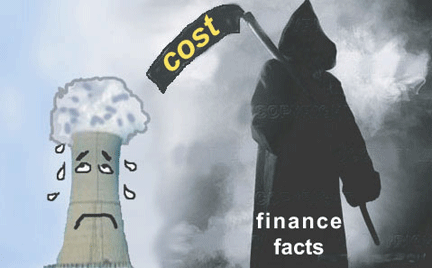
On cost, the promise was that these reactors could be built for US$1,000 (6,300 yuan) per kilowatt of capacity. That would bring a 1,700-megawatt EPR in at US$1.7 billion (10.8 billion yuan). At that price, it was claimed their power would be competitive with the cheapest option, natural gas. Today, even before any of these designs have entered service, the cost estimates are five to six times that level, and there is no sign that they have stopped rising.
On finance, the mandatory opening up of European electricity systems to competition has extinguished the assumption that consumers will underwrite whatever costs are incurred. That means the financial risk falls on the owner, not consumers. Financiers don’t like that equation, especially for a technology with as poor a record for being built to time and cost and operating reliably as nuclear power. Consumers always pay, but plant owners can go bankrupt losing money lent to them by banks.
It has become increasingly clear that a nuclear-power plant will struggle to find finance if destined to operate unprotected in a competitive market. The disastrous Olkiluoto and Flamanville projects suggest the promise of “buildability” was also fanciful – and will have made financiers even more sceptical…. . http://www.chinadialogue.net/article/show/single/en/4956
Vigourous and organised opposition to nuclear power in China
many of the companies building nuclear power plants and the government have not held honest discussions with stakeholders and are unwilling to provide adequate information. The Ministry of Environmental Protection rejected Caixin’s application for more information on documents related to the Pengze plant’s environmental assessment.
“Our actions are divided into three phases: official, media and litigation,” Wang said. Petitioning the government was the first step, and using the media to attract attention the second. “If this still doesn’t work, we can only move to litigation. In the next step, we’ll sue whichever departments approved construction of the Pengze nuclear plant, and we’ll sue to the end.”
 Ex-officials battle China nuclear plant plan, Market watch,Retired officials vigorously battle China nuclear power plant plan By Cui Zheng BEIJING ( Caixin Online ) —”… the meltdown on March 11, 2011, is still fresh on the minds of four retired cadres in Wangjiang County.
They petitioned against the Pengze nuclear power project in neighboring Jiangxi Province and ultimately convinced their local government to oppose the plan. This kind of official opposition to a nuclear undertaking is almost unheard of in China. Continue reading
Japan having “just a bump on the road” to nuclear renaissance?
 An Unexpected Bump on the Road to Oi Restarts By Toko Sekiguchi WSJ, June 6, 2012, Japan’s prime minister is encountering unexpected opposition to his quest to bring two nuclear reactors back online in the next few weeks: lawmakers from his own party.
More than a third of the legislators from the ruling Democratic Party of Japan submitted to Prime Minister Yoshihiko Noda a petition Tuesday urging him to exercise “greater caution” over restarting the No. 3 and 4 reactors at the Oi nuclear plant in western Japan, run by Kansai Electric Power Co.
“Most of the public are of the opinion that we should overcome this summer’s energy needs through conservation and flexibility,” the petition said, signed by 117 members of the DPJ. At issue is what to do with Japan’s fleet of 50 nuclear reactors, …. Critics — including
the popular mayor of Osaka, and the 117 DPJ petitioners — have questioned just how safe the reactors are, and how prepared utilities are should another accident happen.
http://blogs.wsj.com/japanrealtime/2012/06/06/an-unexpected-bump-on-the-road-to-oi-restarts/
China raising funds to launch nuclear power, but public sentiment is “fragile”
China to Stoke Nuclear Power, WSJ 6 June 12, State-Owned Firm Plans IPO to Fund Reactors; $5.4 Billion Deal Is Possible BEIJING—China National Nuclear Power Co. said it is planning a Shanghai initial public offering that will go toward financing part
of five power projects worth 173.5 billion yuan ($27.2 billion), in a multibillion-dollar deal that signals that the country’s ramp-up of nuclear power is moving forward..
… China National Nuclear Power, according to a statement on the environmental ministry website, will sell shares to raise funds for nuclear-power projects in Fujian, Zhejiang, Hainan and Jiangsu provinces, the statement said, adding that these projects were approved by China’s National Development and Reform Commission between 2008 and 2010. Those projects require 173.5 billion yuan in funding,…
the IPO could be asking a lot of the country’s equity markets. The commission hasn’t approved any sizable IPOs since May, when the regulator gave the green light to China Postal Express & Logistics Co.’s potentially 9.98 billion yuan deal, though that has yet to
launch. Since early May, the benchmark Shanghai Composite Index is down 4%.
“A big IPO would weigh on the stock market further as it would divert funds from the secondary market, especially when the sentiment remains fragile,” said Yang Delong, a fund manager at China Southern Fund….. http://online.wsj.com/article/SB10001424052702303665904577449784005256706.html?mod=googlenews_wsj
France’s nuclear dilemma – costs of shutting aged reactors
Nuclear Europe: a dream unwinding, China Dialogue, Steve Thomas June 06, 2012“…… the real challenge – regardless of whether Hollande or Sarkozy had won the election – was always going to be what to do about France’s existing plants when they reach the end of their lives. Under present plans, these ageing reactors will be retired at a rate of five to six per year from 2017 onwards. The cheaper option for the country’s power giant EDF would be to do as the Americans and extend the plants’ lifespans from 40 to 60 years, though thanks to post-Fukushima regulatory requirements that existing plants be made more robust for “extreme situations” this is not such a cheap option as it once was.
On the other hand, if France takes the route of replacing old reactors with EPRs, assuming problems around cost, licensing and construction can be solved, and the EPR remains a viable option, then the cost to EDF of replacing old capacity would be astronomical – far higher than first time around. It is doubtful that France could sustain the logistical and financial challenge of ordering and building four or five EPRs a year for a decade. It would also have to start paying huge sums for decommissioning existing reactors. That leaves France facing some tough choices…. http://www.chinadialogue.net/article/show/single/en/4956
1 This Month

of the week – Shut Down Drone Warfare!


Tell the Ukrainian Government to Drop Prosecution of Peace Activist Yurii Sheliazhenko

Petition to revoke the licensing of the Near Surface Nuclear Disposal Facility (NSDF) at Chalk River. https://www.ourcommons.ca/petitions/en/Petition/Details?Petition=e-7247
To see nuclear-related stories in greater depth and intensity – go to https://nuclearinformation.wordpress.com
-
Archives
- April 2026 (114)
- March 2026 (251)
- February 2026 (268)
- January 2026 (308)
- December 2025 (358)
- November 2025 (359)
- October 2025 (376)
- September 2025 (257)
- August 2025 (319)
- July 2025 (230)
- June 2025 (348)
- May 2025 (261)
-
Categories
- 1
- 1 NUCLEAR ISSUES
- business and costs
- climate change
- culture and arts
- ENERGY
- environment
- health
- history
- indigenous issues
- Legal
- marketing of nuclear
- media
- opposition to nuclear
- PERSONAL STORIES
- politics
- politics international
- Religion and ethics
- safety
- secrets,lies and civil liberties
- spinbuster
- technology
- Uranium
- wastes
- weapons and war
- Women
- 2 WORLD
- ACTION
- AFRICA
- Atrocities
- AUSTRALIA
- Christina's notes
- Christina's themes
- culture and arts
- Events
- Fuk 2022
- Fuk 2023
- Fukushima 2017
- Fukushima 2018
- fukushima 2019
- Fukushima 2020
- Fukushima 2021
- general
- global warming
- Humour (God we need it)
- Nuclear
- RARE EARTHS
- Reference
- resources – print
- Resources -audiovicual
- Weekly Newsletter
- World
- World Nuclear
- YouTube
-
RSS
Entries RSS
Comments RSS
 nuclear-news