USA’s Nuclear Regulatory Commission’s real role is to PROMOTE nuclear power
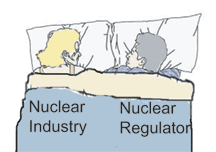
 Nuclear Rubberstamp Commission HUFFINGTON POST, Karl Grossman, 05/30/2012“… The resignation last week of the chairman of the U.S. Nuclear Regulatory Commission is another demonstration of the bankrupt basis of the NRC. Gregory Jaczko repeatedly called for the NRC to apply “lessons learned” from the Fukushima Daiichi nuclear plant disaster in Japan. And, for that, the nuclear industry — quite successfully — went after him fiercely.
The New York Times, in an editorial over the weekend , said that President Obama’s choice to replace Jaczko, Allison Macfarlane, “will need to be as independent and aggressive as Dr. Jaczko.”
That misses the institutional point.
The NRC was created in 1974 when Congress abolished the U.S. Atomic Energy Commission after deciding that the AEC’s dual missions of promoting and at the same time regulating nuclear power were deemed a conflict of interest. The AEC was replaced by the NRC, which was to regulate nuclear power, and a Department of Energy was later formed to advocate for it.
However, the same extreme pro-nuclear culture of the AEC continued on at the NRC. It has partnered with the DOE in promoting nuclear power.
Indeed, neither the AEC, in its more than 25 years, nor the NRC, in its nearly 30 years, ever denied an application for a construction or operating license for a nuclear power plant anywhere, anytime in the United States.
The NRC is a rubberstamp for the nuclear industry. “NRC stands for Nuclear Rubberstamp Commission,” says Kevin Kamps of the organization Beyond Nuclear. And it isn’t that Jaczko opposed nuclear power. “Greg is not anti-nuclear, but he’s pro-nuclear in a smart and considered way,” says Christopher Paine , director of the nuclear program at the Natural Resources Defense Council.
Since the Fukushima accident began last March 11, Jaczko, who has a Ph.D. in physics, has called on the NRC to recognize and incorporate in its rules and actions, the gravity of that catastrophe. As he declared as his four fellow NRC members approved the construction of two nuclear plants in Georgia in February — the first okay for new nuclear plants in the U.S. in years: “I cannot support issuing this license as if Fukushima had never happened.”
“Greg has led a Sisyphean fight against some of the nuclear industry’s opponents of strong, lasting regulations, often serving as the lone vote,” commented Congressman Edward Markey of Massachusetts after the Jaczko resignation.
The nuclear industry and promoters of nuclear power in government would have us believe that Fukushima means nothing. As the American Nuclear Society asserts on its website : “No public ill effects are expected from the Fukushima incident.”
In reality, the consequences — in Japan and all over the world — are expected to be enormous. They’ll be worse than the impacts of the Chernobyl disaster, says Dr. Alexey Yablokov, a biologist and lead scientist of the book published by the New York Academy of Science in 2009, Chernobyl: Consequences of the Catastrophe for the People and the Environment. It reported that now-available medical data shows that that 985,000 people died worldwide between 1986, the year of the Chernobyl accident, and 2004 from the radioactivity released.
“The Fukushima disaster will be worse than Chernobyl,” agrees Dr. Janette Sherman, a toxicologist and the book’s editor. That’s because Fukushima involves, she notes, not one but six nuclear plants along with spent fuel pools, in a “far more populated” area than the Chernobyl plant, and the radioactive discharges from Fukushima have continued for months.
Importantly, a new report by a noted European science institute has determined that Chernobyl and Fukushima were not isolated occurrences. “Severe Nuclear Reactor Accidents Likely Every 10 to 20 Years,” was the headline of the article last week on the report in Science Daily.
“Catastrophic nuclear accidents such as the core meltdowns in Chernobyl and Fukushima are more likely to happen than previously assumed,” said Science Daily, about the report by scientists at the Max Planck Institute for Chemistry in Mainz, Germany. Based on “the number of nuclear meltdowns that have occurred,” they “calculated that such events may occur once every 10 to 20 years.”
And impacts would be global — like Chernobyl and Fukushima. Their computer analyses, said Science Daily , found for the leading radioactive poison discharged in a nuclear plant accident, Cesium-137, some 8 percent can be expected to fall within 50 kilometers of the accident site, 50 percent beyond 1,000 kilometers and 25 percent beyond 2,000 kilometers. “These results underscore that reactor accidents are likely to cause radioactive contamination well beyond national borders,” said Science Daily.
Science Daily, like Jaczko, can’t be decried as “anti-nuclear.”
But for the nuclear industry and nuclear promoters within government, including the NRC, denial is the watchword.
http://www.huffingtonpost.com/karl-grossman/nuclear-regulatory-commission-chairman_b_1549012.html
No comments yet.
1 This Month

of the week – Shut Down Drone Warfare!


Tell the Ukrainian Government to Drop Prosecution of Peace Activist Yurii Sheliazhenko

Petition to revoke the licensing of the Near Surface Nuclear Disposal Facility (NSDF) at Chalk River. https://www.ourcommons.ca/petitions/en/Petition/Details?Petition=e-7247
To see nuclear-related stories in greater depth and intensity – go to https://nuclearinformation.wordpress.com
-
Archives
- March 2026 (230)
- February 2026 (268)
- January 2026 (308)
- December 2025 (358)
- November 2025 (359)
- October 2025 (376)
- September 2025 (257)
- August 2025 (319)
- July 2025 (230)
- June 2025 (348)
- May 2025 (261)
- April 2025 (305)
-
Categories
- 1
- 1 NUCLEAR ISSUES
- business and costs
- climate change
- culture and arts
- ENERGY
- environment
- health
- history
- indigenous issues
- Legal
- marketing of nuclear
- media
- opposition to nuclear
- PERSONAL STORIES
- politics
- politics international
- Religion and ethics
- safety
- secrets,lies and civil liberties
- spinbuster
- technology
- Uranium
- wastes
- weapons and war
- Women
- 2 WORLD
- ACTION
- AFRICA
- Atrocities
- AUSTRALIA
- Christina's notes
- Christina's themes
- culture and arts
- Events
- Fuk 2022
- Fuk 2023
- Fukushima 2017
- Fukushima 2018
- fukushima 2019
- Fukushima 2020
- Fukushima 2021
- general
- global warming
- Humour (God we need it)
- Nuclear
- RARE EARTHS
- Reference
- resources – print
- Resources -audiovicual
- Weekly Newsletter
- World
- World Nuclear
- YouTube
-
RSS
Entries RSS
Comments RSS
 nuclear-news
Leave a comment