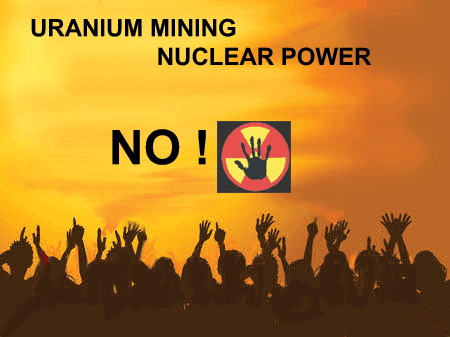
Youthful protestors lead anti nuclear push in Russia
On Murmansk Oblast’s Kola peninsula, however, nuclear backers face one of the strongest environmental organizations in Russia. For more than 10 years, Vitaly Servetnik and other activists at Priroda i molodezh (Nature and Youth) have battled attempts to build new reactors and extend the life of existing ones at the Kola nuclear plant, carrying out more than 100 protest campaigns
Servetnik accuses the authorities of using the Interior Ministry’s anti-terror police, known as Center E, to spy on his small group based in Murmansk.
ecologists persuaded authorities in Volgodonsk, southern Russia, to hold round table talks on the planned power increase of one reactor at the Rostov nuclear plant. In the Kaliningrad exclave, opposition is mounting to the planned 2016 launch of a new reactor at the Baltic plant.
 Nuclear-Strength Kola TOL Special Report: In Russia’s northwest, a scrappy bunch of young environmentalists faces off against a powerful nuclear lobby. By Alexander Tretyakov reporter for SOTV, a publicly funded Internet television channel in Moscow. 24 May 2012 This is the fourth in a series of articles on the state of the environment in Russia.
MOSCOW | Murmansk Oblast in northern Russia has one of the highest
concentrations of nuclear energy on earth. Nuclear submarines and
icebreakers of the Russian Northern Fleet sail the White and Barents
seas, and the Kola nuclear power plant is still going strong nearly 40
years after its first reactor hummed into life.
Russia’s nuclear industry is due for a massive expansion under a
government plan to increase nuclear’s share in national power
production. Russia has shown no sign of wavering on nuclear power in
the wake of last year’s Fukushima disaster, …..
On Murmansk Oblast’s Kola peninsula, however, nuclear backers face one
of the strongest environmental organizations in Russia. For more than
10 years, Vitaly Servetnik and other activists at Priroda i molodezh
(Nature and Youth) have battled attempts to build new reactors and
extend the life of existing ones at the Kola nuclear plant, carrying
out more than 100 protest campaigns, with more success than some of
their fellow campaigners elsewhere in Russia. Campaigners took heart
when several years ago local government seemed to be warming to their
enthusiasm for wind power and other forms of renewable energy.
“The Kola nuclear plant is in a critical state,” said Andrei
Ozharovsky, a nuclear physicist and expert with the Bellona
Foundation. The Norwegian-based environmental group has long been
critical of Russia’s heavy reliance on nuclear power in the far north.
“Although the plant has some of the oldest reactors, there are plans
to increase the output of Unit 4 by 7 percent.”
The two oldest reactors at Kola have been in operation since the
1970s. Unit 4 went online in 1984. All four units are
pressurized-water reactors, similar to those used in many countries,
but Russia is the only country that still uses graphite-moderated RBMK
reactors such as the one that exploded at Chernobyl. Eleven RBMK units
are still in operation at the Kursk, Leningrad, and Smolensk power
plants. Anti-nuclear campaigners can boast of one victory in the
post-Fukushima era: Russia’s state nuclear energy conglomerate Rosatom
said in March it was stopping work on a fifth RBMK reactor at the
Kursk plant which had been under construction since 1985, a year
before the Chernobyl disaster…….
Servetnik accuses the authorities of using the Interior Ministry’s
anti-terror police, known as Center E, to spy on his small group based
in Murmansk.
“The most active members of our organization are under surveillance
by Center E,” he said in a recent interview.
“The pressure increased after 4 March,” he said, in a reference to the
day Vladimir Putin was elected to a third term as president. “This may
be connected with the participation of members of the group, as well
as my own, in activities of the regional Golos [election monitoring
group].”
Despite the pressure, over the years activists from Nature and Youth
and the allied Kola Environmental Center have thrown a number of
wrenches into the plans of the nuclear lobby. In 2006, Servetnik and
colleagues from Nature and Youth challenged Rosatom’s bid to expand
the nuclear plant, partly to service a power-hungry aluminum smelter.
They managed to persuade Rosatom head Sergei Kirienko to meet with
them. It turned out to be the last time Kirienko met members of the
group, but the expansion plan was shelved. ……
“It is impossible to get support for anti-nuclear projects on the
regional level, because they are not considered to be
socially-oriented activities,” Servetnik said. “Picking up garbage and
planting trees are always welcome, but discussing energy policies is
not. It is also difficult to get into the local media. Coverage of our
activities has been reduced in the past few years.”
Fortunately for local environmentalists, Scandinavia with its
comparatively powerful anti-nuclear groups lies just across the
border. Opposition to expansion of the Kola plant has been spearheaded
by Nature and Youth’s parent group and by Bellona, both based in
Norway. Anti-nuclear groups elsewhere in Russia are more isolated and
their protests are generally more muted. Nevertheless, ecologists
persuaded authorities in Volgodonsk, southern Russia, to hold round
table talks on the planned power increase of one reactor at the Rostov
nuclear plant. In the Kaliningrad exclave, opposition is mounting to
the planned 2016 launch of a new reactor at the Baltic plant……..
local environmentalists still see the Kola nuclear plant as the main
obstacle blocking development of wind and other alternative energy
sources. As long as nuclear is king on the peninsula, local
authorities will not even consider licensing alternative power plants,
Bellona’s Ozharovsky charges
http://www.tol.org/client/article/23174-nuclear-strength-kola.html

No comments yet.
1 This Month

of the week – Shut Down Drone Warfare!



Tell the Ukrainian Government to Drop Prosecution of Peace Activist Yurii Sheliazhenko

Petition to revoke the licensing of the Near Surface Nuclear Disposal Facility (NSDF) at Chalk River. https://www.ourcommons.ca/petitions/en/Petition/Details?Petition=e-7247

of the week – STOP SMALL MODULAR REACTORS IN CANADA
To see nuclear-related stories in greater depth and intensity – go to https://nuclearinformation.wordpress.com
-
Archives
- March 2026 (222)
- February 2026 (268)
- January 2026 (308)
- December 2025 (358)
- November 2025 (359)
- October 2025 (376)
- September 2025 (258)
- August 2025 (319)
- July 2025 (230)
- June 2025 (348)
- May 2025 (261)
- April 2025 (305)
-
Categories
- 1
- 1 NUCLEAR ISSUES
- business and costs
- climate change
- culture and arts
- ENERGY
- environment
- health
- history
- indigenous issues
- Legal
- marketing of nuclear
- media
- opposition to nuclear
- PERSONAL STORIES
- politics
- politics international
- Religion and ethics
- safety
- secrets,lies and civil liberties
- spinbuster
- technology
- Uranium
- wastes
- weapons and war
- Women
- 2 WORLD
- ACTION
- AFRICA
- Atrocities
- AUSTRALIA
- Christina's notes
- Christina's themes
- culture and arts
- Events
- Fuk 2022
- Fuk 2023
- Fukushima 2017
- Fukushima 2018
- fukushima 2019
- Fukushima 2020
- Fukushima 2021
- general
- global warming
- Humour (God we need it)
- Nuclear
- RARE EARTHS
- Reference
- resources – print
- Resources -audiovicual
- Weekly Newsletter
- World
- World Nuclear
- YouTube
-
RSS
Entries RSS
Comments RSS
 nuclear-news
Leave a comment