Nuclear fuel rods at Fukushima’s reactor no. 4 – highly dangerous
 The workers are like Samurai warriors, they’re like suicide workers. They know they are getting huge amounts of radiation going to the site. They can only go in, seconds to minutes, at a time doing work and then the next batch has to come in.
Chernobyl had a half a million workers who worked minutes at a time. Here we have a situation much worse than Chernobyl simply because we have basically five reactors that could go up. One reactor setting off the next reactor, that’s a huge amount of radiation, over ten times the radiation inventory found in Chernobyl.
“People don’t realize that the Fukushima reactor (Number 4) is on a knife’s edge; it’s near the tipping point.
 includes videos and audio http://deathby1000papercuts.com/2012/05/large-crack-on-south-wall-of-fukushima-nuclear-reactor-number-four-photo/ Large
  Crack on South Wall of Fukushima Nuclear Reactor Number Four? DBKP. May 20, 2012 By LBG1 We could have adisaster much worse, many times worse than Chernobyl.” Dr. Michio Kaku on the precarious state of the spent fuel rods in the severely damaged Fukushima nuclear reactor Unit Number Four building Continue reading
Germany doing well with nuclear phaseout – despite the nuclear lobby’s lies about this

 Busting the carbon and cost myths of Germany’s nuclear exit, Guardian UK Damian Carrington, 23 May 12 Critics of the atomic phase-out said energy emissions, costs and imports would all rise. They were wrong. it’s worth taking a look at what actually happens when you phase out nuclear power in a large, industrial nation.
That is what Germany chose to do after the Fukushima nuclear disaster, closing eight plants immediately – 7GW – and another nine by 2022. The shrillest critics predicted blackouts, which was always daft and did not happen.
But more serious critics worried that the three things at the heart of th eenergy and climate change debate – carbon, cost and security of supply – would all head in the wrong direction. Here in Berlin, I have found they were wrong on every count. Continue reading
States rebel against financing Small Modular Nuclear reactors (SMRs)
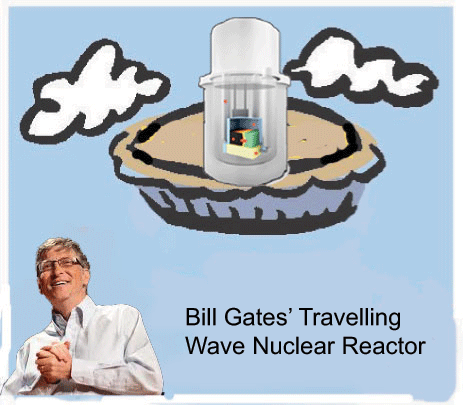 Experts: Nuclear Power Industry Woes Spreading Across Nation From Florida To Iowa Market Watch WASHINGTON, May 23, 2012 /PRNewswire via COMTEX/ — As Ratepayer Rebellion Rages in Florida, Small Modular Reactor and “CWIP” Advance Financing Drive Stopped Dead in Iowa; Next Battleground States: Missouri and North Carolina.
Though its trials and travails at the national level get all the attention, the nuclear power industry is finding fewer and fewer friends in statehouses across the nation. In the Southeast, traditionally the stronghold of new nuclear power projects, a growing ratepayer rebellion in Florida seeks to curb advance financing of reactors that experts say will most likely never be constructed.
In Iowa, even Warren Buffett could not help to persuade state lawmakers to permit advancing financing of a small modular reactor (SMR) in that state. The Iowa defeat marked the nuclear power industry’s failure in its first attempt to push its much-ballyhooed SMR technology through a state legislature. Opposition to advance financing of a new reactor is so strong in Missouri that the industry has been forced to go to Washington, D.C., to seek a $452-million taxpayer-funded grant in the absence of state-level and Wall Street support. In North Carolina, diverse groups are coming together to block a push by Duke to
liberalize construction work in progress (CWIP) provisions to dig even deeper into the pockets of ratepayers in that state.
Examples of the growing state-level opposition to advance financing of SMRs and other new nuclear reactors include the following: Continue reading
Severe radiation risk at Fukushima’s nuclear reactor Unit 4

 Concerns focus on Fukushima unit stability TOKYO, May 23 (UPI) — Whether a pool where spent fuel is stored at Japan’s Fukushima nuclear plant could withstand another strong earthquake has become a source of growing concern.
The concerns among activists, experts and politicians focus on Unit 4, which contains most of the plant’s spent fuel not stored in dry, hardened storage casks, Stars and Stripes reported Wednesday.
After the 9-magnitude earthquake and tsunami, an investigative report by the Rebuild Japan Initiative Foundation, an independent think tank started to investigate the causes of the plant disaster, cited among risks a loss of cooling water in Unit 4.
If left exposed, the spent fuel could heat and melt, releasing a huge amount of radiation.
The plant’s operator, Tokyo Electric Power Co., has said on its Web site Unit 4 is sound and the building could withstand an earthquake of the magnitude of the March 11, 2011, temblor.
But public trust in Tepco remains low, Stars and Stripes said, and calls for more efforts to empty and secure Unit 4 continue in Japan and beyond…… http://www.upi.com/Top_News/World-News/2012/05/23/Concerns-focus-on-Fukushima-unit-stability/UPI-67051337797686/#ixzz1vpwgvulJ
Fukushima workers at risk of cancer
Fukushima 1 workers risk cancer, Voice of Russia, May 24, 2012 About 170 people who worked at the Japanese nuclear power plant “Fukushima-1”, received doses of radiation, which have increased their risk of cancer according to reports published on Wednesday covering the results of studies conducted by experts of the Scientific Committee of the UN….
http://english.ruvr.ru/2012_05_24/75768400/
Infants in some areas at risk of thyroid cancer from Fukushima radiation
 Infants in Namie were thought to have received thyroid radiation doses of 100-200 mSv, it added. The thyroid is the most exposed organ as radioactive iodine concentrates there and children are deemed especially vulnerable.
The report did not deal with radiation exposure suffered by emergencyworkers or people closest to the disaster site……
WHO releases mixed Fukushima radiation report Money Control , May 23, 2012 By Stephanie Nebehay GENEVA (Reuters) – Spikes in radiation caused by the Fukushima nuclear disaster were below cancer-causing levels in almost all of Japan, but infants in one town appear to be at a higher risk of developing thyroid cancer, the World Health Organization said on Wednesday. Continue reading
Taxpayers dudded on loan guarantees for Vogtle Nuclear Power Plant
The credit subsidy cost these documents reveal for the Vogtle project is absurdly low. It is now years out of date and little information on how it was justified is provided. This information shows that taxpayers should be even more worried about signing off on an $8.3
billion loan guarantee for the Vogtle reactor.” “A one percent fee doesn’t even begin to reflect the risk of default”
Taxpayers deserve to see the basis on which the ridiculously low fee for Southern Company was calculated.
 SACE has filed a FOIA request to unearth what the new estimates are in order to understand what risks taxpayers still face…… the terms
of the updated loan guarantee deal are still being held in secret.
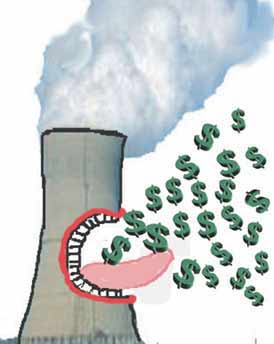 Secret Documents Highlight Nuclear’s Risk to Taxpayers Market Watch, ATLANTA, May 23, 2012 /PRNewswire via COMTEX/ — A closer look at new documents shows Department of Energy significantly underestimated controversial Vogtle Nuclear Plant’s risk of default
Late last week Southern Alliance for Clean Energy (SACE) successfully negotiated the release of hundreds of pages of secret nuclear loan guarantee documents to settle Freedom of Information Act (FOIA) litigation spanning nearly two years. These documents reveal that one of the nation’s largest utilities, Southern Company, was aggressively pursuing controversial federal nuclear loan guarantees at significantly below market rates. Continue reading
Fort Calhoun, just one of America’s problem nuclear reactors
 In each of the last two years, at nuclear plants across the country, the NRC has uncovered about a dozen incidents that outside safety experts consider serious, from faulty plans to protect against floods to inadvertent reactor shutdowns to problems with cooling systems.
The NRC has traced many of them back to specific problems that the plant operators and the regulatory agency were aware of but never fixed.
 Focus Grows on Nuclear Plant, WSJ 23 May 12,, Nebraska Reactor Illustrates Problem That Vexed Departing Federal Regulator At 9:27 a.m. on June 7, 2011, operators of the Fort Calhoun nuclear-power plant near Omaha noticed flickering lights on their control panels. A couple of minutes later, they heard the fire-extinguishing system kick in.
The fire cut off power for 90 minutes to a pool where radioactive spent-fuel rods are stored, and the pool’s temperature rose by several degrees. In the end, the fire didn’t release any radioactivity or cause major damage to the plant, which was already shut down at the
time because of flooding.
But Fort Calhoun is a prime example of a problem that has vexed departing Nuclear Regulatory Commission Chairman Gregory Jaczko and, by his account, that never was fully resolved, Continue reading
The transition to renewable s – American’s energy revolution under way
America’s renewables revolution, Climate Spectator , 24 May 2012 John Kemp “……Speaking in his state of the union address to Congress in January, the president claimed, “We’ve subsidised oil companies for a century. That’s long enough. It’s time to end the taxpayer giveaways to an industry that rarely has been more profitable and double-down on a clean energy industry that never has been more promising.”
But the rhetoric obscures an unprecedented push to cut energy consumption and increase the share of renewable energy generation underway at all levels of government as well as in the private sector.
Federal, state and local governments, coupled with local power and gas utilities, are pouring billions of dollars a year into a vast range of initiatives to boost efficiency and renewables.
Support for efficiency and renewables is split across thousands of
different programs, which has tended to hide the scale of the overall effort. As a result, many energy analysts fail to appreciate the scale of the shift underway. However, the sheer amount of support being given to clean technology and energy efficiency programs suggests a revolutionary transformation of the energy system will likely occur in the next two decades. Continue reading
German government working carefully on phasing out nuclear power
Germany beefs up monitoring of nuclear shutdown, Google News By JUERGEN BAETZ, Associated Press 24 May 12, BERLIN (AP) — The German government will more closely oversee the country’s move from nuclear power to renewable energy, Chancellor Angela Merkel said Wednesday — a mammoth 10-year project for Europe’s biggest economy that has been going slowly so far.
Merkel said she will be meeting with all of Germany’s 16 state governors twice a year to take stock of the transformation’s progress and shortcomings, stressing that everything must be done to avoid blackouts and ensure affordable energy. Continue reading
Nuclear radiation more serious than previously thought
Scientists Warn of Increased Nuclear Radiation Risks Market Watch, SANTA ROSA, Calif., May 23, 2012 (GlobeNewswire via COMTEX) — Recent news reports and scientific reviews warn that nuclear radiation exposure is more serious than we believed. Continue reading
Nuclear Regulatory Commission extends Hanford nuclear license for 20 more years
License for nuclear power plant at Hanford extended to 2043 Oregon Live.com , May 23, 2012 YAKIMA, Wash.-– The Nuclear Regulatory Commission has extended the license for the Northwest’s only commercial nuclear power plant by an additional 20 years, the plant’s operator announced Wednesday.
The license extends operations at south-central Washington’s Columbia Generating Station through 2043. The plant had been operating on a 40-year license that expires at the end of 2023.
The plant is operated by Energy Northwest, a public power consortium composed of 28 member utilities. Controversy swirled around the plant last year because it is the same general type as those stricken after the tsunami in Japan…. http://www.oregonlive.com/environment/index.ssf/2012/05/license_for_hanford_nuclear_po.html
Confusion in estimating Fukushima radiation
TEPCO estimate sees more radiation than NISA’s, The Yomiuri Shimbun, 24 May 12 Tokyo Electric Power Co. has estimated the total amount of radioactive substances discharged from its Fukushima No. 1 nuclear power plant measured 760,000 terabecquerels, 1.6 times the estimate released by the Economy, Trade and Industry Ministry’s Nuclear and Industrial Safety Agency in February. Continue reading
Small scale renewable energy for millions in Sub-Saharan Africa
Solar energy enterprise to provide 10 million with access to renewable energy, PR Wire 24 May 12 The BCtA is a global initiative that encourages private sector efforts to fight poverty, supported by several international organizations including the UN Development Programme (UNDP).
Ten million low-income people living in rural communities in Sub-Saharan Africa, Asia and the Pacific, Latin America and the Caribbean, will gain access to low-cost solar energy by 2015, in part due to a commitment made by solar energy provider Barefoot Power to the Business Call to Action (BCtA).
The BCtA is a global initiative that encourages private sector efforts to fight poverty, supported by several international organizations including the UN Development Programme (UNDP). Continue reading
Fire on nuclear submarine
Nuclear sub catches fire in Maine Naval shipyard By Ros Krasny BOSTON May 23, 2012 (Reuters) – Fire broke out on Wednesday evening on a U.S. Navy nuclear-powered submarine docked at the Portsmouth Naval Shipyard in Maine, injuring four firefighters, officials said.
The cause of the fire is not yet known, but the vessel’s nuclear reactor was not involved. There were no weapons aboard the sub, which is at the shipyard for system upgrades and maintenance.
The fire started in the “forward compartment” of the U.S.S. Miami, an attack submarine docked at the Kittery, Maine, shipyard shortly before 6 p.m. ET Firefighters were still battling the blaze after 10 p.m., with equipment brought in from as far away as Boston’s Logan International Airport, about 60 miles away…..
http://www.reuters.com/article/2012/05/24/us-usa-submarine-fire-idUSBRE84N04I20120524
1 This Month
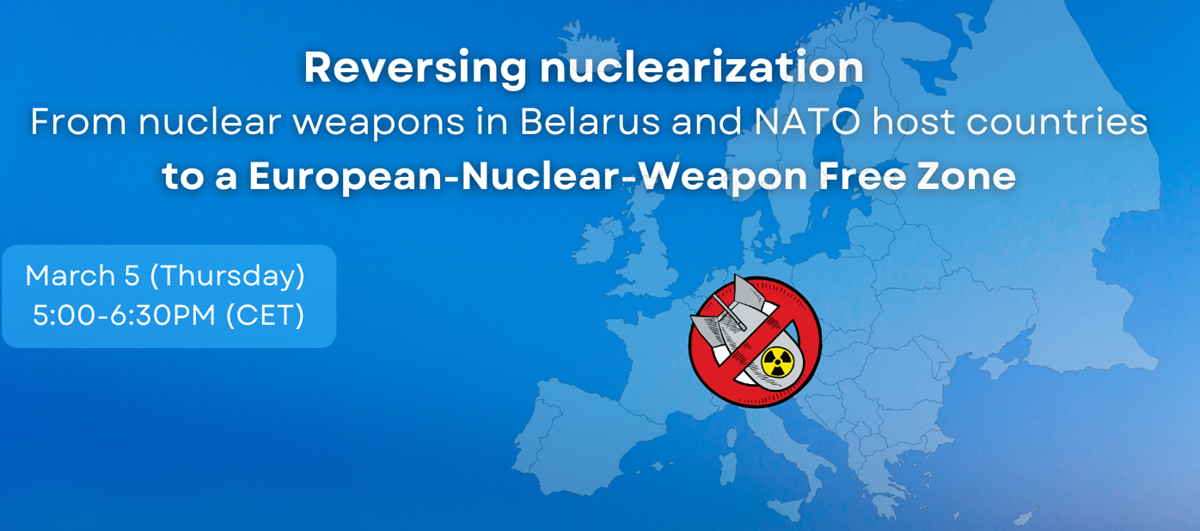
5 March -Online – Reversing nuclearization:
From nuclear weapons in Belarus and NATO host countries to a European-Nuclear-Weapon Free Zone
11am-12:30pm Eastern Time USA / 5pm-6:30pm CET

of the week – Advocating for a
nuclear free beach – https://www.samuellawrencefoundation.org/
The Samuel Lawrence Foundation advocates for a Nuclear Waste Free Beach at San Onofre, join us and take action!

10 March A LIVE WEBINAR THE REAL EFFECTS OF NUCLEAR POWER
What the Industry Isn’t Telling Us
1:00 PM Mountain, 2 pm Central, 3 pm Eastern. Live on the Keepers of the Water Facebook page

18 March Webinar @ 1 PM EST: An Assessment of SMR Projects: The Case of Canada
register for the zoom:
https://us02web.zoom.us/webinar/register/WN_o8BIIOUvQ2ONJR1nta65DQ#/registration

of the week – STOP SMALL MODULAR REACTORS IN CANADA
To see nuclear-related stories in greater depth and intensity – go to https://nuclearinformation.wordpress.com
-
Archives
- March 2026 (51)
- February 2026 (268)
- January 2026 (308)
- December 2025 (358)
- November 2025 (359)
- October 2025 (376)
- September 2025 (258)
- August 2025 (319)
- July 2025 (230)
- June 2025 (348)
- May 2025 (261)
- April 2025 (305)
-
Categories
- 1
- 1 NUCLEAR ISSUES
- business and costs
- climate change
- culture and arts
- ENERGY
- environment
- health
- history
- indigenous issues
- Legal
- marketing of nuclear
- media
- opposition to nuclear
- PERSONAL STORIES
- politics
- politics international
- Religion and ethics
- safety
- secrets,lies and civil liberties
- spinbuster
- technology
- Uranium
- wastes
- weapons and war
- Women
- 2 WORLD
- ACTION
- AFRICA
- Atrocities
- AUSTRALIA
- Christina's notes
- Christina's themes
- culture and arts
- Events
- Fuk 2022
- Fuk 2023
- Fukushima 2017
- Fukushima 2018
- fukushima 2019
- Fukushima 2020
- Fukushima 2021
- general
- global warming
- Humour (God we need it)
- Nuclear
- RARE EARTHS
- Reference
- resources – print
- Resources -audiovicual
- Weekly Newsletter
- World
- World Nuclear
- YouTube
-
RSS
Entries RSS
Comments RSS
 nuclear-news