Wrap up of the week’s nuclear news

Christina Macpherson’s websites & blogs
Low level radiation research Studies of the Mortality of Atomic Bomb Survivors, Report 14 finds that the linear theory of radiation holds good, – as low doses increase, cancer risk increases.
Japan The Oi municipal assembly passed a new resolution Monday to restart Unit 3 and 4 reactors. Anti nuclear activists determined to continue their struggle. Japan still may get through summer without nuclear power – this would be a blow to nuclear and uranium industries. Radiation levels continue to increase in Tokyo Bay.
UK Controversy over what to do with Britain’s huge amount of highly radioactive wastes. Govt offering incentives to counties to ‘welcome’ a waste dump. Shepway District Council wants the community to accept a waste dump on the wetlands of Romney Marsh in Kent – but is meeting much opposition. UK government trying to give French nuclear company EDF a subsidy, but make it look like not a subsidy. UK govt wary about France’s new somewhat anti nuclear President.
USA. The ORC International survey find that the majority of Americans, whether Republican or Democrat, want renewable energy, and the phasing out of coal and nuclear. Military experts call for reduction in spending on nuclear weapons . USA quietly weakens its nuclear emergency procedures New Vogtle nuclear power project runs into trouble – huge cost overrun and delay.
India. A Member of Parliament calls for the scrapping of the nuclear power programme.
Africa. Uranium miners striking for better conditions and wages in Malawi, Namibia and Niger.
Research report – low level radiation IS a cancer causer

 Studies of the Mortality of Atomic Bomb Survivors, Report 14, 1950–2003: http://www rrjournal.org/doi/pdf/10.1667/RR2629.1 An Overview of Cancer and Noncancer Diseases
Despite Fukushima, USA inexplicably weakening its nuclear emergency procedures
The latest changes, especially relaxed exercise plans for 50-mile emergency zones, are being flayed by some local planners and activists who say the widespread contamination in Japan from last year’s Fukushima nuclear accident screams out for stronger planning in the United States, not weaker rules……
 Evacs and drills pared near nuke plants, Bloomberg, By JEFF DONN, 17 May 12, Without fanfare, the nation’s nuclear power regulators have overhauled community emergency planning for the first time in more than three decades, requiring fewer exercises for major accidents and recommending that fewer people be evacuated right away.
The revamp, the first since the program began after Three Mile Island in 1979, also eliminates a requirement that local responders always practice for a release of radiation.
At least four years in the works, the changes appear to clash with more recent lessons of last year’s reactor crisis in Japan. Continue reading
UK’s nuclear waste could fill 5 Royal Albert Halls

 Who will bury Britain’s nuclear waste in their backyard? The Telegraph, 17 May 12, A quiet and scenic corner of Kent is asking residents to let it be the country’s first Nuclear Research and Disposal Facility. By Louise Gray9 17 May 2012 “….. Even without building any more nuclear power stations, we now have enough radioactive waste to fill the Royal Albert Hall five times over. The bulk of our high level waste – the most radioactive – is kept in spent fuel ponds at existing power stations, principally Sellafield.
More than 60 years after the dawn of the nuclear age, no civil nuclear waste has yet been disposed of permanently underground anywhere in the world. Governments have struggled to find any local population willing to risk the dangers of radioactivity …..
The Department for Energy and Climate Change asked councils to “volunteer” to store nuclear waste four years ago, following the “Managing Radioactive Waste Safely” White Paper. The request was met with silence, until three West Cumbrian councils suggested that they might be willing to store more waste around the existing Sellafield power station.
Now Shepway district council has also expressed an interest in the £12 billion project. But first the local community must be persuaded, before a formal expression of interest can be put forward this September; this would be followed by a lengthy consultation and
investigations into the geological viability of the area. The sweetener for the locals would be jobs: Romney Marsh has double the levels of unemployment of the rest of rural Kent….
Energy companies say that nuclear waste transported by train would be
stored in special flasks that would protect it in an accident.
However, protesters fear terrorist attacks, natural disasters or even simple human mistakes still risk a leak of radioactive waste…..
Large scale study shows Australia is warming, due to global greenhouse emissions
“Our study revealed that recent warming in a 1,000-year context is highly unusual and cannot be explained by natural factors alone, suggesting a strong influence of human-caused climate change in the Australasian region,”
1,000 years of climate data confirms Australia’s warming http://phys.org/news/2012-05-years-climate-australia.html May 17, 2012 By Alvin Stone In the first study of its kind in Australasia, scientists used 27 natural climate records to create the first large-scale temperature reconstruction for the region over the past 1,000 years. The study led by researchers at the University of Melbourne, used a range of natural indicators including tree rings, corals and ice cores to study Australasian temperatures over the past millennium. They then compared these with climate model simulations.
Dr. Stephen Phipps, a researcher with UNSW’s Climate Change Research Centre and the Centre of Excellence for Climate System Science led the climate model simulation research. He said the results showed there were no other warm periods in the past 1,000 years that match the warming experienced in Australasia since 1950. Continue reading
The long struggle against nuclear power in Japan
Environmentalists, meanwhile, say they remain undaunted by the Oi decision, which has become a watershed moment in their activism.
 Activists Brace for Long War Against Nuclear Power, By Suvendrini Kakuchi TOKYO, May 17, 2012 (IPS) – For the past two decades Masao Ishiji (59), has been fighting tooth and nail to ban the operation of four nuclear reactors that dot the western coastline of Oi in the Fukui prefecture facing the Japan Sea.
Earlier this week, that desperate battle reached a critical front. When the Oi municipal assembly passed a new resolution Monday to restart Unit 3 and 4 reactors that had been closed for a year for stress tests, anti-nuclear activists knew they had reached a crucial juncture in their fight to eradicate nuclear power from the country. Continue reading
Majority of Americans want renewable energy, see USA politics as corrupt
the public has clearly picked up on the fact that corrupt politics is a key reason we don’t have more of that. 82% of Americans (69% of Republicans, 84% of Independents, and 95% of Democrats) agree with this statement: “The time is now for a new, grassroots-driven politics to realize a renewable energy future.
76% of Americans Want Clean Energy Instead of Nuclear, Natural Gas, & Coal Clean Technica MAY 15, 2012 BY ZACHARY SHAHAN Yet another recent poll showed that Americans really support clean energy, across political affiliations (though, there’s clearly more support on the left).
The ORC International survey, conducted for the nonprofit and nonpartisan Civil Society Institute (CSI), found that 76% of Americans (58% of Republicans, 83% of Independents, and 88% of Democrats) want to see ”a reduction in our reliance on nuclear power, natural gas and coal, and instead, launch a national initiative to boost renewable energy and energy efficiency.” (And who knows what the remaining 24% are smoking?) Continue reading
USA prepared to strike Iran
US ready to strike Iran, says envoy, SMH, Amy Teibel May 18, 2012 – The US has plans in place to attack Iran if necessary to prevent it from developing nuclear weapons, Washington’s envoy to Israel says, days ahead of a crucial round of nuclear talks with Tehran…. Continue reading
UK government wooing county Kent to accept nuclear waste dump
 Wetlands of Romney Marsh in Kent could become new home of nuclear waste dump Mail Online, By SUZANNAH HILLS, 17 May 2012 The wildlife-rich wetlands of Romney Marsh in Kent could become the home of an underground nuclear waste dumping ground if government plans get the go ahead.
Thousands of letters have been sent by Shepway District Council to residents living in the area as part of a consultation over the proposal for a multi-million pound Nuclear Research and Disposal Facility.
Under the plans, hazardous nuclear waste would be buried between 200m to 1000m below the ground in underground vaults, while a research facility would be constructed on the surface…. http://www.dailymail.co.uk/news/article-2145628/Wetlands-Romney-Marsh-Kent-new-home-nuclear-waste-dump.html#ixzz1vGB2CiZp
UK dispute over plan for nuclear waste dump in Kent
 Row over nuclear waste dump proposal in Kent Romney Marshes mooted as site for Britain’s first store of high-level radioactive material by Shepway council in Kent Terry Macalister guardian.co.uk, 17 May 2012 A furious row has broken out among local politicians over a proposal to build a nuclear waste dump in Kent.
Romney Marshes is being mooted as a site for Britain’s first store for high-level radioactive materials by members of Shepway district council but the move has infuriated the leader of Kent county council and a local MP.
“Let’s not sell Romney Marsh short; I believe it has and deserves a better future than being the dumping ground for all of Britain’s high level nuclear waste,” said Damian Collins, MP for Folkestone and Hythe, on his own website.
“Shepway council has started a consultation to ask whether residents want to find out more about building this underground storage facility here and my view, and that of the Marsh’s county councillor Carole Waters, is that the answer should be ‘no’.”
Paul Carter, leader of Kent council, told a local website, thisiskent, it would be “utter madness” to even consider building such a facility in an area which he said was “both an earthquake zone and one of the busiest shipping lanes in the world”…. http://www.guardian.co.uk/environment/2012/may/17/row-nuclear-waste-dump-proposal
Increased radiation in Tokyo Bay
Radiation increasing in Tokyo Bay May 18, 2012 “If the contamination were to spread to fish, it is possible that radioactive isotopes could accumulate when bigger fish feed on smaller ones.” — Hideo Yamazaki
Radioactive contamination from Japan’s Fukushima nuclear disaster has risen sharply in Tokyo Bay over the past several months rather than decline, according to a new study.
Researcher Hideo Yamazaki from Osaka’s Kinki University found that contaminated sludge has accumulated due to runoff into the bay from rivers flowing from highly contaminated regions. This has caused radioactive cesium levels to rise by 1.5 to 13 times since August, Yamazaki says.
Communities benefiting from distributed renewable energy
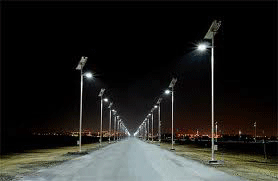 It’s possible to reduce today’s energy consumption for street and road lighting by as much as 60% with new technologies – LED, smart lighting, distributed wind energy and even lights out programs.
The distributed energy market refers to small-scale energy produced primarily for on-site energy consumption meaning street lights, roof tops and ledges anything that requires a direct power source. In 2011, the size of the distributed renewable energy market was estimated around $70 billion dollars globally. It’s expected to top $150 billion by 2015. Because distributed energy is generated at the source of where energy is needed, the inefficient transmission lines are eliminated, creating a more direct source of renewable energy, with the traditional grid being used as a supplemental energy source.
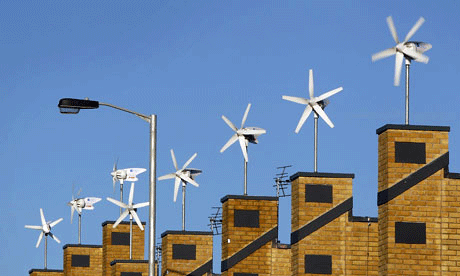
Small Wind Energy Goes Urban In Italy, Korea, Brazil And Texas , by Jennifer Hcks, 18 May 12, http://www.forbes.com/sites/jenniferhicks/2012/05/17/small-wind-energy-goes-urban-in-italy-korea-brazil-and-texas-yes-texas/?ss=innovation-science Streetlights usually operate at electricity rates like the ones we pay in our private homes. About one-third of a municipality’s electrical costs are for street lighting. So having that energy provided by some form of renewable energy, means that every cent is saved and for municipalities, whose budgets are being squeezed, that’s something serious to consider. Continue reading
Massive Olympic Dam uranium mine project might mot go ahead
 projects such as the massive expansion of the Olympic Dam copper-uranium mine in Australia and the potash development in Canada are far less certain…… Where the money is put will say a lot about their expectations for demand for specific commodities now and into the future.
Knives Are Out, But Will BHP and Rio Cut?, WSJ, By Robb M. Stewart, May 16, 2012, BHP Billiton and Rio Tinto have signaled that harder times lie ahead for global miners but have given little indication of where the cuts, if any, will come to the billions of dollars worth of mining projects that both have in the pipeline in Australia and globally.
Neither is backtracking on their long held view about China’s long-term demand for iron ore and coal, but it is now clear that not every expansion project is guaranteed to get off the ground in the current environment–and those that do will be phased in over a longer time period… Continue reading
Bi-partisan agreement on USA’s wasteful spending on nuclear weapons
Reducing or redirecting this wasteful spending brings together a bi-partisan medley of leading national security leaders, deficit hawks, and arms control experts……
Nuclear weapons: A bad security investment THE HILL, By Major General Rogere R. Blunt (Ret.), Civil and nuclear engineer – 05/17/12 Most debates in Washington have battle lines that are predictable and largely unmoving. Certainly this is true of most of the budget
battles, which often seem the political equivalent of trench warfare—lots of fighting, but the lines don’t move and little gets done.
There are, however, subjects where bipartisan agreement can emerge. Things get done when members put country over partisanship and assess programs with a more objective cost-benefit analysis and set aside ideological rigidity. The ability to do so should be a litmus test for voters.
America’s nuclear weapons budget is a perfect case in point. A growing consensus has emerged that we should reduce spending on redundant nuclear programs that are hugely expensive, add little or nothing to our defense capabilities, and siphon money away from our troops and more important national security priorities. Continue reading
Military action in Syria could escalate into nuclear war
Russia says action on Syria, Iran may go nuclear By Gleb Bryanski MOSCOW | May 17, 2012 (Reuters) – Russian Prime Minister Dmitry Medvedev warned on Thursday that military action against sovereign states could lead to a regional nuclear war, starkly voicing Moscow’s opposition to Western intervention ahead of a G8 summit at which Syria and Iran will be discussed.
“Hasty military operations in foreign states usually bring radicals to power,” Medvedev, president for four years until Vladimir Putin’s inauguration on May 7, told a conference in St. Petersburg in remarks posted on the government’s website.
“At some point such actions which undermine state sovereignty may lead to a full-scale regional war, even, although I do not want to frighten anyone, with the use of nuclear weapons,” Medvedev said. “Everyone should bear this in mind.”…
http://www.reuters.com/article/2012/05/17/us-g8-russia-idUSBRE84G18M20120517
1 This Month

10 March A LIVE WEBINAR THE REAL EFFECTS OF NUCLEAR POWER
What the Industry Isn’t Telling Us
1:00 PM Mountain, 2 pm Central, 3 pm Eastern. Live on the Keepers of the Water Facebook page

18 March Webinar @ 1 PM EST: An Assessment of SMR Projects: The Case of Canada
register for the zoom:
https://us02web.zoom.us/webinar/register/WN_o8BIIOUvQ2ONJR1nta65DQ#/registration


of the week – STOP SMALL MODULAR REACTORS IN CANADA
To see nuclear-related stories in greater depth and intensity – go to https://nuclearinformation.wordpress.com
-
Archives
- March 2026 (51)
- February 2026 (268)
- January 2026 (308)
- December 2025 (358)
- November 2025 (359)
- October 2025 (376)
- September 2025 (258)
- August 2025 (319)
- July 2025 (230)
- June 2025 (348)
- May 2025 (261)
- April 2025 (305)
-
Categories
- 1
- 1 NUCLEAR ISSUES
- business and costs
- climate change
- culture and arts
- ENERGY
- environment
- health
- history
- indigenous issues
- Legal
- marketing of nuclear
- media
- opposition to nuclear
- PERSONAL STORIES
- politics
- politics international
- Religion and ethics
- safety
- secrets,lies and civil liberties
- spinbuster
- technology
- Uranium
- wastes
- weapons and war
- Women
- 2 WORLD
- ACTION
- AFRICA
- Atrocities
- AUSTRALIA
- Christina's notes
- Christina's themes
- culture and arts
- Events
- Fuk 2022
- Fuk 2023
- Fukushima 2017
- Fukushima 2018
- fukushima 2019
- Fukushima 2020
- Fukushima 2021
- general
- global warming
- Humour (God we need it)
- Nuclear
- RARE EARTHS
- Reference
- resources – print
- Resources -audiovicual
- Weekly Newsletter
- World
- World Nuclear
- YouTube
-
RSS
Entries RSS
Comments RSS
 nuclear-news