A new anti nuclear demographic – mothers
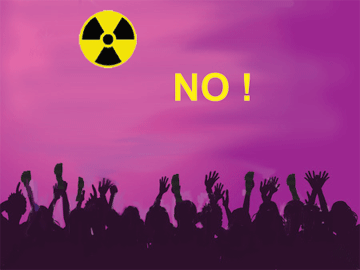 Often, mothers and women want to leave Fukushima and protect their kids, while men tend to accept the line, from the government and the utility, Tepco, that “all is safe.” This can lead to conflict in a culture where women are taught not to challenge their husbands or government, figures of authority.
How a Group of Japanese Mothers Are Saying No to Nuclear Power The Fukushima disaster has brought a powerful new demographic to Japan’s anti-nuclear movement: mothers. AlterNet April 25, 2012 |
On the one-year anniversary of the Fukushima nuclear disaster, Japanese women in New York City gathered for a rally they called Pregnant With Fear of Radiation. Protestors wore fake pregnant bellies, or carried posters with images of pregnant women wearing face masks. Well aware that fetuses, children under five, and women are at the greatest risk from radiation exposure, mothers have emerged as a powerful voice in Japan’s growing anti-nuclear movement.
To call attention to their message, the mothers have organized marches, petitioned government officials, fasted, and held months-long sit-ins in public locations. They regularly wear symbols of maternity and motherhood in deliberately confrontational ways.
The mothers call for action on multiple fronts. Most immediately, they demand the evacuation of all the families of Fukushima, where radiation emissions continue. They ask for tougher safety standards for food and drink in Japan, and an end to the practice of spreading and burning radioactive rubble from the contaminated zone throughout the country’s various prefectures. And, to prevent future disasters, they call for the permanent closure of all nuclear power plants in Japan and throughout the world.
The rise of maternal anti-nuclear activism in Japan began shortly after the March 11, 2011 disaster, when the hundreds of thousands of residents of Fukushima living outside the 20-kilometer evacuation zone were told if was safe to stay. Soon after the plant failed, the Japanese government raised the maximum limit of radiation considered safe, from 1mSv (millesieverts) prior to March 11 to 20mSv. This new measure exposed (and exposes) the people of Fukushima to doses 20 times higher than is normally considered safe.
The families of Fukushima whom the government did not evacuate face a hard choice: leave of their own accord and abandon their homes and jobs (while continuing to be responsible to pay taxes, rents, and/or mortgages), or remain in Fukushima and expose their families to dangerous levels of radiation?
According to mother and activist Kaori Izumi, gender plays into responses to this precarious situation. Often, mothers and women want to leave Fukushima and protect their kids, while men tend to accept the line, from the government and the utility, Tepco, that “all is safe.” This can lead to conflict in a culture where women are taught not to challenge their husbands or government, figures of authority.
Many worried mothers leave Fukushima with their children while fathers remain behind. “Often husbands don’t want to support two households and they tell the wives to come back to Fukushima, or they’ll stop sending them money,” says Izumi. “As a result, we’re seeing an increase in divorce rates.”…..
As the spreading of rubble continues, more and more women throughout the world have joined the fight (their petition is here)…..
Many activist mothers worry about their children’s health and feel they must leave the country. Ikuko Nitta left Fukushima the day after the disaster at her 12-year-old son’s insistence; they moved to Wakayama, believing it to be safe. When Wakayama agreed to accept rubble and incinerate it, Nitta began to make plans to move to Canada. When she recently tested her children’s radiation levels, her son tested positive for Cesium 137. Where the contamination came from, Nitta does not know, as they left Fukushima so quickly and she monitors the children’s food very carefully. …..
http://www.alternet.org/world/155154/how_a_group_of_japanese_mothers_are_saying_no_to_nuclear_powe
No comments yet.
1 This Month

of the week – Shut Down Drone Warfare!


Tell the Ukrainian Government to Drop Prosecution of Peace Activist Yurii Sheliazhenko

Petition to revoke the licensing of the Near Surface Nuclear Disposal Facility (NSDF) at Chalk River. https://www.ourcommons.ca/petitions/en/Petition/Details?Petition=e-7247
To see nuclear-related stories in greater depth and intensity – go to https://nuclearinformation.wordpress.com
-
Archives
- March 2026 (230)
- February 2026 (268)
- January 2026 (308)
- December 2025 (358)
- November 2025 (359)
- October 2025 (376)
- September 2025 (257)
- August 2025 (319)
- July 2025 (230)
- June 2025 (348)
- May 2025 (261)
- April 2025 (305)
-
Categories
- 1
- 1 NUCLEAR ISSUES
- business and costs
- climate change
- culture and arts
- ENERGY
- environment
- health
- history
- indigenous issues
- Legal
- marketing of nuclear
- media
- opposition to nuclear
- PERSONAL STORIES
- politics
- politics international
- Religion and ethics
- safety
- secrets,lies and civil liberties
- spinbuster
- technology
- Uranium
- wastes
- weapons and war
- Women
- 2 WORLD
- ACTION
- AFRICA
- Atrocities
- AUSTRALIA
- Christina's notes
- Christina's themes
- culture and arts
- Events
- Fuk 2022
- Fuk 2023
- Fukushima 2017
- Fukushima 2018
- fukushima 2019
- Fukushima 2020
- Fukushima 2021
- general
- global warming
- Humour (God we need it)
- Nuclear
- RARE EARTHS
- Reference
- resources – print
- Resources -audiovicual
- Weekly Newsletter
- World
- World Nuclear
- YouTube
-
RSS
Entries RSS
Comments RSS
 nuclear-news
Leave a comment