Fukishima’s radioactive wastes and the failure of nuclear reprocessing
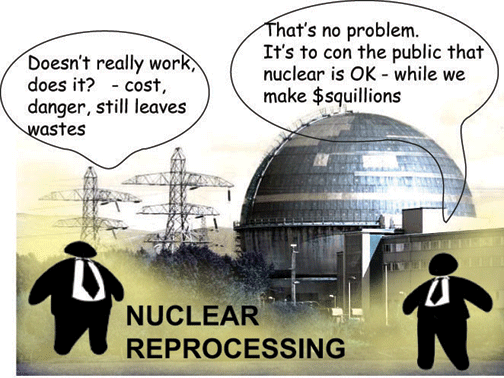 The main reason why there is so much spent fuel at the Da-Ichi site is that the plan to send it off for nuclear recycling has collapsed.
This scheme is based on long discredited assumptions of …. a new generation of “fast” reactors
nearly all of the spent fuel at the Da-Ichi containing some of the largest concentrations of radioactivity on the planet will remain indefinitely in vulnerable pools.
The Fukushima Nuclear Disaster Is Far From Over HUFFINGTON POST, Robert Alvarez, Senior Scholar, Institute for Policy Studies, 22 April 12,“……Last week, Tokyo Electric Power Company (TEPCO) revealed plans to remove 2,274 spent fuel assemblies from the damaged reactors that will probably take at least a decade to accomplish. The first priority will be removal of the contents in Pool No. 4. This pool is structurally damaged and contains about 10 times more cesium-137 than released at Chernobyl. Removal of SNF from the No. 4 reactor is optimistically expected to begin at the end of 2013. A significant amount of construction to remove debris and reinforce the structurally-damaged reactor buildings, especially the fuel- handling areas, will be required.
Also, it is not safe to keep 1,882 spent fuel assemblies containing ~57 million curies of long-lived radioactivity, including nearly 15 times more cs-137 than released at Chernobyl in the elevated pools at reactors 5, 6, and 7, which did not experience meltdowns and explosions.
The main reason why there is so much spent fuel at the Da-Ichi site is that the plan to send it off for nuclear recycling has collapsed. It was supposed to go to the incomplete Rokkasho reprocessing plant, just south of the Fukushima nuclear site, where plutonium would be extracted as a fuel for “fast” reactors. This scheme is based on long discredited assumptions that world uranium supplies would be rapidly exhausted and that a new generation of “fast” reactors, which held the promise of making more fuel than they use, would be needed. Over the past 20 years the Rokkasho’s costs have tripled along with 18 major delays. World uranium supplies are far from depleted. Moreover, in November of last year, Japan’s “fast” reactor project at Monju was cancelled for cost and safety reasons — dealing a major blow to this whole scheme.
The stark reality, if TEPCO’s plan is realized, is that nearly all of the spent fuel at the Da-Ichi containing some of the largest concentrations of radioactivity on the planet will remain indefinitely in vulnerable pools. TEPCO wants to store the spent fuel from the damaged reactors in the common pool, and only to resort to dry, cask storage when the common pool’s capacity is exceeded. At this time, the common pool is at 80 percent storage capacity and will require removal of SNF to make room. TEPCO’s plan is to minimize dry cask storage as much as possible and to rely indefinitely on vulnerable pool storage. Sen. Wyden finds that that TEPCO’s plan for remediation carries extraordinary and continuing risk and sensibly recommends that retrieval of spent fuel in existing on-site spent fuel pools to safer storage… in dry casks should be a priority.
Despite the enormous destruction from the earthquake and tsunami, little attention was paid to the fact that the nine dry spent fuel casks at the Fukushima Da-Ichi site were unscathed. This is an important lesson we cannot afford to ignore. http://www.huffingtonpost.com/robert-alvarez/the-fukushima-nuclear-dis_b_1444146.html
No comments yet.
1 This Month

of the week – Shut Down Drone Warfare!


Tell the Ukrainian Government to Drop Prosecution of Peace Activist Yurii Sheliazhenko

Petition to revoke the licensing of the Near Surface Nuclear Disposal Facility (NSDF) at Chalk River. https://www.ourcommons.ca/petitions/en/Petition/Details?Petition=e-7247
To see nuclear-related stories in greater depth and intensity – go to https://nuclearinformation.wordpress.com
-
Archives
- March 2026 (230)
- February 2026 (268)
- January 2026 (308)
- December 2025 (358)
- November 2025 (359)
- October 2025 (376)
- September 2025 (257)
- August 2025 (319)
- July 2025 (230)
- June 2025 (348)
- May 2025 (261)
- April 2025 (305)
-
Categories
- 1
- 1 NUCLEAR ISSUES
- business and costs
- climate change
- culture and arts
- ENERGY
- environment
- health
- history
- indigenous issues
- Legal
- marketing of nuclear
- media
- opposition to nuclear
- PERSONAL STORIES
- politics
- politics international
- Religion and ethics
- safety
- secrets,lies and civil liberties
- spinbuster
- technology
- Uranium
- wastes
- weapons and war
- Women
- 2 WORLD
- ACTION
- AFRICA
- Atrocities
- AUSTRALIA
- Christina's notes
- Christina's themes
- culture and arts
- Events
- Fuk 2022
- Fuk 2023
- Fukushima 2017
- Fukushima 2018
- fukushima 2019
- Fukushima 2020
- Fukushima 2021
- general
- global warming
- Humour (God we need it)
- Nuclear
- RARE EARTHS
- Reference
- resources – print
- Resources -audiovicual
- Weekly Newsletter
- World
- World Nuclear
- YouTube
-
RSS
Entries RSS
Comments RSS
 nuclear-news
Leave a comment