Fukushima Daiichi’s Unit 4 reactor a radioactive time bomb
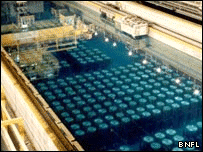 if the [spent fuel rods] pool should spring a leak, or another earthquake bring the pool crashing down, all that fuel would be exposed to the outside air, letting them heat up and release massive amounts of radiation.
Fukushima Daiichi’s Achilles Heel: Unit 4′s Spent Fuel? WSJ, By Phred Dvorak, April 17, 2012, Just how dangerous is the situation at Japan’s crippled Fukushima Daiichi nuclear plant? Very, according to U.S. Senator Ron Wyden, a senior member of the Senate’s energy committee who toured the plant earlier this month.
Another big earthquake or tsunami could send Fukushima Daiichi’s fragile reactor buildings tumbling down, resulting in “an even greater release of radiation than the initial accident,”
Mr. Wyden warned in a Monday letter to Japanese Ambassador to the U.S. Ichiro Fujisaki. Continue reading
After May 5, Japan will be functioning with no nuclear power

 Japan to be without nuclear power after May 5 By Yoko Kubota TOKYO, April 17 | 2012 (Reuters) – Japan will within weeks have no nuclear power for the first time in more than 40 years, after the trade minister said two reactors idled after the Fukushima disaster would not be back online before the last one currently operating is shut down.
Trade Minister Yukio Edano signalled it would take at least several weeks before the government, keen to avoid a power crunch, can give a final go-ahead to restarts, meaning Japan is set on May 6 to mark its first nuclear power-free day since 1970.
“If we thoroughly go through the procedure, it would be (on or) after May 6 even if we could restart them,” Edano told a news conference, adding that whether they can actually be brought back online is still up to ongoing discussions….. Exactly when Fukui Governor Issei Nishikawa and Ohi Mayor Shinobu Tokioka will make decisions is unclear.
Members of the expert panel will be visiting the Ohi plant on Wednesday and are likely to meet several more times before they reach a conclusion, while the Fukui assembly may meet as early as next week to discuss whether they can back the restarts, Masao Sato, a member ofthe assembly, told Reuters…… http://www.reuters.com/article/2012/04/17/japan-nuclear-idUSL3E8FH16V20120417
Britain’s nuclear pickle, as French firms demand more subsidies for building reactors
 The comments will send a shockwave through Whitehall because they come just weeks after the German utilities RWE and E.ON said they would not proceed with plans to build new nuclear plants at Wylfa in Wales and Oldbury in Gloucestershire.
“UK energy policy is being manipulated and subverted to make it possible for French nuclear power companies (EDF and Areva) to start building four new reactors in the UK – two at Hinkley Point in Somerset and two at Sizewell in Suffolk.”
 GDF Suez’s nuclear reservations hit government energy policy French firm needs more financial incentives if it is to proceed with new nuclear plant in Cumbria, says CEO Gérard Mestrallet, Terry Macalister guardian.co.uk, 16 April 2012 The government’s energy policy has suffered a fresh blow when GDF Suez, the French firm behind plans to build a new nuclear plant in Cumbria, said it needed more financial incentives if it was to proceed. Continue reading
India’s ‘China killer’ nuclear missile

 India to test ‘China Killer’ missile, SMH, Ben Doherty, April 18, 2012 INDIA could test fire its most powerful nuclear-capable missile yet as early as today, a 50-tonne, 20-metre rocket that has the potential to reach all of Asia and large parts of Europe.
The Agni V – named for the Hindu god of fire, but given the incendiary appellation ”the China Killer” by the more sensationalist of the local press – has a range of more than 5000 kilometres, and has beenslated for a 1000-second test flight some time between today and Friday…… Continue reading
Nuclear and coal energy in ‘cloud computing’
Apple, Twitter, Microsoft using ‘dirty’ cloud technology: Greenpeace, By Sheila Dabu Nonato, Postmedia News April 17, 2012 Cloud computing — the rapidly expanding practice of delivering data and applications over the Internet — is being fuelled by “dirty” energy, including coal and nuclear power, with some industry leaders like Facebook, Google and Yahoo leading the way in making the technology greener, while other big names such as Apple, Microsoft, Amazon and Twitter are lagging behind, Greenpeace says in a report released Tuesday. Continue reading
Pro nuclear governments’ dishonest efforts to prop up the ailing nuclear industry
 At this critical moment of a fading nuclear power industry, pro-nuclear governments of France, the UK, Poland, and the Czech Republic seem to have embarked upon a mission to save the future of nuclear energy. According to a leaked letter to the European Commission, they have voiced their wish that nuclear energy should be on par with young renewable energy technologies, thus making their struggling nuclear projects eligible to receive EU subsidies.
 Where is the Positive Image of Nuclear Energy Coming From?, Clean Technica, 16 April 12, Despite the problems and disasters of the past and present, nuclear power is still being praised for being a cheap, abundant, and clean form of energy production by many politicians. Of course, it’s also “safe” and without any kind of “waste management problems” (due to future developments that would make energy out of dangerous nuclear waste), but those slogans are a little harder to sell today, so the focus is usually on “clean” and “cheap”. Continue reading
Don’t drink and Drive a Nuclear reactor

 Nuclear regulator proposes drug, alcohol policy for workers, The Star, 18 April 12 If you can’t drink and drive, maybe you shouldn’t drink and run a nuclear power plant.
Canada’s nuclear regulator has proposed new “fitness for duty” rules that would require anyone with unescorted access to sensitive areas of a nuclear plant to be subject to random drug and alcohol testing. The policy would be a departure for the Canadian Nuclear Safety Commission. “Presently, the CNSC does not have explicit alcohol or drug testing
requirements,” a spokesman said.
The commission does require nuclear operators to have a “fitness for
duty” program, but doesn’t spell out the requirements for drug and
alcohol use. Now, the commission has released a discussion paper proposing to change that.
“The CNSC believes in being proactive, in order to reduce the risk of impairment-related safety events at Canada’s nuclear power plants,” says the paper……
http://www.thestar.com/business/article/1163170–nuclear-regulator-proposes-drug-alcohol-policy-for-workers
Russia’s top nuclear reactor designer arrested for fraud

 Russian Nuclear Reactors’ Designer Held on Suspicion of Fraud. 17/04/2012 MOSCOW, April 17 (RIA Novosti) –The head of the Russian nuclear reactor design bureau Gidropress, a subsidiary of the State Atomic Energy Corporation Rosatom, Viktor Mokhov has been detained on suspicion of an 18-million-ruble ($600,000) fraud scheme. Continue reading
Fire at Idaho nuclear research laboratory
Fire prompts evacuation at nuclear research lab in Idaho SALMON, Idaho, April 16 (Reuters) – A welder’s torch ignited a small fire on the roof of a building at a nuclear research laboratory in Idaho on Monday, prompting an evacuation, but no one was hurt and no radioactive material was involved, lab officials said.
Nearly 100 employees were cleared from the building, part of a complex that includes facilities housing spent nuclear fuel and radioactive waste at the Idaho National Laboratory, the U.S. Energy Department’s leading facility for nuclear reactor technology. Continue reading
Australia launches renewable energy fund

 $10b fund for renewable energy firms http://www.perthnow.com.au/business/b-fund-for-renewable-energy-firms/story-e6frg2r3-1226330084361 AAP April 17, 2012 COMPANIES involved in renewable energy will soon be able to tap into a $10 billion federal pool. The Gillard government released today an independent review into the Clean Energy Finance Corporation (CEFC), which is due to start operating from July 2013.
The government accepted all recommendations made by the review.
The CEFC will provide $10 billion worth of financing to companies involved in renewable energy, low-emissions and energy efficiency technology. The review was led by Reserve Bank of Australia board member Jillian Broadbent.
The CEFC will encourage private investment and help overcome capital market barriers for cleaner energy technologies, the government said in a statement today.
The fund will apply “commercial rigor” to its investment decisions to make sure companies have a positive rate of return and are able to repay the loans.
Nuclear test moratorium no longer respected by North Korea
 North Korea says no longer bound by nuclear test moratorium (Reuters) 17 April 12, North Korea on Tuesday dismissed a rebuke by the U.N. Security Council of its failed long-range rocket launch and said it was no longer bound by an agreement with the United States for a moratorium on missile and nuclear tests and arms inspection.
The Security Council on Monday condemned the North for Friday’s rocket launch and warned of further action if Pyongyang carried out a nuclear test, reflecting concern that it may follow a pattern it set in 2009 with its second nuclear test…… The fate of a planned visit by international inspectors to the North’s nuclear site under the February agreement is also in doubt since Pyongyang raised tensions by going ahead with the rocket launch against international warning…… http://www.reuters.com/article/2012/04/17/us-korea-north-us-idUSBRE83G12H20120417
30 years later, today’s road workers affected by radioactive spill
Workers sick amid highway radiation scare http://www.abc.net.au/news/2012-04-18/radioactive-discovery-halts-pacific-hwy-upgrade/3957168 April 18, 2012 Road workers were sent for medical treatment after vomiting when suspected nuclear material was unearthed during work on an upgrade to the Pacific Highway on the mid-north coast of New South Wales The materials, which include caesium, were buried north of Port Macquarie after a truck carrying radioactive isotopes from Sydney’s Lucas Heights nuclear reactor crashed in the area in 1980.
The isotopes were being taken to Brisbane, before being shipped to the United States. The upgrade’s project manager, Bob Higgins, says road workers fell ill after unearthing a strange clay-like material.
“As we’ve taken down the cutting there we exposed the face of the existing material (and) came across a clay material that when it’s exposed to air it gets an orange streak through it,” he said. ”There were a number of workers that felt a little bit of nausea and there was a bit of vomiting when they were in close proximity. ”[They went] off to the doctor, but obviously we need to be extremely careful here.”
The Environmental Impact Statement for the highway upgrade had noted some uncertainty about where exactly the containers were buried. Specialists are in the area assessing what to do with the radioactive materials, and if they pose any risk.
Let the Facts Speak: 1980, December 4 PORT MACQUARIE, AUSTRALIA Continue reading
The nuclear renaissance that was not
 the big energy lie is being unmasked by the large-scale introduction of renewable energy sources around the globe. The technologies required to harvest the abundant natural energy potentials from renewable resources are proving to be more than enough to supply even our growing energy needs of today, despite being at the beginning of their technological development.
Where is the Positive Image of Nuclear Energy Coming From? Clean Technica, 16 April 12, “….The Nuclear Renaissance that Was Not Most nuclear reactors that are in operation were built in the 1970s or 1980s. That means that the bulk of these highly subsidized power plants are nearing the end of their life and need to be decommissioned. If the nuclear lobby doesn’t manage to turn this situation into a necessity to build new reactors, the nuclear age in the field of electricity production will come to an inevitable end. Continue reading
Rare Earths company has no proper radioactive waste management plan
Unlike the Lynas plant, the other three refineries’ radioactive wastes are sent back to the respective mines.
“Lynas has no concrete radioactive waste management plan. Lynas claims it can store its waste onsite forever.
The Lynas plant, she added, would have 500 tonnes of liquid discharge per hour channelled into the Balok River.
 Lynas whitewashing refinery safety concerns, says Fuziah, The Malaysian Insider, By Shazwan Mustafa Kamal April 16, 2012 KUALA LUMPUR, — PKR’s Fuziah Salleh has accused Lynas Corp of whitewashing safety concerns of its planned refinery in Kuantan by claiming there is a “concerted political campaign” against the plant’s construction,
In response, Fuziah accused the Lynas Corp head of “deviating” from the real issue of safety, saying that a simple comparative study showed the Lynas refinery did not support any form of “sustainable development.”
“They are not addressing concerns of safety, whitewashing safety concerns, silent about safety issues. “They have only addressed radiation aspects, external radiation… they are narrow-minded in terms of perspective of radiation,” the PKR vice-president told The Malaysian Insider. Continue reading
Smart grids – we’d be dumb not to use them
Clever energy: why smart grids matter. The Green Piece. 17 April 2012. Smart grids-they’ve been in the news a lot lately and their importance is ever growing. The UK, like countries around the world, is seeking to increase the share that renewable sources play in its energy mix, while also striving for cleaner forms of transport such as electric
vehicles.
As a result, smart grids are set to play an important role in how we manage these changes to our energy generation and use. With increasing reliance on intermittent sources of power such as wind and solar, and increased demand on electricity supplies through the use of battery-powered cars, it is going to become ever more important to properly manage our energy use.
According to a new report from IDC Energy smart grid spending will increase 17.4 per cent globally between 2010-2015; with overall spending set to reach close to $46.4billion in 2015. What is a smart grid? Continue reading
1 This Month



Tell the Ukrainian Government to Drop Prosecution of Peace Activist Yurii Sheliazhenko

Petition to revoke the licensing of the Near Surface Nuclear Disposal Facility (NSDF) at Chalk River. https://www.ourcommons.ca/petitions/en/Petition/Details?Petition=e-7247


of the week – STOP SMALL MODULAR REACTORS IN CANADA
To see nuclear-related stories in greater depth and intensity – go to https://nuclearinformation.wordpress.com
-
Archives
- March 2026 (222)
- February 2026 (268)
- January 2026 (308)
- December 2025 (358)
- November 2025 (359)
- October 2025 (376)
- September 2025 (258)
- August 2025 (319)
- July 2025 (230)
- June 2025 (348)
- May 2025 (261)
- April 2025 (305)
-
Categories
- 1
- 1 NUCLEAR ISSUES
- business and costs
- climate change
- culture and arts
- ENERGY
- environment
- health
- history
- indigenous issues
- Legal
- marketing of nuclear
- media
- opposition to nuclear
- PERSONAL STORIES
- politics
- politics international
- Religion and ethics
- safety
- secrets,lies and civil liberties
- spinbuster
- technology
- Uranium
- wastes
- weapons and war
- Women
- 2 WORLD
- ACTION
- AFRICA
- Atrocities
- AUSTRALIA
- Christina's notes
- Christina's themes
- culture and arts
- Events
- Fuk 2022
- Fuk 2023
- Fukushima 2017
- Fukushima 2018
- fukushima 2019
- Fukushima 2020
- Fukushima 2021
- general
- global warming
- Humour (God we need it)
- Nuclear
- RARE EARTHS
- Reference
- resources – print
- Resources -audiovicual
- Weekly Newsletter
- World
- World Nuclear
- YouTube
-
RSS
Entries RSS
Comments RSS
 nuclear-news