Uranium mining damages health of workers and environment
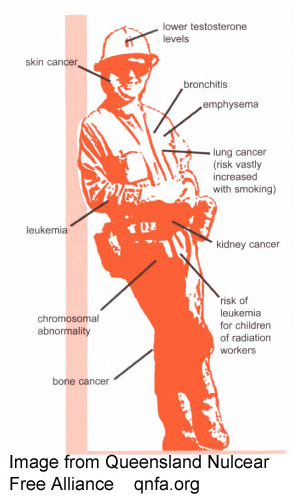 the World Health Organisation (WHO) acknowledges that Radon, which is a heavy gaseous radioactive chemical, is the second cause of lung cancer after smoking.
Uranium, even when purified, Chareyron said is radioactive and miners cannot really be protected from it.
 Concerns over uranium mining New Era, 12 Apr 2012 – by Irene Hoaës WINDHOEK – Renewed concern has been expressed regarding uranium mining activities along the coastal areas and its impact on the environment following tests undertaken by the Commission for Independent Research and Information about Radiation (CRIIRAD) and EARTHLIFE Namibia.
These mining activities have a direct bearing on people’s health as they reportedly cause cancer, especially to people that get exposed to them.
According to CRIIRAD, people that spend 30 minutes to 35 hours at a distance below 25 meters from the waste rock dump, would receive an external radiation dose above the trivial dose of 10 microsieverts per year.
One of the main concerns is uranium concentrates found in underground water sources and on sediments in areas where Rössing and the Langer Heinrich mines are found, especially along the Khan and Gawib rivers.
According to Bruno Chareyron, a Nuclear Physics Engineer and Director of the CRIIRAD Laboratory, the radioactive tailings (waste) of the mines are not covered and dust particles from the tailings are accumulating on bushes and slopes.
“When it rains, this dust is even washed off the waste rock dumps that are situated next to the river banks and therefore deposited into the river system,” the nuclear engineer said. Continue reading
Rapid increase in brachytherapy for breast cancer, but is this wise?
 “The most plausible explanation for our data is that women treated with brachytherapy were at increased risk of having a recurrence of cancer in their breast”
A large federally funded study is trying to clarify the risks and benefits of brachytherapy for breast cancer. But the results won’t be out for years.
 includes audio. Wider Use Of Breast Cancer Radiation Technique Raises Concern http://www.npr.org/blogs health/2012/04/09/150088892/wider-use-of-breast-cancer-radiation-technique-raises-concern?ps=sh_stcathdl “…..there’s an intense debate under way about whether the approach is being used too widely before there’s clear evidence it’s as effective as the traditional approach. Continue reading
Japanese government’s unseemly haste to prop up the nuclear industry
“recklessly rushing to bring the reactors back online now, saying they meet its lax safety requirements”.. “The nuclear industry and the government…. are trying to pretend they can call Oi safe without improving safety or emergency measures,”

 Criticism hits Japan’s plan to restart nuclear reactors NDTV, Agence France-Presse | April 15, 2012 Tokyo: Japan’s plan to restart two offline nuclear reactors came under fire today from media and environmental groups amid doubts over the safety of atomic power after the Fukushima accident. Continue reading
Japan could manage without nuclear power: and it might do so “momentarily”
It was not certain if and when the government could gain approval from regional authorities around the Oi plant for the reactors to be restarted amid persistent public distrust….
Independent studies show that there will be no power shortages,” said Wakao Hanaoka, the Japan campaign manager for the environment watchdog Greenpeace….
Japan may be ‘momentarily’ without nuclear power Google News (AFP) 15 April 12, TOKYO — Japan may go “momentarily” without nuclear power next month when the only one reactor still in operation shuts down for maintenance work, the country’s industry minister warned Sunday. Continue reading
Radiation safety fears in Sri Lanka, due to proximity to India’s nuclear projects
The recent developments in the Kudankulam nuclear power plant in Tamil Nadu’s Tirunelveli district is making Sri Lanka nervous as the power plant is only 250 kilo meters from Sri Lanka’s northwestern coastal town of Mannar.
 Sri Lanka sets up radiation warning system, Apr 14, 2012, ColomboPage News Desk, Sri Lanka. Apr 14, Colombo: Sri Lanka has taken measures to establish a warning system to alert to the danger of radiation in an event of a leak from the nuclear plants in neighboring India. Continue reading
Trinidad’s scandal of over-radiated cancer patients
 The radiation incident at BLCTC has been shrouded in secrecy from the outset
Over-radiated cancer patients at Lara Centre… Trinidad Express, By Camini Marajh Head Investigative Desk Story Apr 14, 2012 Ninety-one or 40.8 per cent of the 223 cancer patients over-radiated by the Brian Lara Cancer Treatment Centre (BLCTC) are dead.
Continuing Sunday Express investigations into the radiation over-exposure incident at the private facility which is owned by powerful business interests reveal that the board and management of BLCTC failed internationally accepted guidelines on several critical
fronts, specifically: Continue reading
Vermont rallies to keep its right to veto nuclear power plants
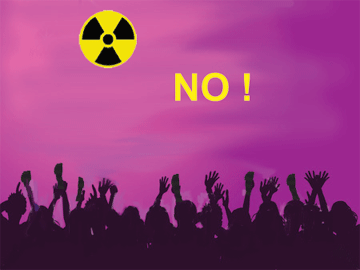 “We are demanding justice for an agreement made 40 years ago,” said Sanders, who drew the loudest cheers. He said the state had the right to determine a “safe energy future for our kids and grandkids.”
Organizers estimated the crowd at between 1,500 and 2,000 people.
 Shumlin, Sanders rally anti-nuclear protesters By Susan Smallheer, Rutland Herald, April 15, 2012, BRATTLEBORO — More than 1,200 anti-nuclear protesters flocked to the Brattleboro Common on Saturday and listened to three of the state’s top politicians — Gov. Peter Shumlin, U.S. Sen. Bernard Sanders and Attorney General William Sorrell — take turns criticizing Entergy Nuclear and its Vermont Yankee nuclear power plant. Continue reading
Growing alarm over the unsafety of the Pilgrim Nuclear Power Station in Plymouth.
 Petitions raise alarm on N-plant, Critics want new safety rules met at Pilgrim station By Jennette Barnes Boston Globe April 15, 2012 Concern about nuclear safety is gaining visibility south of Boston as voters in several communities determine the fate of a petition that aims to shut down, at least temporarily, the Pilgrim Nuclear Power Station in Plymouth.
Although the nonbinding questions focus on making the plant safe, rather than closing it permanently, they would, in effect, endorse closing it down for more than four years.
A Town Meeting article passed in Duxbury, Kingston, and Scituate. Marshfield Town Meeting is expected to vote April 23, and Plymouth takes up the issue by ballot May 12. A number of Cape Cod communities are planning votes, as well…..
http://www.boston.com/news/local/articles/2012/04/15/nuclear_activism_gains_momentum_as_south_towns_vote_on_future_of_pilgrim_power_plant/
Thousands of gallons of radioactive water into the river
NRC reveals radioactive water spill at Limerick nuke plant, The Mercury, By Evan Brandt 04/12/12 LIMERICK — “Several thousand gallons” of water containing as much as five-times the government’s “safe” level of radioactive tritium was accidentally released at Exelon Nuclear’s Limerick Generating Station last month and then flushed into the Schuylkill River, The Mercury learned Thursday….. http://www.pottsmerc.com/article/20120412/NEWS01/120419797/nrc-reveals-radioactive-water-spill-at-limerick-nuke-plant&pager=full_story
Modernizing nuclear weapons – a recipe for global destruction
 http://www.reachingcriticalwill.org/news/latest-news/5713-new-publication-from-rcw-on-nuclear-modernization New publication from RCW on nuclear modernization, On Tuesday 10 April, Reaching Critical Will launched its latest publication, Assuring Destruction Forever: Nuclear weapon modernization around the world. This new, groundbreaking study explores in-depth the nuclear weapon modernization programmes in China, France, India, Israel, Pakistan, Russia, the United Kingdom, and the United States, and analyzes the costs of nuclear weapons in the context of the economic crisis, austerity measures, and rising challenges in meeting human and environmental needs
Really safe nuclear power, like the really unsinkable Titanic
 The Titanic and the nuclear fiasco, Japan Times, 15 April On the night of April 15, 1912, 100 years ago today, the allegedly unsinkable luxury liner RMS Titanic sank in the North Atlantic after hitting an iceberg. Of the ship’s 2,200 passengers, 1,500 lost their lives. Since then the Titanic has become an object lesson, an obsession and the subject of countless books and films…..
Presenting technology as completely safe, trustworthy or miraculous may seem to be a thing of the past, but the parallels between the Titanic and Japan’s nuclear power industry could not be clearer. Japan’s nuclear power plants were, like the Titanic, advertised as
marvels of modern science that were completely safe. Certain technologies, whether they promise to float a luxury liner or provide clean energy, can never be made entirely safe….
http://www.japantimes.co.jp/text/ed20120415a1.html
Nuclear fusion – an expensive pipedream
“Fusion will never be a practical source because it requires vast resources and technical capital”
The Tantalizing Promise And Peril Of Nuclear Fusion, Forbes, 15 April 12 “…..To be clear, fusion is different from fission, which is how today’s nuclear reactor’s produce energy. Fission splits atoms apart whereas fusion combines them — a process that thus far consumes more energy than it generates. Continue reading
Japanese people willing to cut energy use, rather than restart nuclear reactors
“We have learned from olden times to live with natural disasters ….The difference here is that this nuclear nightmare has resulted directly from man’s will.”
Japanese wary of restarting reactors By Matthew Fisher, MINAMISOMA, JAPAN April 15, 2012 Calgary Herald, Whether to turn some of the country’s nuclear power back on is an emotive and hugely divisive issue. It pits businesses concerned about higher energy prices and electricity shortages against the general population, which is not sure it wants any of the nuclear plants turned on again even if it means that their homes will go dark for several hours every day during the summer. Continue reading
1 This Month

of the week – Shut Down Drone Warfare!


Tell the Ukrainian Government to Drop Prosecution of Peace Activist Yurii Sheliazhenko

Petition to revoke the licensing of the Near Surface Nuclear Disposal Facility (NSDF) at Chalk River. https://www.ourcommons.ca/petitions/en/Petition/Details?Petition=e-7247
To see nuclear-related stories in greater depth and intensity – go to https://nuclearinformation.wordpress.com
-
Archives
- March 2026 (227)
- February 2026 (268)
- January 2026 (308)
- December 2025 (358)
- November 2025 (359)
- October 2025 (376)
- September 2025 (257)
- August 2025 (319)
- July 2025 (230)
- June 2025 (348)
- May 2025 (261)
- April 2025 (305)
-
Categories
- 1
- 1 NUCLEAR ISSUES
- business and costs
- climate change
- culture and arts
- ENERGY
- environment
- health
- history
- indigenous issues
- Legal
- marketing of nuclear
- media
- opposition to nuclear
- PERSONAL STORIES
- politics
- politics international
- Religion and ethics
- safety
- secrets,lies and civil liberties
- spinbuster
- technology
- Uranium
- wastes
- weapons and war
- Women
- 2 WORLD
- ACTION
- AFRICA
- Atrocities
- AUSTRALIA
- Christina's notes
- Christina's themes
- culture and arts
- Events
- Fuk 2022
- Fuk 2023
- Fukushima 2017
- Fukushima 2018
- fukushima 2019
- Fukushima 2020
- Fukushima 2021
- general
- global warming
- Humour (God we need it)
- Nuclear
- RARE EARTHS
- Reference
- resources – print
- Resources -audiovicual
- Weekly Newsletter
- World
- World Nuclear
- YouTube
-
RSS
Entries RSS
Comments RSS
 nuclear-news