The eternal cost of dealing with dead, but radioactive, nuclear reactors
Turkish nuclear power – an unwarranted venture, Hurriyet Daily News, ERHUN KULA, 12 April 12 “……Studies in France (available from the author), the most nuclear dependent nation, reveal that nuclear energy is more expensive then hydro and fossil fuel powered units, even when the end cost of nuclear power plants – which is decommissioning and storing highly dangerous nuclear wastes in repositories for thousands of years – is ignored. The most expensive and risky problem with nuclear energy is the safe disposal of the radioactive waste. It has to be transported over long distances, stored and monitored over a very long period of time.
A few months ago the Mersin Akkuyu Nuclear Electricity Production Corporation commissioned an “independent” engineering company, DOKAY, to carry out an environmental impact assessment of the proposed nuclear power unit. In its over 100 page report, DOKAY provided a “pleasing” document to its sponsor. As for nuclear wastes – the end product – only a few sentences are reserved, which is quite outrageous.
There are more than 400 nuclear reactors operating in various countries. A nuclear power station has 35-40 years of operating life. After that it must be dismantled and the area must be cleaned up (the decommissioning process). But so far, no nuclear power station has been completely decommissioned in the world. It has been estimated that decommissioning could last about 50 years and it would cost more than the construction cost.
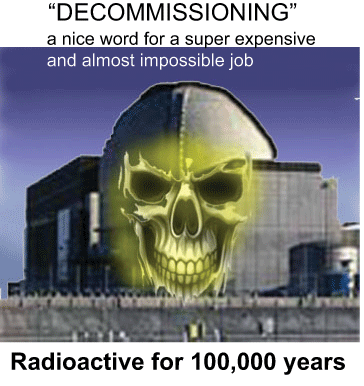
One of the earliest decommissioning efforts is taking place at Dounrey plant, on the northern tip of Scotland. It started more than 15 years ago and we need at least 30 years more to finish the job. After that, waste must be stored in nuclear graves (waste repositories) for thousands of years. United States regulations require the storage period to be at least 10,000 years.
The cost of decommissioning and waste storage will fall upon future generations at huge costs. My American colleague, Prof. S. Frachette, argues that large quantities of nuclear waste is likely to endanger the health, safety and civil liberties of generations yet to be born.
Professor Erhun Kula, from Istanbul’s Bahçesehir University, researched economic and moral aspects of nuclear power in the U.K., the United States and Sweden, and has published widely in this field. http://www.hurriyetdailynews.com/turkish-nuclear-power–an-unwarranted-venture.aspx?pageID=238&nID=18223&NewsCatID=396
Russia joins Japan in planning to make money out of Britain’s nukes
 ‘The British market is very attractive,’ said the group’s director of communications, Sergei Novikov…..
An agreement yesterday between the UK government and Japan ‘will open up opportunities’ for British firms to decommission the country’s nuclear sites.
Russian nuclear giant that built Chernobyl interested in erecting generators in Britain… well, they do have glowing references Daily Mail, By PETER CAMPBELL, 11 April 2012 | The Russian nuclear giant that built Chernobyl has confirmed interest in erecting generators in Britain. Kremlin-owned Rosatom is fundamentally the same group that built the Ukrainian reactors, one of which exploded in 1986. Continue reading
Germany needs to make sure that nuclear companies pay for nuclear decommissioning
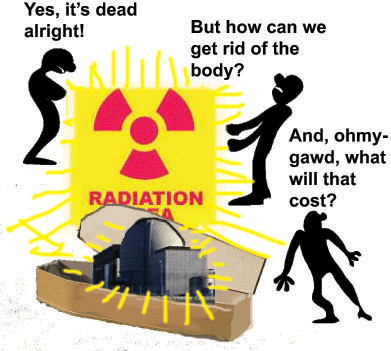 Germany open to nuclear shutdown fund – minister Greenpeace calls for state to run nuclear dismantling fund
* Environment minister says Greenpeace proposal can be examined
* Major utilities reject idea
DUESSELDORF, Germany, April 11 (Reuters) – Germany would consider ringfencing billions of euros to be put aside by utilities for disposing of radioactive waste, the environment minister said, to ensure decommissioning of the country’s nuclear power plants is completed decades from now. He was speaking on Wednesday in response to a call from environmental group Greenpeace that wants the government to administer some of the money earmarked for nuclear decommissioning.
German Chancellor Angela Merkel’s decision last year, following Japan’s nuclear plant disaster, to phase out nuclear power by 2022 has thrown big utilities on the defensive, weakening their finances and forcing them to rethink their business models.
Germany’s top four nuclear operators – E.ON, RWE , EnBW and Swedish’s Vattenfall – are footing the bill to dismantle the plants and dispose of radioactive waste. They have already made provisions of more than 30 billion euros ($39.3 billion).
Managing the disposal of waste will take decades after the last nuclear plant is due to shut in 2022 and Greenpeace fears that the companies may not be able to honour their obligations in the future or could try to wriggle out of them.
Parking the companies’ money in a separate state-run fund would protect German taxpayers should one or more of the firms become insolvent, Greenpeace said. “This is an idea that can be examined,” Environment Minister Norbert Roettgen told Reuters on Wednesday, adding it was clear that the operators of nuclear plants were responsible for dismantling them. ”We need to look at whether a combined fund is a better solution than relying on individual responsibility,” he added.
Greenpeace has also called for provisions to be raised to 44 billion euros. http://www.reuters.com/article/2012/04/11/germany-nuclear-idUSL6E8FB2XT20120411
Exelon Nuclear company begging for taxpayer charity
 State Help Needed for New Nuclear Units, Exelon Chief Says Bloomberg News, By Brian Wingfield April 11, 2012 U.S. utilities will need government help to build nuclear reactors as other forms of electric power become less expensive, a top executive of Exelon Corp. (EXC) (EXC), the nation’s largest commercial producer of atomic energy, said.
State support may include letting companies recover costs from customers during construction, providing loan guarantees or agreeing to buy power from the plant, Mayo Shattuck III, executive chairman of Chicago-based Exelon, said today at a conference in Washington.
Building reactors may require “the sovereign support of that state, which really means it’s on the backs of the ratepayers, not the backs of the shareholders,” Shattuck said at an event hosted by the Center for Strategic and International Studies. The Nuclear Regulatory
Commission on March 30 awarded Scana Corp. (SCG) (SCG) a permit to build two reactors at a plant near Columbia, South Carolina, and on Feb. 9 approved Southern Co. (SO) (SO)’s plan for two units at its Vogtle plant near Augusta, Georgia. Southern expects its project to
cost $14 billion. Scana will cover 55 percent of the estimated $10.2 billion for the South Carolina reactors. The plants, being financed partly by customers, may be among the last in the U.S. this decade…..
Economic conditions raise “very serious questions” about the possibility of building new reactors without government support, Shattuck said……
http://www.businessweek.com/news/2012-04-11/state-help-needed-for-nuclear-units-exelon-chief-says
USA military bases in Australia – making Australia a nuclear target?
If too closely aligned with the US, Australia will be associated with any mistakes. US actions, mounted from Australia, will implicate Australia. In the Cold War US joint intelligence facilities were a target for Soviet nuclear weapons……
Australia needs to be careful that it does not make inevitable the future that it should fear the most. Current decisions are being made without public debate or discussion. Once made they will be difficult to reverse.

We must not get too close to the US, BY: PETER LEAHY The Australian April 12, 2012 “……. there can be too much of a good thing, especially if it involves putting unnecessary pressure on China. By substantially increasing its
close relationship with the US, Australia may unduly complicate its relationship with China. Care needs to be taken to ensure that Australia is not caught between the US, as security guarantor, and China as economic underwriter.
As a sovereign nation Australia should maintain the ability to say no to the US and separate itself from its actions. This will require careful thought and deft diplomacy……By agreeing to the US Marine Corps and potentially more extensive air and naval access requests, Australia has confirmed that it is firmly in the US security camp……. Continue reading
Nuclear election issue in France: former AREVA chief exposed Sarkozy’s manipulations

 “Atomic Anne” tries to nuke France’s Sarkozy, Apr 11,
 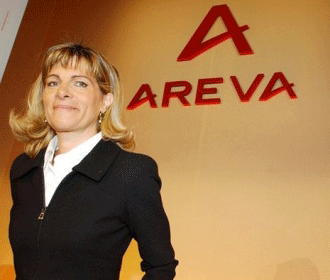 2012 * Ex-CEO says Sarkozy tried to sell reactor to Gaddafi * Government says Lauvergeon’s account is “fiction” * Socialists question EDF boss’ future By Paul Taylor, PARIS, April 11 (Reuters) – Nuclear warfare has broken out between France’s two main political parties 11 days before the first round of a presidential election, with a woman known as “Atomic Anne” launching a strike on President Nicolas Sarkozy. Continue reading
Diplomacy the best hope in dealing with Iran’s nuclear ambitions

 Give nuclear talks a chance, Haaretz, 12 April 12, The talks due to be renewed in Istanbul on Saturday between Iran and the five permanent members of the UN Security Council along with Germany have already been dubbed “the last diplomatic opportunity.” Continue reading
Mystery of USA’s lost nuclear attack submarine
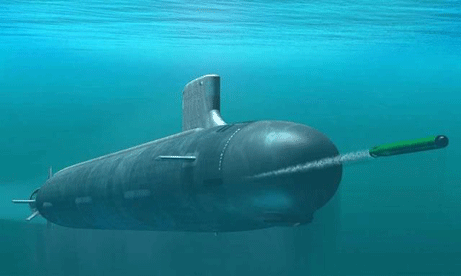 Experts out to solve deep-sea mystery of the USS Scorpion By Dan Vergano, USA TODAY 12 April 12, Shipwreck disaster experts are calling for a deep-sea expedition to a lost U.S. nuclear attack sub, the USS Scorpion, in an effort to verify a new theory on what caused the Cold War vessel to sink. Continue reading
Renewable energy investment climbing in UK

 Renewable energy investment bounces back after 2010 slump UK came 7th in global ranking for investment in clean energy last year, spending $9.4bn – up from $3.3bn in 2010, Madeleine Cuff guardian.co.uk, 11 April 2012 Investment in clean energy in the UK bounced back last year after its 2010 slump, the respected US-based Pew charitable trust has said in a comparison of investment across G20 countries. A total of $9.4bn was invested in wind, wave, solar and other renewable sources of power compared to $3.3bn in 2010 – a leap of 185%.
The UK came seventh in the global ranking for total investment in the Clean Energy Race 2011 report, below the United States, China, Italy and Germany. In 2010 the UK fell from 3rd to 13th in the world ranking, as investment plummeted from a high of over $11bn in 2009. The reduction was attributed to “uncertainty surrounding the policy perspective of a new government,” according to the 2010 report from Pew…..
Global investment in clean energy rose in 2011 by 6.5% to $263bn, fuelled by rising demand for solar panels, which are becoming ever cheaper to make and install. America is currently top of the clean energy table, but Italy and India saw large increases on their 2010 investment levels. The figures, based on Bloomberg New Energy Finance data released in a less granular form in January, also include finance for improving energy efficiency and research into low carbon technology.
Over half of Britain’s renewable energy comes from wind, and there is growing interest in the development of offshore windfarms. An extra $2.3bn of investment was ploughed into the UK wind sector this year….. http://www.guardian.co.uk/environment/2012/apr/11/renewable-energy-investment-bounces-back
Nuclear power for Turkey – pleases Russian sales, not the Turkish people
more than two thirds of the Turks do not want nuclear power. A government that constantly argues that it represents the will of the people is actually acting against the will of the people in this case….
 Turkish nuclear power – an unwarranted venture, Hurriyet Daily News, ERHUN KULA, 12 April 12 On Nov. 9, 2007, the ruling Justice and Development Party passed a law in the Turkish Parliament to build nuclear power plants in Turkey, which started the nuclear ball rolling. The government argued that this venture would provide “cheap,” “clean,” “safe” and sustainable energy to help rapidly expanding and diversifying Turkish industry. Of course, none of these claims about nuclear power is true. In fact, it is extremely expensive, unclean, unsafe and unsustainable. Continue reading
1 This Month

of the week – Shut Down Drone Warfare!


Tell the Ukrainian Government to Drop Prosecution of Peace Activist Yurii Sheliazhenko

Petition to revoke the licensing of the Near Surface Nuclear Disposal Facility (NSDF) at Chalk River. https://www.ourcommons.ca/petitions/en/Petition/Details?Petition=e-7247
To see nuclear-related stories in greater depth and intensity – go to https://nuclearinformation.wordpress.com
-
Archives
- March 2026 (230)
- February 2026 (268)
- January 2026 (308)
- December 2025 (358)
- November 2025 (359)
- October 2025 (376)
- September 2025 (257)
- August 2025 (319)
- July 2025 (230)
- June 2025 (348)
- May 2025 (261)
- April 2025 (305)
-
Categories
- 1
- 1 NUCLEAR ISSUES
- business and costs
- climate change
- culture and arts
- ENERGY
- environment
- health
- history
- indigenous issues
- Legal
- marketing of nuclear
- media
- opposition to nuclear
- PERSONAL STORIES
- politics
- politics international
- Religion and ethics
- safety
- secrets,lies and civil liberties
- spinbuster
- technology
- Uranium
- wastes
- weapons and war
- Women
- 2 WORLD
- ACTION
- AFRICA
- Atrocities
- AUSTRALIA
- Christina's notes
- Christina's themes
- culture and arts
- Events
- Fuk 2022
- Fuk 2023
- Fukushima 2017
- Fukushima 2018
- fukushima 2019
- Fukushima 2020
- Fukushima 2021
- general
- global warming
- Humour (God we need it)
- Nuclear
- RARE EARTHS
- Reference
- resources – print
- Resources -audiovicual
- Weekly Newsletter
- World
- World Nuclear
- YouTube
-
RSS
Entries RSS
Comments RSS
 nuclear-news