Collapse of nuclear power projects for financial reasons
The long list of nuclear reactor projects cancelled due to lack of financing and shoddy economics just got longer. It has been this way for decades
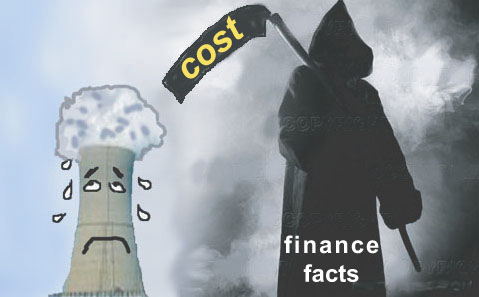 Double trouble for nuclear power: UK and Bulgaria projects collapse Greenpeace, by Justin McKeating – April 4, 2012 Yet more news in the past week about how bad an investment nuclear power is. In Bulgaria a plan to build a nuclear power plant was cancelled while in the UK plans to build two new plants were thrown into chaos.
First, on March 28, the Bulgarian government announced it was cancelling the Belene nuclear power plant, construction of which began way back in 1981. This brings to a successful close10 years of resistance to this bad idea. There were death threats against one of the key activists, Albena Simeonova, legal actions, and the involvement of hundreds of activists, volunteers, citizens, experts, politicians and civil servants.
The Bulgarian project finally collapsed over the issue of its cost. The Russian company Rosatom, the plant’s builders, said Belene would cost €6.3 billion. The government said it was unwilling to pay more than €5 bn and so, unable to attract western investment, it pulled the plug.
The very next day the UK’s plans for its own nuclear “renaissance” were hit by the German utilities RWE and E.ON pulling out of the consortium planning to build two new nuclear power plants at Oldbury and Wylfa. The companies expressed “doubts over financing the projects and costs associated with the German government’s decision to abandon nuclear power in the wake of the Fukushima disaster.” This follows French energy giant EDF cancelling another nuclear project just two weeks ago.
Belene and the RWE/E.ON decisions are yet two more examples of how the economics of nuclear power are broken. Since the costs of building new reactors are massive, private investors aren’t interested in the risks.
The long list of nuclear reactor projects cancelled due to lack of financing and shoddy economics just got longer. It has been this way for decades. Even back in the 1970s and 1980s – supposedly the boom years for nuclear power – “half of planned nuclear reactors had to be abandoned or cancelled due to massive cost overruns”…..
As Germany is showing, we don’t need to wait to increase renewable energy. Solar and wind power are increasing in their efficiency while their costs are falling every day. And, unlike nuclear, they are attracting investment and creating jobs. http://www.greenpeace.org/international/en/news/Blogs/nuclear-reaction/double-trouble-for-nuclear-power-uk-and-bulga/blog/39858/
No comments yet.
1 This Month

of the week – Shut Down Drone Warfare!



Tell the Ukrainian Government to Drop Prosecution of Peace Activist Yurii Sheliazhenko

Petition to revoke the licensing of the Near Surface Nuclear Disposal Facility (NSDF) at Chalk River. https://www.ourcommons.ca/petitions/en/Petition/Details?Petition=e-7247

of the week – STOP SMALL MODULAR REACTORS IN CANADA
To see nuclear-related stories in greater depth and intensity – go to https://nuclearinformation.wordpress.com
-
Archives
- March 2026 (222)
- February 2026 (268)
- January 2026 (308)
- December 2025 (358)
- November 2025 (359)
- October 2025 (376)
- September 2025 (258)
- August 2025 (319)
- July 2025 (230)
- June 2025 (348)
- May 2025 (261)
- April 2025 (305)
-
Categories
- 1
- 1 NUCLEAR ISSUES
- business and costs
- climate change
- culture and arts
- ENERGY
- environment
- health
- history
- indigenous issues
- Legal
- marketing of nuclear
- media
- opposition to nuclear
- PERSONAL STORIES
- politics
- politics international
- Religion and ethics
- safety
- secrets,lies and civil liberties
- spinbuster
- technology
- Uranium
- wastes
- weapons and war
- Women
- 2 WORLD
- ACTION
- AFRICA
- Atrocities
- AUSTRALIA
- Christina's notes
- Christina's themes
- culture and arts
- Events
- Fuk 2022
- Fuk 2023
- Fukushima 2017
- Fukushima 2018
- fukushima 2019
- Fukushima 2020
- Fukushima 2021
- general
- global warming
- Humour (God we need it)
- Nuclear
- RARE EARTHS
- Reference
- resources – print
- Resources -audiovicual
- Weekly Newsletter
- World
- World Nuclear
- YouTube
-
RSS
Entries RSS
Comments RSS
 nuclear-news
Leave a comment