Killing Iran’s nuclear scientists – counter productive says U.S. security agency

 Assassinations will not stop Iran’s nuclear program: ISIS Press TV 7 March 12, The US-based Institute for Science and International Security (ISIS) says killing Iranian nuclear scientists will not delay the progress of Tehran’s nuclear energy program.
In its March 7 report on Iran, the institute focused on the situationof the Iranian nuclear energy program and efforts by Western countries to prevent the Islamic Republic from acquiring nuclear capability.
Referring to Western efforts to stymie Iran’s nuclear energy program, the report said the assassination of Iranian scientists or threatening Tehran with a possible military strike were not good options for preventing the progress of the country’s nuclear energy program.
Pointing to the disadvantages of employing “risky” strategies against Iran, the report said, “Assassinations of Iranian nuclear scientists and engineers have occurred with greater frequency but should be stopped because they carry too high a risk of retaliation.”
Moreover, the ISIS report added, assassinations are unlikely to be effective in setting back the Iranian nuclear energy program because they involve thousands of specialists and ingrained know-how.
The institute cautioned the West that “Iran might argue that assassinations are equivalent to a military attack and use this as justification for further provocations.”
“An under-siege mentality created by use of such tactics could motivate Iran to further degrade its cooperation with IAEA [International Atomic Energy Agency] and resist offers of
negotiation,” the report stated. … http://presstv.com/detail/230477.html
UK and the world under threat of radioactive ‘dirty bomb’
 WHAT IS A DIRTY BOMB?
A dirty bomb combines normal explosives (such as dynamite or Semtex)and radioactive materials.
The bomb blast rapidly spreads the radioactive particles, creating a
major contamination hazard.
The blast itself is as forceful as any other type of high-explosive
device but would boost radiation levels in the detonation area,
causing long-term damage. It could increase the risk of cancer and
kill people several years in the future.
 Nuclear-armed terrorists are a real threat to Britain, Deputy Prime Minister Nick Clegg will warn
Police ‘unable to contain’ nuclear threat
Spectre of nuclear attack ‘impossible to ignore’
Countries must ‘work together’ to prevent destruction
Maol Online, By MATT BLAKE, 7th March 2012 Stateless terrorists are closer to unleashing a nuclear attack on Britain than ever before, Nick Clegg will warn today.
The Deputy Prime Minister will say materials and internet instructions on how to make a ‘dirty bomb’ have become so readily available in recent years that police forces are unable to contain such a threat.
Al Qaeda are already known to be actively trying to amass nuclear material and recruit rogue scientists to build a radioactive ‘dirty bomb’ while diplomatic temperatures between Iran and the West are at boiling point.
Mr Clegg will issue a plea for more co-operation between countries to fight the spectre of terrorism, crime and economic collapse Continue reading
Nuclear power – an antiquated and uneconomic technology
The economic argument for renewable energy is also compelling. Nuclear power is an antiquated technology that requires billions of euros in subsidies; so far, German taxpayers have contributed €196 billion for this purpose.
A German government study has estimated that, between 2010 and 2050, Germany could save more than €700 billion by relying on non-nuclear renewable energy instead of nuclear power or imported fossil fuels such as coal, gas, and oil.
No nuclear please, we’re German, ABC JGEN TRITTIN, 8 March 12, “…….. while Germany is now heading in the right direction, the security risks of nuclear power plants in neighbouring countries, such as France and the Czech Republic, remain. There must be a general shift in both European and global energy policies.
The current European stress tests of nuclear-power plants are a first step; but, as long as they are voluntary and under the operators’ control, they will be nothing more than political window
dressing. Continue reading
Santa Susanna’ s radiation pollution from 1959 nuclear accident
 Santa Susanna pollution data raises more questions about long term radiation than it answers, 89.3 KPCC, March 6, 2012 | By Molly Peterson I did a short story today about the former Santa Susanna Field Laboratory site, where Rocketdyne and others once had operations, and where in 1959 a nuclear accident released far more radioactive material than Three Mile Island. I don’t just hang out on the EPA’s website, or at the gates of that property. Instead, I heard about the data release from State Senator Julia Brownley’s release yesterday :
“This confirms what we were worried about,” said Assemblywoman Julia Brownley, D-Oak Park, a long-time leader in the fight for a complete and thorough cleanup of this former Rocketdyne rocket engine testing laboratory. “This begins to answer critical questions about what’s still up there, where, how much, and how bad?”
Brownley’s release asserts that the new samples collected are up to 1000 times higher than the “radiation trigger levels” approved by state and federal officials in 2010, when state officials reached agreements deemed, at the time, “historic,” with NASA and the Department of Energy for cleanups. Continue reading
Radiation therapy – necessary, but can cause secondary cancers
 Younger patients are especially susceptible to the effects of radiation, and the three cancers that have been most strongly associated with radiation are breast cancer, thyroid cancer and bone marrow cancers, including leukemia
Clinicians say the benefits of radiation treatment for many types of cancer far outweigh the potential risks of experiencing serious adverse effects years later, and say radiation is now a lot safer than it once was. …. “We try to use radiation as sparingly as possible, but unfortunately, it is frequently part of the cure in a lot of cancers and it’s absolutely necessary,”
 Radiation Therapy Linked to Secondary Cancers KBOI News, 7 March 12, (NEW YORK) — While the number of cancer survivors has tripled since the 1970s and continues to grow, the cost of that survival for many has been the development of secondary cancers and cardiovascular disease related to radiation treatment, according to an upcoming report by a scientific committee. Continue reading
Virginia – hasty uranium regulations, behind closed doors
Activists urge caution on regulations for uranium mining, Virgnia Politics, 03/07/2012, By Anita Kumar As Gov. Bob McDonnell’s administration begins developing regulations for uranium mining, some activists are expressing concerns about the process.
In a letter to the administration, representatives of the Piedmont Environmental Council, Virginia League of Conservation Voters and Sierra Club say they worry that the regulations, which are supposed to be written over the next year, will be done too quickly, behind closed doors and with little input from the public.
Another group of business leaders from Southside Virginia called for additional data instead before the regulations are developed. In January, McDonnell (R) recommended that the state further study the impact of excavating a site in Southside Virginia that contains the nation’s largest known uranium deposit before lifting a mining ban.
He created a multi-agency group — comprised of staff from the Virginia Department of Health, the Virginia Department of Environmental Quality and Virginia Department of Mines, Minerals and Energy — to study the site and draft regulations for a possible new mining industry in Virginia. The group will accept public comments during four open meetings and on a new Web site ….. Environmental groups — worried that a uranium mine in Virginia’s relatively rainy climate could contaminate natural resources, cause illness and have long-term effects on plants and animals — are disappointed that McDonnell wants to begin preparing regulations….. http://www.washingtonpost.com/blogs/virginia-politics/post/activists-urge-caution-on-regulations-for-uranium-mining/2012/03/07/gIQAwJpYxR_blog.html
Doctors report on radiation and the nuclear danger
 Radiation is silent and invisible and the potential for long-term serious health effects are concepts that are difficult to grasp by the lay person. The need to educate the public could undermine the, until now, strongly projected assurance by both nuclear operators and government agencies, that nuclear power is safe…..
RECOMMENDATIONS: According to the new PSR report: “The past experience with catastrophic nuclear accidents and their frequency indicates that no country is prepared physically or financially to deal with the short and long term effects. As opposed to natural disasters, experience has shown us that nuclear catastrophes do not remain isolated but tend to become global problems affecting us all. Such preparations in the U.S. will likely be useless if a similar accident happens in countries such as North Korea, Pakistan, or other countries that have nuclear power reactors but no emergency plans. In reality, there is no cure once these events have happened; the only options are mitigation and palliation. In the absence of a cure, prevention is the only option.”
 Physicians for Social Responsibility PSR Report: U.S. First Responders, Medical Infrastructure not Prepared for Fukushima-Level Reactor Crisis in the United States Market Watch, WASHINGTON, March 6, 2012 – One Year After Japanese Disaster, Little or No Movement Seen in U.S. to Improve Response Capability; Complicating Factors: Growing Population Near Nuclear Sites, Aging Reactors & Lack of Gov’t Coordination.
One year after the Fukushima reactor crisis in Japan, no meaningful progress has been achieved in improving the ability of first responders and medical professionals to react to a disaster on a similar scale in the United States, according to a major new report from Physicians for Social Responsibility (PSR). Continue reading
Epidemic of cancer from nuclear bomb testing in Marshall Islands
“Today we are witnessing an exploding epidemic of cancer cases,” … “Cancers, birth anomalies and other radiogenic diseases make a compelling argument for the United States to reopen the nuclear issue,”
RMI CRITICIZES U.S. OVER NUCLEAR COMPENSATION PACIFIC ISLANDS REPORT Pacific Islands Development Program/East-West CenterWith Support From Center for Pacific Islands Studies/University of Hawai‘i
‘Exploding epidemic of cancer cases,’ $2 billion in unpaid claims
By Giff Johnson SAIPAN, CNMI (Marianas Variety, March 6, 2012) – Marshall Islanders accused the United States government of refusing to provide adequate nuclear test compensation on the 58th anniversary of the largest American hydrogen bomb test that exposed thousands of islanders to radioactive fallout. Continue reading
United Nations Scientific Committee on the Effects of Atomic Radiation
The committee, known as UNSCEAR, will publish a report in May 2013 that aims to give an analysis of radiation dosages among citizens and forecast health risks in the coming decades
 Children Wait for UN Radiation Study After Fukushima Crisis, Bloomberg By Yuriy Humber and Tsuyoshi Inajima March 05, 2012 As five-year-olds charge through the corridors of a kindergarten in northeast Japan at lunchtime, teacher Junko Kamada says she is still unsure if their food is safe a year after the Fukushima nuclear accident.
Since the March 11 earthquake and tsunami wrecked the Fukushima plant, about 100 kilometers (62 miles) south of the Sakuragi Hanazono kindergarten in Tagajo city, parents of the 198 children have been seeking assurances that the school lunches are free of radiation…..
wait at least another 14 months for a unified view on food contamination when the United Nations Scientific Committee on the Effects of Atomic Radiation issues the first global and independent assessment of the Fukushima nuclear accident. Continue reading
Japan’s Tsuruga nuclear plant over an active earthquake fault

 Fault under Tsuruga nuclear plant could trigger M7.4 quake: research TOKYO Mainichi Daily News, 6 March 12, (Kyodo) — An active fault running under the Nos. 1 and 2 reactors at Japan Atomic Power Co.’s Tsuruga nuclear plant in Fukui Prefecture is at least 35 kilometers long and could trigger an earthquake with a magnitude of around 7.4, much higher than previously anticipated, a team of government-affiliated researchers said Monday. Continue reading
Is Japan’s 3/11 history? Not unless we change the definition.
Radiation is still venting into the air around Fukushima.
Noda says the entire Japanese establishment had been taken in by the “myth of safety” and it’s all a do-over. At the same time, that establishment also propagated the now laughable argument that nuclear power is clean, safe and cheap…..
Most Japanese don’t want a nuclear future, yet they’re being strong-armed into submission. If that’s not a crime, I’m not sure what is
Pesek: Japan Nuclear Mobsters Don’t Share Pain, Bloomberg, By William Pesek Mar 6, 2012 A year after an earthquake in Japan (JGDPAGDP) touched off the worst nuclear crisis since Chernobyl, here’s the question on my mind: Who’s going to jail? The news media are asking the obvious and safe questions ahead of March 11: How well did the government respond? Whither the devastated northeast? What’s the economic effect? When might the 52 of 54 nuclear reactors mothballed since then reopen?
This barrage of “anniversary” articles misses the point. Continue reading
6 World Powers to Resume Nuclear Talks With Iran
 World Powers Agree to Resume Nuclear Talks With Iran, NYT, By NICHOLAS KULISH and JAMES KANTER , March 6, 2012 BERLIN — For the first time in more than a year the global powers dealing with Iran ’s disputed nuclear program said Tuesday that they would resume face-to-face negotiations. “I have offered to resume talks with Iran on the nuclear issue,” said Catherine Ashton, the European Union’s foreign affairs chief, who represents the United States, Russia, China, France, Britain and Germany in dealings with Iran. “We hope that Iran will now enter into a sustained process of constructive dialogue which will deliver real progress.”…..
Fears of a pre-emptive Israeli attack on Iran’s nuclear facilities have driven up oil prices and represent a threat to the already fragile state of a global economy still reeling from a sovereign debt crisis in Europe . At the same time, the Iranians have acutely felt the squeeze from sanctions aimed at pressing the government to freeze its uranium enrichment program.
The resumed talks represent a significant step forward, because all six parties agreed to participate……http://www.nytimes.com/2012/03/07/world/middleeast/iran-agrees-to-inspection-of-secret-military-site-report-says.html
Should UK scrap its probably useless Trident nuclear missiles?
UK’s nuclear weapons in the frame, Guardian UK Richard Norton Taylor and Nick Hopkins, 6 Mar 12, LibDems question future of Trident Debate building up in coalition over deterrent Pressure on defence budget remains There are signs, like green shoots heralding spring, that the last taboo of British politics is breaking.
Liberal Democrats are finally gearing themselves up seriously to question the Conservative attachment to Britain’s Trident nuclear weapons system and commitment to replace it with a “like for like” fleet of ballistic missile submarines.
Trident – the ultimate strategic weapon – was excluded from the coalition government’s “strategic defence and security review” last autumn.
And judging from the “shadow defence review” consultation paper, just launched, there is no difference at all between Labour and Conservatives on the matter…..
Now, the thinktank CentreForum – independent but linked to the LibDems – says the plans to build a new Trident system are “nonsensical” and should be scrapped. As my colleague, Nick Hopkins, notes, the 60-page study, Dropping the Bomb: A Post-Trident Future, is believed to reflect the views of many senior Lib Dems who are trying to force a debate on whether the UK still needs a nuclear deterrent.
The report says the government is sleepwalking into taking a costly and illogical decision at a time the army, navy, and air force are being squeezed by budget cuts. The cost of a new fleet of Trident submarines alone is officially estimated at £25bn. Interestingly, the report’s author, Toby Fenwick, is a former Treasury official. BAE Systems, manufacturer of the Trident subs, is listed on CentreForum’s website, as one of the thinktank’s “corporate partners”.
In his memoirs, A Journey, Tony Blair described Trident’s expense as “huge” and its military use as a weapon “non-existent”…. http://www.guardian.co.uk/news/defence-and-security-blog/2012/mar/06/uk-nuclear-trident?newsfeed=true
Fukushima to get off shore wind farm
 Mixed Greens: Offshore wind for Fukushima REnew economy, By Sophie Vorrath 7 March 2012 Almost one year after an earthquake and tsunami hit Fukushima and sent three out of six of its nuclear reactors into meltdown, the Japanese government has announced plans to install two Mitsubishi Heavy 7MW turbines, and a 2MW turbine made by Fuji Heavy, at a floating wind farm off the coast of the devastated prefecture. Recharge News reports that the estimated ¥12.5 billion project is part of a government plan to kick-start the country’s offshore wind sector and rejuvenate the Fukushima region. Tokyo has flagged plans to install 1GW of offshore wind power in the Fukushima region, and Japan’s Wind Power Association estimates potential for 519GW of floating offshore wind capacity in Japan. “The Tokyo area has good potential for offshore. It’s easy to get grid connections. The Fukushima nuclear power plants will never operate again so there’s a vacant grid line there,” says Yoshinori Ueda, assistant general manager at MHI.
The floating wind farm will be located between 20-40km offshore, where ocean depths range from 100-150 metres, the average wind speed is more than 7-metres per second and wave heights are 10-15 metres. It will be built by a consortium including Japanese trading house Marubeni, MHI, Mitsubishi Corp, IHI Marine United, Mitsui Engineering & Shipbuilding, Nippon Steel, Hitachi, Furukawa Electric and Shimizu; with consultation from the University of Tokyo and Mizuho Information & Research Institute. The first phase of the project, due to be completed by March 2013, will see the installation one of Fuji Heavy’s Subaru80 2MW turbines with a four-column, semi-submarine type floater and a 66kV floating offshore substation. In the second phase, from 2013-15, Mitsubishi Heavy will install two of its new 7MW turbines, with a three-column, semi-submarine type floater.
Mitsubishi Heavy’s 7MW turbine, known as the ‘SeaAngel’ and developed with about ¥5 billion in backing from the Japanese government, uses a hydraulic transmission system to eliminate the need for a gearbox. The first prototype is set to be installed onshore in the UK next year, ahead of the Fukushima offshore project…. http://reneweconomy.com.au/2012/mixed-greens-offshore-wind-for-fukushima-64769
World’s biggest man made hole – BHP ‘s uranium mine, might not go ahead
 Reuters report on mining conference in Canada Mar 6, 2012 By Euan Rocha TORONTO, March 6 – The Anglo-Australia mining giant, which already operates an underground mine at the site, has yet to sign off on the budget for
the open pit…. but BHP may opt to delay taking on the heavy financial burden that could easily be in the $10 billion to $20 billion range…..
…. PDAC, the mining industry’s largest annual gathering. The convention, organized by the Prospectors and Developers Association of Canada, opened in Toronto on Sunday.
Even though Olympic Dam, located 550 km (345 miles) north of Adelaide, is one of BHP’s biggest growth prospects, the cost of
digging the massive pit may prove prohibitive.
Last month the company reported a profit decline, and it struck a cautious tone on its expectations for growth in China, one of its
biggest markets. That has led some to speculate that the miner may delay spending on capital-intensive projects such as Olympic Dam and the Jansen potash project in the Canadian province of Saskatchewan.
In late 2011, BHP finalized state approvals to begin construction work on the open-pit phase of the Olympic Dam project, but the agreement would lapse around December if BHP delays its decision on proceeding.
“We want to see a board decision before the end of the year about substantial works beginning. If not, the approvals run out and BHP know this,” said Tom Koutsantonis, minister for mineral resources and energy for the state of South Australia.” I’m not in the business, and no government should be in the business, of allowing anyone to have massive tenements that they don’t develop …”-
A spokesman for BHP declined to comment on the remarks.
MASSIVE SCALE The sheer scale of the open-pit project is formidable. BHP will have to shovel rock for five to seven years before it reaches the Olympic Dam ore body, discovered in the mid-1970s….. http://www.reuters.com/article/2012/03/06/canada-mining-pdac-olympicdam-idUSL2E8E60E220120306
1 This Month
22 June – Virtual Event –Climate Change: New Data, New Debate

Monday, June 22, 2026 2:30 p.m. – 3:15 p.m. CT
YouTube. Register here

Protect Sazan Island from the Trump family! https://secure.avaaz.org/campaign/en/protect_sazan_island_from_the_trump_family_loc/?bqFCVab&v=174511&cl=22707147157&_checksum=5e9dde668860e8231c33699735e16a1fbf22ab2cb01da50c999fe8732b9775ef&utm_source=email&utm_medium=blast_email&utm_campaign=174511
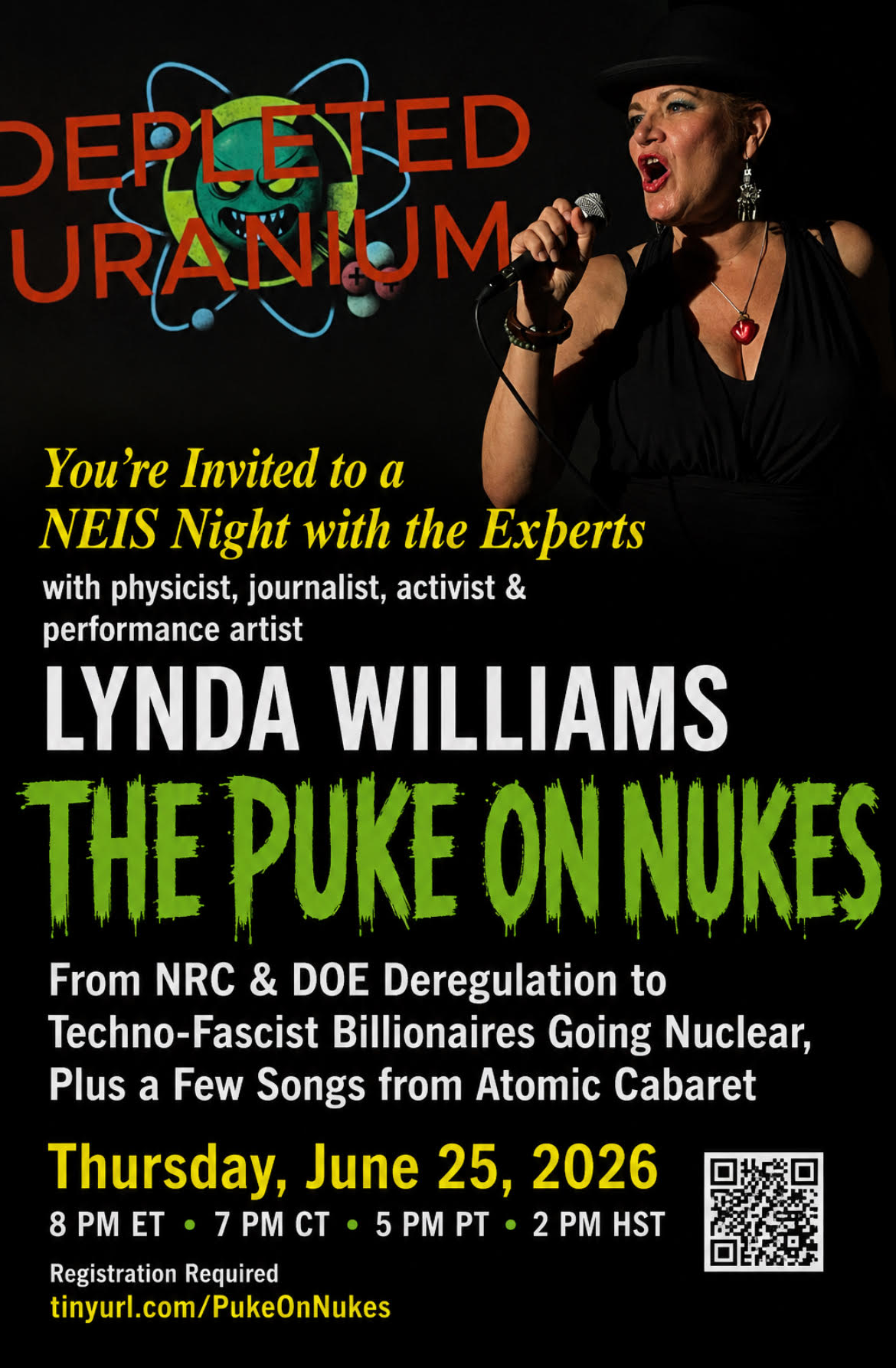
25 June- THE PUKE ON NUKES
Thursday, June 25, 2026
7pm Central Time (8pm ET, 6pm MT, 5pm PT) UTC – 5
From NRC & DOE Deregulation to Techno-Fascist Billionaires Going Nuclear, Plus a Few Songs from Atomic Cabaret REGISTER
26 June – Radiation Trainwreck at the NRC / Join the Protect Better Campaign – https://us02web.zoom.us/meeting/register/4ZlZ5_qLSHGiLSCg8FF6Bg#/registration


Cuba Is Not a Failed State – It Is a Besieged State
PETITION: “Global Appeal to Endorse Palestinian Right of Return of Refugees”
To see nuclear-related stories in greater depth and intensity – go to https://nuclearinformation.wordpress.com
-
Archives
- June 2026 (193)
- May 2026 (306)
- April 2026 (356)
- March 2026 (251)
- February 2026 (268)
- January 2026 (308)
- December 2025 (358)
- November 2025 (359)
- October 2025 (376)
- September 2025 (257)
- August 2025 (319)
- July 2025 (230)
-
Categories
- 1
- 1 NUCLEAR ISSUES
- business and costs
- climate change
- culture and arts
- ENERGY
- environment
- health
- history
- indigenous issues
- Legal
- marketing of nuclear
- media
- opposition to nuclear
- PERSONAL STORIES
- politics
- politics international
- Religion and ethics
- safety
- secrets,lies and civil liberties
- spinbuster
- technology
- Uranium
- wastes
- weapons and war
- Women
- 2 WORLD
- ACTION
- AFRICA
- Atrocities
- AUSTRALIA
- Christina's notes
- Christina's themes
- culture and arts
- Events
- Fuk 2022
- Fuk 2023
- Fukushima 2017
- Fukushima 2018
- fukushima 2019
- Fukushima 2020
- Fukushima 2021
- general
- global warming
- Humour (God we need it)
- Nuclear
- RARE EARTHS
- Reference
- resources – print
- Resources -audiovicual
- Weekly Newsletter
- World
- World Nuclear
- YouTube
-
RSS
Entries RSS
Comments RSS
 nuclear-news