YouTube: Beyond Nuclear Remembers Fukushima
 Remembering Fukushima nuclear disaster, Ed Asner urges an end to nuclear energy

How would a regional nuclear war affect climate?
 Effects of a regional nuclear war on global temperatures, Chron.com Eric Berger, 10 Mar 12, Despite a flurry of diplomatic efforts tensions between Israel and Iran appear to be reaching a boiling point regarding the latter country’s designs on joining the nuclear club.
This is not a geopolitical blog, but rather a science one. So I want to address the question of nuclear war’s effect on climate.
Rutgers University environmental research Alan Robock has studied this question in a meaningful way, using NASA’s climate ModelE to study the climatic effects of the byproducts of a nuclear war. Let me be clear, its effect on climate change is down the list of problems posed by nuclear weapons, but the long-term effects would nonetheless be profound, most specifically through colder temperatures, shorter growing seasons and famine.
First lets look at the consequences of a regional nuclear war using 100 15-kT (Hiroshima-size) weapons.
In this scenario, using Pakistan and India, weapons were dropped on the 50 targets in each country to produce the maximum smoke. An estimated 20 million would die, and 5 teragrams of smoke would be pumped into the atmosphere. Such a war would encompass just 0.3 percent of the world’s nuclear arsenal.
Here is its effect on global temperatures:..[very good graphs here] ….. there would be a substantial temporary cooling, but within a decade temperatures would likely respond to 1990s levels.
Then, the research group looked at the consequences of a full-scale nuclear war between the United States and Russia. While highly unlikely, the results of such a war on global temperatures live up to the nuclear winter of which Carl Sagan warned. ….. http://blog.chron.com/sciguy/2012/03/effects-of-a-regional-nuclear-war-on-global-temperatures/
Shutdown soon for Japan’s nuclear industry
Japan nuclear industry nears shutdown TOKYO, Outcome Magazine, March 9 (UPI) — The nuclear energy industry that once supplied a third of Japan’s electricity has nearly shut down amid safety concerns and public opposition, officials say.
Nearly a year after an earthquake and tsunami caused the Fukushima nuclear power plant meltdown all but two of Japan’s 54 commercial nuclear reactors have gone off-line, with no indication when they’ll restart, and the last operating reactor is scheduled to go off-line next month, The New York Times reported.
Prime Minister Yoshihiko Noda says he supports restarting the plants as soon as possible but phasing out nuclear power over several decades in a country that was once a world leader in use of atomic energy. And Noda said he will not allow reactors to restart without the backing of local community leaders.
The dramatic move away from nuclear energy provides an indication of how much attitudes about safety have shifted in Japan since the magnitude-9 earthquake and tsunami.
“March 11 has shaken Japan to the root of its postwar identity,” said Takeo Kikkawa, an economist at Hitotsubashi University in Tokyo. “We were the country that suffered Hiroshima and Nagasaki, but then we showed we had the superior technology and technocratic expertise to safely tame this awesome power for peaceful economic progress. Nuclear accidents were things that happened in other countries.”…. http://outcomemag.com/world/2012/03/09/japan-nuclear-industry-nears-shutdown/
Evacuation plans last year, as Fukushima crisis occurred
Mr McLean revealed that Australia and other nations began compiling elaborate evacuation plans amid growing concern and uncertainly as the Fukushima plant began to explode.
The former ambassador confirmed Australia had evacuation plans in place but voiced the uncomfortable truth that, in reality, greater Tokyo (population 35 million) would have been almost impossible to evacuate.
Ex-ambassador frustrated by post-tsunami silence BY: RICK WALLACE, TOKYO CORRESPONDENT The Australian March 10, 2012 AUSTRALIA’S former ambassador to Japan has told of his frustrations with the Japanese government for keeping its close partners in the dark about the extent of the damage to the Fukushima nuclear plant at the height of the crisis almost one year ago. Continue reading
Germany closing nuclear, France divided on the subject
Sarkozy’s main rival, Socialist Party candidate Francois Hollande, wants to reduce France’s dependence on nuclear energy but not end it altogether.
But Yannick Rousselet, who heads nuclear issues at Greenpeace France, believes this is the beginning of the end.
Year After Fukushima, Nuclear Energy Divides Europe, Voice of America, Lisa Bryant March 09, 2012 Paris Last year’s accident at Japan’s Fukushima-Daichi nuclear power plant has intensified divisions in Europe over the safety and future of nuclear energy. Perhaps nowhere are the differences more apparent than between the region’s biggest powers – France and Germany. . Continue reading
North Korea’s unsafe nuclear reactor
 Shortcuts to another nuclear disaster SF Gate, Philip Yun, 9 Mar 12, “……Fukushima cautions us that nuclear technology is inherently dangerous. It also reminds us that accidents are always possible, despite the best of precautions. Right now there is a potential nuclear disaster in Asia that is under the radar: the construction of an unsafe light-water reactor in Yongbyon, North Korea. Continue reading
Rising oil prices – a compelling indicator for renewable energy growth
Increasing Oil Prices could Trigger Renewable Energy Growth, March 9, 2012 by Jason Staeck ProspectingJournal , “……The Energy Information Agency recently released its “Annual Energy Outlook 2012”. It reported that renewable energy production was set to double by 2035 even if all government tax breaks had expired. Electricity demand is expected to grow by just under 1 percent each year, with the outlook also suggesting a growing reliance on renewable sources in electricity consumption.
California has set a precedent, with regulators issuing rules that will require 1 in 7 cars produced in 2025 to contain either zero-emission or plug-in hybrid technologies. Many analysts are bullish other markets will follow suit.
Regardless, oil prices are likely to remain the decisive factor in advocating such changes. With global reliance on oil growing there is little reason to believe prices will decrease in the near future. …. higher prices may be realized very rapidly. If that were the case, we
are likely on the brink of compelling many to restructure their consumption habits in favor of renewable energy sources. And history tells us that there will be more oil shocks to come.
http://www.prospectingjournal.com/increasing-oil-prices-could-trigger-renewable-energy-growth030912/
Renewable energy a growth area for India, China and South Korea
India, China focussing on renewable energy sources: WEF, Economic Times, 9 MAR, 2012, DUBAI: India, China and South Korea are increasingly focusing on renewable energy sources, including wind and solar, as potential growth sectors for their economies, a World Economic Forum report said today. …. While multiplier effects for solar and wind energy were lower during operation, their contribution during the construction phase also reached as high as 3.3 indirect jobs per energy job.
“The energy industry is unique in its economic importance and has the potential to be a tremendous catalyst for job creation and sustainable growth without harming the sector’s overall performance,” said Chairman Daniel Yergin of IHS CERA, which partnered in the preparation of the WEF report. …. http://economictimes.indiatimes.com/news/politics/nation/india-china-focussing-on-renewable-energy-sources-wef/articleshow/12198416.cms
Fukushima fallout goes global
 The World is Powerless Against Fukushima Fallout, Hyphen Submitted by New America Media, March 8, 2012 by Yoichi Shimatsu A year on, the Fukushima nuclear disaster has reached far beyond Japan as an encroaching threat to human health everywhere and to the very existence of life on Earth. As the fallout goes global, there’s nowhere to run or hide since even tiny dosages in rainwater and the food chain have a cumulative effect.
In high-tech societies under constant exposure to radiation from medical scanners, security systems, telecom devices and consumer electronics, nearly everyone is teetering at the brink of the cancer abyss. The slightest exposure to dust from Fukushima is a ticket to an early exit.
Despite new admissions of a cover-up from high officials and an independent investigation in Japan, governments and the nuclear establishment continue to deny or downplay the immense dangers posed by atmospheric fallout and sea dumping from the Fukushima meltdowns.
An accurate reckoning of the danger to public health worldwide is not being discussed because governments are powerless against the nuclear monstrosity they created.
Decades of assurances about nuclear safety have been blown away by the unexpected global effects of the March meltdowns. The past year’s crisis yanked open a Pandora’s Box of bizarre science that staggers the imagination of corporate scientists and bureaucrat engineers, from whom there comes only dumfounded silence. These include:…. . http://www.hyphenmagazine.com/blog/archive/2012/03/world-powerless-against-fukushima-fallout
Fukushima radiation in Ireland shows the global reach of nuclear pollution
Fukushima radiation measured in Ireland, The Irish Times – , March 9, 2012 DICK AHLSTROM, Science Editor RADIOACTIVITY FROM the Fukushima nuclear reactor accident in Japan reached Ireland in the weeks after the event. It arrived at such low levels, however, that it had no significance for either public health or food safety, according to a report on the incident from the Radiological Protection Institute of Ireland. “The levels that we have detected were very low,” Dr Ciara McMahon, the institute’s director of environmental surveillance and assessment, said yesterday….
“Fukushima couldn’t be much further away from Ireland, but we still must be able to monitor for accidents. We have to be ready to respond.”
The incident, triggered by the impact of an earthquake and tsunami, showed the need for nuclear authorities worldwide to re-evaluate their safety procedures, said the institute’s chief executive, Dr Ann McGarry.
 There was “no room for complacency within the international nuclear industry”. “A nuclear accident anywhere has potential to be a nuclear accident everywhere.” The radioactive particles that reached Ireland were similar to those arriving as nuclear fallout here after the Chernobyl nuclear power plant disaster in 1986, according to data from the institute. The
monitoring stations detected radioactive Iodine-131 and two forms of radioactive Caesium, Cs-137 and Cs-134. http://www.irishtimes.com/newspaper/ireland/2012/0309/1224313062967.html
Video on the failure of the nuclear dream
Scroll down this page http://www.economist.com/node/21549098 to see excellent video with Oliver Morton
The dream that failed, Oliver Morton, The Economist, Mar 10th 2012 The renaissance that wasn’t…

In the energy world, nuclear has found its place nourishing technophile establishments like the “nuclear village” of vendors, bureaucrats, regulators and utilities in Japan whose lack of transparency and accountability did much to pave the way for Fukushima and the distrust that has followed in its wake. http://www.economist.com/node/21549098
Economics point to the failure of nuclear power
The West’s “nuclear renaissance” much bruited over the past decade, in part as a response to climate change, fizzled out well before the roofs blew off Fukushima’s first, third and fourth reactor buildings…..
at the same time as the cost of new nuclear plants has become prohibitive … worries about the dark side of nuclear power are resurgent, thanks to what is happening in Iran…..
The dream that failed The Economist, Oliver Morton, Mar 10th 2012 | THE LIGHTS ARE not going off all over Japan, but the nuclear power plants are. Of the 54 reactors in those
plants, with a combined capacity of 47.5 gigawatts (GW, a thousand megawatts), only two are operating today. Continue reading
Conciliatory approach by Iran’s supreme leader

 Iran’s supreme leader praises Barack Obama over war stance,
Iran’s supreme leader took the unusual step of praising President Barack Obama for eschewing the language of war on Thursday, raising hopes that he may genuinely be seeking a negotiated solution to Tehran’s nuclear impasse with the West. Telegraph, By Adrian Blomfield, 08 Mar 2012 Ayatollah Ali Khamenei chose to ignore a toughening in US rhetoric towards Iran in recent days, focusing instead on Mr Obama’s insistence that there was still a “window of opportunity” to resolve the dispute with Tehran in a peaceful manner.
“We heard two days ago that the US president said that (they) are not thinking about war with Iran,” the Iranian leader was quoted as saying. “These words are good words and an exit from delusion.”
Although the ayatollah’s compliment was undoubtedly barbed, it represented a significant departure from the virulently anti-Western demagoguery he normally employs, leading some observers to suggest that he was sending a conciliatory message to Washington…..
http://www.telegraph.co.uk/news/worldnews/middleeast/iran/9131974/Irans-supreme-leader-praises-Barack-Obama-over-war-stance.html
Obama and the Republicans in the warm embrace of the nuclear lobby
 Big Nuclear’s cosy relationship with the Obama administration One year on from Fukushima, the US is rewarding the nuclear energy lobby by underwriting new investment – regardless of risk Amy Goodman guardian.co.uk, 8 March 2012 Super Tuesday demonstrated the rancor rife in Republican ranks, as the four remaining major candidates slug it out to see how far to the right of President Barack Obama they can go. While attacking him daily for the high cost of gasoline, both sides are traveling down the same perilous road in their support of nuclear power.
 This is mind-boggling, on the first anniversary of the Fukushima nuclear disaster, with the chair of the US Nuclear Regulatory Commission warning that lessons from Fukushima have not been implemented in this country. Nevertheless, Democrats and Republicans agree on one thing: they’re going to force nuclear power on the public, despite the astronomically high risks, both financial and environmental…… Continue reading
UK’s Trident nuclear submarines – completely useless as deterrent
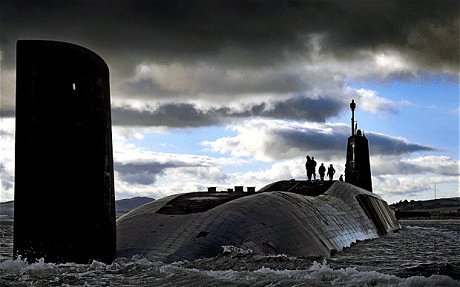 Trident is a colossal waste of money that will encourage further nuclear proliferation The Independent , By James Bloodworth, 9 March 2012 “……. Trident was excluded from the government’s Strategic Defence and Security Review in October 2010; and despite murmurings from some Liberal Democrats (aren’t there always murmurings from Liberal Democrats?), the coalition seems intent on spending £20 billion-plus renewing a weapons system which, if ever deployed, would result in the deaths of thousands, if not millions of human beings.
Twenty billion is just a figure of course. To put it into some kind of perspective, George Osborne’s first budget planned for cuts of six billion pounds; and public sector workers currently face a three per cent rise in their pension contributions to save the state just under two billion. A modern hospital costs in the region of £90 million (which, as it happens, would save thousands of lives a year, rather than stand-by ready to exterminate them), and a state-of-the-art environmentally friendly school costs between five and £10 million. To give free school dinners to every primary school child in the country would cost a further one billion pounds.
All of the above, as you might have noticed, are a pittance compared to the gigantic sum set aside for the renewal of Trident. In order to justify a spend three times that of George Osborne’s first year of budget cuts, you would at least expect Trident to have a substantial argument behind it. It doesn’t.
Trident categorically fails on its own terms, for there is very little to suggest it would “deter” anybody much from anything. As far as traditional warfare goes, Britain was a nuclear power when Egypt nationalised the Suez Canal and General Galtieri invaded the Falklands, and the possession of a nuclear arsenal did little to dissuade either party from their course of action – for the obvious reason that we could never morally justify using such a weapon; nor do so without first attaining the authorisation of the United States.
As for the contemporary security threat, back in 2009 a letter sent to The Times signed by a group of senior military officers – figures not known for their pacifist tendencies – said the following: “Nuclear weapons have shown themselves to be completely useless as a deterrent to the threats and scale of violence we currently face or are likely to face, particularly international terrorism.”
In reality, having nuclear weapons is likely to encourage other states to pursue their own nuclear capabilities….. http://blogs.independent.co.uk/2012/03/09/trident-is-a-colossal-waste-of-money-that-will-encourage-further-nuclear-proliferation/
1 This Month
22 June – Virtual Event –Climate Change: New Data, New Debate

Monday, June 22, 2026 2:30 p.m. – 3:15 p.m. CT
YouTube. Register here

Protect Sazan Island from the Trump family! https://secure.avaaz.org/campaign/en/protect_sazan_island_from_the_trump_family_loc/?bqFCVab&v=174511&cl=22707147157&_checksum=5e9dde668860e8231c33699735e16a1fbf22ab2cb01da50c999fe8732b9775ef&utm_source=email&utm_medium=blast_email&utm_campaign=174511
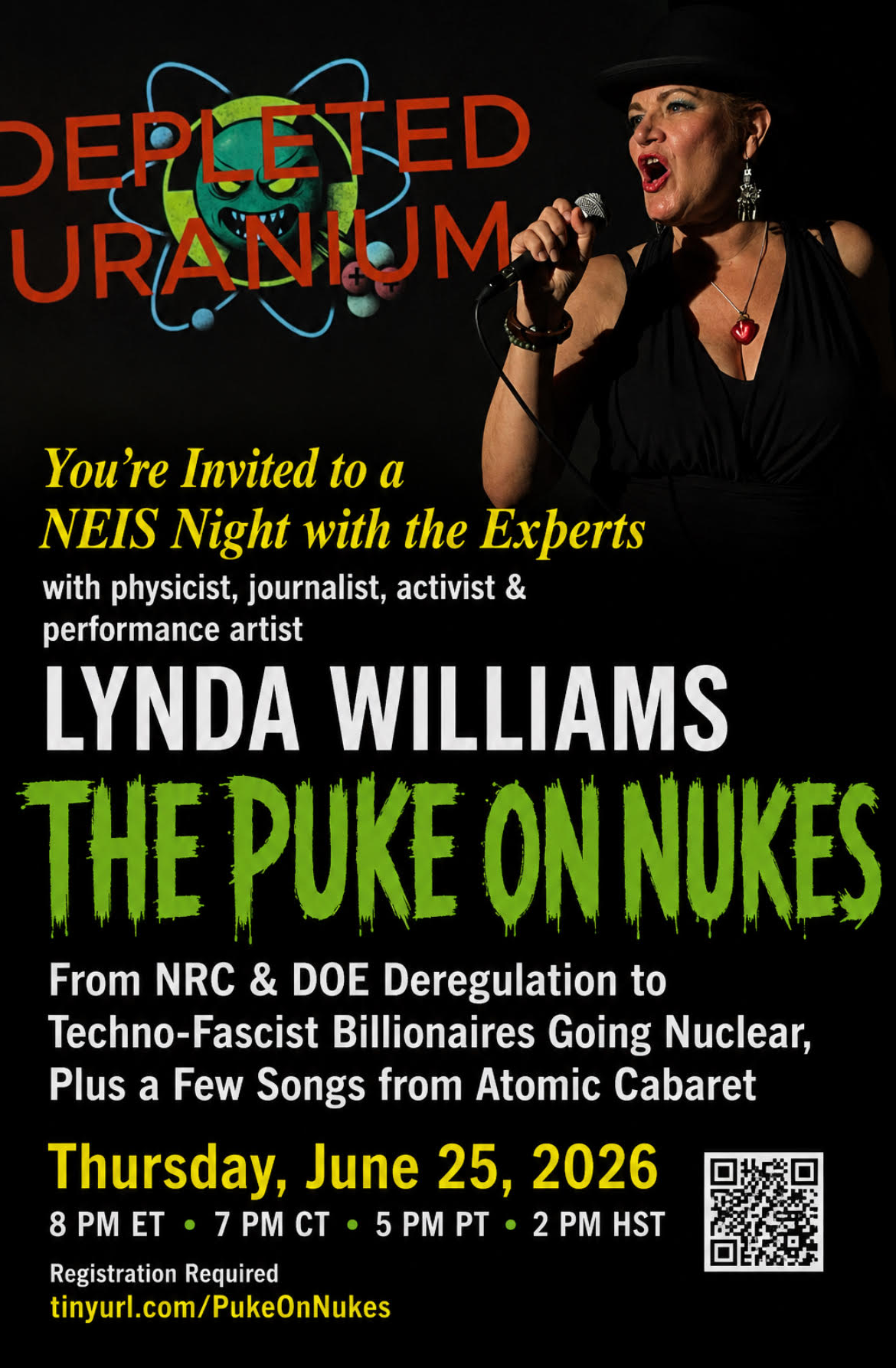
25 June- THE PUKE ON NUKES
Thursday, June 25, 2026
7pm Central Time (8pm ET, 6pm MT, 5pm PT) UTC – 5
From NRC & DOE Deregulation to Techno-Fascist Billionaires Going Nuclear, Plus a Few Songs from Atomic Cabaret REGISTER
26 June – Radiation Trainwreck at the NRC / Join the Protect Better Campaign – https://us02web.zoom.us/meeting/register/4ZlZ5_qLSHGiLSCg8FF6Bg#/registration


Cuba Is Not a Failed State – It Is a Besieged State
PETITION: “Global Appeal to Endorse Palestinian Right of Return of Refugees”
To see nuclear-related stories in greater depth and intensity – go to https://nuclearinformation.wordpress.com
-
Archives
- June 2026 (193)
- May 2026 (306)
- April 2026 (356)
- March 2026 (251)
- February 2026 (268)
- January 2026 (308)
- December 2025 (358)
- November 2025 (359)
- October 2025 (376)
- September 2025 (257)
- August 2025 (319)
- July 2025 (230)
-
Categories
- 1
- 1 NUCLEAR ISSUES
- business and costs
- climate change
- culture and arts
- ENERGY
- environment
- health
- history
- indigenous issues
- Legal
- marketing of nuclear
- media
- opposition to nuclear
- PERSONAL STORIES
- politics
- politics international
- Religion and ethics
- safety
- secrets,lies and civil liberties
- spinbuster
- technology
- Uranium
- wastes
- weapons and war
- Women
- 2 WORLD
- ACTION
- AFRICA
- Atrocities
- AUSTRALIA
- Christina's notes
- Christina's themes
- culture and arts
- Events
- Fuk 2022
- Fuk 2023
- Fukushima 2017
- Fukushima 2018
- fukushima 2019
- Fukushima 2020
- Fukushima 2021
- general
- global warming
- Humour (God we need it)
- Nuclear
- RARE EARTHS
- Reference
- resources – print
- Resources -audiovicual
- Weekly Newsletter
- World
- World Nuclear
- YouTube
-
RSS
Entries RSS
Comments RSS
 nuclear-news