Bill Gates’ fantastic new nuclear vaccine- or intractable virus
Nuclear energy like a fantastic vaccine? http://blog.seattlepi.com/energy/2012/03/26/nuclear-energy-like-a-fantastic-vaccine/ seattle pi, 26 Mar 12In the 1950s, “too cheap to meter” was the tag line for then-nascent atomic energy. That promise, which Bill Gates now calls a “fantastic vaccine,” has thus far been more of an intractable virus.
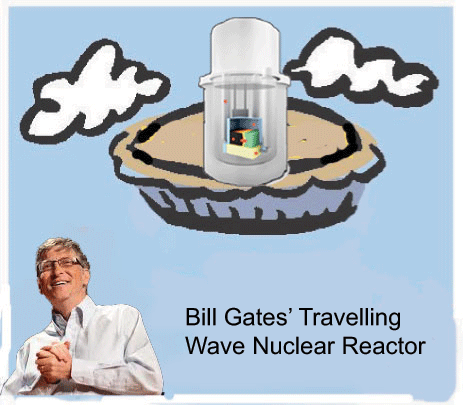
Last week Mr. Gates revived the “nuclear is cheap” message to promote his TerraPower nuke startup venture . He also came off decidedly pessimistic about the world’s prospects for combating climate change.
The nuclear industry has long touted “cheap” alongside “clean” in its bid against renewable energy to supply electricity to a power-hungry world. It has also argued loudly against subsidies for renewables, and claimed that nuclear is the only way to slow global warming.
Gates has joined that chorus , stating that he’s skeptical that the world can dramatically cut greenhouse-gas emissions in less than 75 years, and suggesting that wind and solar subsidies should be conditional upon commercializing energy storage technologies first.
To make the “cheap and clean” argument, you have to ignore some significant externalities. A big problem with “cheap” nuclear power has been the cost — construction budget overruns , bailouts , storing spent rods , site clean-up , and human lives . The caveat with “clean” (low-carbon) nuclear power is its multigenerational legacy of radioactive waste.
The traveling wave reactor technology revealed in 2008 as the core of TerraPower’s development is a half-century-old breeder-reactor technology that could run on some of the waste stream from nuclear fuel production. A TWR has been computer-modeled, but never built.
If Gates and his TerraPower partner Nathan Myhrvold want to change the world with nuclear energy, they need to overcome several major issues, and quickly, before the widely imagined nuclear renaissance completely loses steam:
Developed nations, the ones the world is most comfortable with having radioactive materials, have for the most part stopped building nuclear power plants. Emerging nations, even if they can afford to experiment with this new technology, will need to handle the radioactive fuel and waste, including the eventual decommissioning of plants themselves. Convincing populations of a TWR plant’s safety will be a significant hurdle.
Even before Fukushima, John Rowe, chief executive of nuclear power heavyweight Exelon, said in a Politico interview that “except with massive subsidies, there’s really nothing one can do to make a whole lot of nuclear plants economic right now.” The company bought a major renewable energy firm and started moving into wind power.
1 Comment »
Leave a comment
1 This Month

of the week – Shut Down Drone Warfare!


Tell the Ukrainian Government to Drop Prosecution of Peace Activist Yurii Sheliazhenko

Petition to revoke the licensing of the Near Surface Nuclear Disposal Facility (NSDF) at Chalk River. https://www.ourcommons.ca/petitions/en/Petition/Details?Petition=e-7247
To see nuclear-related stories in greater depth and intensity – go to https://nuclearinformation.wordpress.com
-
Archives
- March 2026 (244)
- February 2026 (268)
- January 2026 (308)
- December 2025 (358)
- November 2025 (359)
- October 2025 (376)
- September 2025 (257)
- August 2025 (319)
- July 2025 (230)
- June 2025 (348)
- May 2025 (261)
- April 2025 (305)
-
Categories
- 1
- 1 NUCLEAR ISSUES
- business and costs
- climate change
- culture and arts
- ENERGY
- environment
- health
- history
- indigenous issues
- Legal
- marketing of nuclear
- media
- opposition to nuclear
- PERSONAL STORIES
- politics
- politics international
- Religion and ethics
- safety
- secrets,lies and civil liberties
- spinbuster
- technology
- Uranium
- wastes
- weapons and war
- Women
- 2 WORLD
- ACTION
- AFRICA
- Atrocities
- AUSTRALIA
- Christina's notes
- Christina's themes
- culture and arts
- Events
- Fuk 2022
- Fuk 2023
- Fukushima 2017
- Fukushima 2018
- fukushima 2019
- Fukushima 2020
- Fukushima 2021
- general
- global warming
- Humour (God we need it)
- Nuclear
- RARE EARTHS
- Reference
- resources – print
- Resources -audiovicual
- Weekly Newsletter
- World
- World Nuclear
- YouTube
-
RSS
Entries RSS
Comments RSS
 nuclear-news
Reblogged this on emmageraln.