Democracy and nuclear power just don’t go together
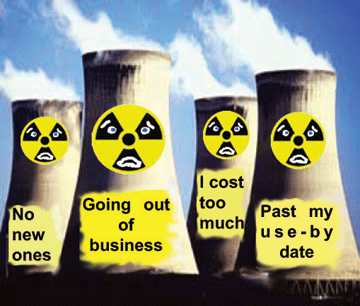 The end of the nuclear illusion, The Daily Star, Praful Bidwai, 20 March 12, “…….Nuclear power is now on the run globally. The number of reactors operating worldwide has fallen from the historic peak of 444 (2002) to 429. Their share in global electricity supply has shrunk from 17% to 13%. And it’s likely to fall further as some 180-plus 30 years-old or older reactors are retired. Just about 60 new ones are planned.
Post-Fukushima, nobody will build reactors without big subsidies or high state-guaranteed returns –or unless they are China or India. China’s rulers don’t have to bother about democracy, public opinion or safety standards.
Nor are India’s rulers moved by these. They are desperate to award the reactor contracts promised to the US, France and Russia for lobbying for the US-India nuclear deal in the International Atomic Energy Agency.
Dr. Manmohan Singh has even stooped to maligning Indian anti-nuclear protesters as foreign-funded, as if they had no minds of their own, and as if the government’s priority wasn’t to import reactors.
Nuclear power is bound up with secrecy, deception and opacity, which clash with democracy. It evokes fear and loathing and can only be promoted by force while violating civil liberties.
A recent BBC-GlobeScan poll shows that 69% of people in 23 countries oppose building new reactors, including 90% in Germany, 84% in Japan, 80% in Russia and 83% in France. This proportion has sharply risen since 2005. Only 22% of people in the 12 countries which operate nuclear plants favour building new ones.
The world has witnessed five core meltdowns in 15,000 reactor-years. At this rate, we can expect one core meltdown every eight years in the world’s 400-odd reactors. This is simply unacceptable. Yet, the nuclear industry behaves as if this couldn’t happen. It has a collusive relationship with regulators, highlighted in numerous articles on Japan, including one by Yoichi Funabashi, chair of the Rebuild Japan Initiative Foundation: “We Japanese have long prided
ourselves on being a society that provides safety and security…[But this] has been matched by our aversion to facing the potential threat of nuclear emergencies…”
He adds: “Any drills for a nuclear emergency were meticulously designed to avoid giving any impression that an accident could possibly progress to the severity of a meltdown…. But avoidance ultimately translated into un-preparedness.”
Nuclear power is bound up with radiation, which is harmful in all
doses, at each step of the nuclear fuel cycle. Nuclear plants
routinely expose surrounding populations to harmful radioactive and
chemical emissions.
Nuclear power is costlier not just than coal- or gas-based
electricity, but increasingly, renewable energy. The European
Pressurised Reactor of the crisis-ridden French firm Areva, and
earmarked for Jaitapur in India, is now quoting for $6,500-plus per
kilowatt, compared to under $2,000 for wind turbines.
Nuclear power cannot be a solution to the climate crisis. Its
potential contribution is too small, it’s too slow to deploy, and too
expensive. By contrast, renewables have already emerged as a safe,
flexible, quickly deployable solution, with a typically lower carbon
footprint than nuclear power.
The world needs a new climate-friendly, safe, decentralised energy
system with smart grids and high efficiency. Nuclear power can have no
place in it. http://www.thedailystar.net/newDesign/news-details.php?nid=226925
No comments yet.
1 This Month

of the week – Shut Down Drone Warfare!


Tell the Ukrainian Government to Drop Prosecution of Peace Activist Yurii Sheliazhenko

Petition to revoke the licensing of the Near Surface Nuclear Disposal Facility (NSDF) at Chalk River. https://www.ourcommons.ca/petitions/en/Petition/Details?Petition=e-7247
To see nuclear-related stories in greater depth and intensity – go to https://nuclearinformation.wordpress.com
-
Archives
- April 2026 (114)
- March 2026 (251)
- February 2026 (268)
- January 2026 (308)
- December 2025 (358)
- November 2025 (359)
- October 2025 (376)
- September 2025 (257)
- August 2025 (319)
- July 2025 (230)
- June 2025 (348)
- May 2025 (261)
-
Categories
- 1
- 1 NUCLEAR ISSUES
- business and costs
- climate change
- culture and arts
- ENERGY
- environment
- health
- history
- indigenous issues
- Legal
- marketing of nuclear
- media
- opposition to nuclear
- PERSONAL STORIES
- politics
- politics international
- Religion and ethics
- safety
- secrets,lies and civil liberties
- spinbuster
- technology
- Uranium
- wastes
- weapons and war
- Women
- 2 WORLD
- ACTION
- AFRICA
- Atrocities
- AUSTRALIA
- Christina's notes
- Christina's themes
- culture and arts
- Events
- Fuk 2022
- Fuk 2023
- Fukushima 2017
- Fukushima 2018
- fukushima 2019
- Fukushima 2020
- Fukushima 2021
- general
- global warming
- Humour (God we need it)
- Nuclear
- RARE EARTHS
- Reference
- resources – print
- Resources -audiovicual
- Weekly Newsletter
- World
- World Nuclear
- YouTube
-
RSS
Entries RSS
Comments RSS
 nuclear-news
Leave a comment