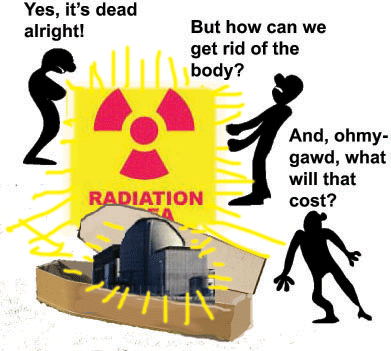
140 nuclear reactors now dead, but only 17 buried!
Intermediate-level waste, contrary to its name, is even more of a problem because it may require deep ground burial alongside the high-level spent fuel
 In 1976, a British Royal Commission said no more nuclear power plants should be built until the waste disposal problems were resolved. Thirty-five years on, nothing much has changed.
How to dismantle a nuclear reactor, New Scientist, 15 March 2012 by Fred Pearce By the start of 2012, according to the International Atomic Energy Agency, 138 commercial power reactors had been permanently shut down. At least 80 are expected to join the queue for decommissioning in the coming decade – more if other governments join Germany in deciding to phase out nuclear power following the Fukushima disaster in Japan last year.
And yet, so far, only 17 of these have been dismantled and made permanently safe. That’s because decommissioning is difficult, time-consuming and expensive.
A standard American or French-designed pressurised water reactor (PWR) – the most common reactor design now in operation – will produce more than 100,000 tonnes of waste, about a tenth of it significantly radioactive, including the steel reactor vessel, control rods, piping and pumps. Decommissioning just a single one generally costs up to half a billion dollars.
That’s bad enough, but many reactors are not standard PWRs. Decommissioning Germany’s Soviet-designed power plant at Greifswald produced more than half a million tonnes of radioactive waste (see “Where the waste goes“). The UK’s 26 gas-cooled Magnox reactors produce similar amounts and will eventually cost up to a billion dollars each to decommission. Even the £375 million budget the UK has allotted for decommissioning each advanced gas-cooled reactor may not be enough. That’s because they weren’t designed with decommissioning in mind.
“The major components of standard PWRs were built in factories and put together on site, so taking them apart again is relatively easy,” says Tim Abram, head of nuclear fuel technology at the University of Manchester, UK. “But Britain’s reactors are huge civil engineering structures, built on site. They will be much harder to dismantle.” They are also typically about 30 times bigger.
The many variations also mean that there is no agreed-upon standard for how to go about the process. If you want to decommission a nuclear power plant, you have three options. The first is the fastest: remove the fuel, then take the reactor apart as swiftly as possible, storing the radioactive material somewhere safe to await a final burial place. One US PWR, Maine Yankee, closed in 1996 and all that remains at the site today is a small, secure store containing the spent fuel.
The second approach is to remove the fuel but lock up the reactor, letting its troublesome radioactive isotopes decay, which makes dismantling easier – much later. The UK has put its now largely defunct fleet of Magnox reactors under “care and maintenance” for around 100 years.
The third option is to simply entomb the reactor where it is. In 2011, the US government buried two old weapons-producing reactors at Savannah river in South Carolina in 200,000 cubic metres of concrete. Inside, they stowed a time capsule containing People magazine’s report on that month’s wedding of Prince William and Kate Middleton. If anybody reads it in less than 1400 years, the entombment plan will have failed.
Even when the reactor can be dismantled, where do you put the radioactive waste? Even the least contaminated material – old overalls, steel heat exchangers and toilets – must be carefully separated and sent to specially licensed landfill sites. Not every country has such designated facilities.
Intermediate-level waste, contrary to its name, is even more of a problem because it may require deep ground burial alongside the high-level spent fuel (see “How long it takes“)
In 1976, a British Royal Commission said no more nuclear power plants should be built until the waste disposal problems were resolved. Thirty-five years on, nothing much has changed….. http://www.newscientist.com/article/mg21328551.400-how-to-dismantle-a-nuclear-reactor.html?
No comments yet.
1 This Month

of the week – Shut Down Drone Warfare!


Tell the Ukrainian Government to Drop Prosecution of Peace Activist Yurii Sheliazhenko

Petition to revoke the licensing of the Near Surface Nuclear Disposal Facility (NSDF) at Chalk River. https://www.ourcommons.ca/petitions/en/Petition/Details?Petition=e-7247
To see nuclear-related stories in greater depth and intensity – go to https://nuclearinformation.wordpress.com
-
Archives
- March 2026 (237)
- February 2026 (268)
- January 2026 (308)
- December 2025 (358)
- November 2025 (359)
- October 2025 (376)
- September 2025 (257)
- August 2025 (319)
- July 2025 (230)
- June 2025 (348)
- May 2025 (261)
- April 2025 (305)
-
Categories
- 1
- 1 NUCLEAR ISSUES
- business and costs
- climate change
- culture and arts
- ENERGY
- environment
- health
- history
- indigenous issues
- Legal
- marketing of nuclear
- media
- opposition to nuclear
- PERSONAL STORIES
- politics
- politics international
- Religion and ethics
- safety
- secrets,lies and civil liberties
- spinbuster
- technology
- Uranium
- wastes
- weapons and war
- Women
- 2 WORLD
- ACTION
- AFRICA
- Atrocities
- AUSTRALIA
- Christina's notes
- Christina's themes
- culture and arts
- Events
- Fuk 2022
- Fuk 2023
- Fukushima 2017
- Fukushima 2018
- fukushima 2019
- Fukushima 2020
- Fukushima 2021
- general
- global warming
- Humour (God we need it)
- Nuclear
- RARE EARTHS
- Reference
- resources – print
- Resources -audiovicual
- Weekly Newsletter
- World
- World Nuclear
- YouTube
-
RSS
Entries RSS
Comments RSS
 nuclear-news
Leave a comment