Please donate to help mind-blowing new film on today’s global nuclear issues
We have never asked for donations to nuclear-news.net, and we’re not doing so now.
 However, we’re just very keen to support Frontline Films David Bradbury is an Australian film-maker who has earned an international reputation as a film maker willing to go to extraordinary lengths for a cause, exposing political oppression and environmental vandalism.
Bradbury has won many international film festival prizes, received five Australian Film Industry awards, and two Academy Award nominations.
He is currently producing a very up to date film on the situation of nuclear power – globally. Bradbury’s Frontline Films nevertheless runs on the proverbial shoe string – and with little encouragement from the mainstream media.
We believe that Frontline Film’s newest documentary will be a remarkable and eye-opening film. But David Bradbury needs funds to get these filmed events and interviews edited, and onto DVD and film. And then – to get this – the most up to date film about the global nuclear scene, to the 2nd International Uranium Film Festival of Rio de Janeiro 28. June – 14. July 2012.
 So – we’re calling for donations. The Frontline Film Foundation is a registered charity and has tax deductible status. All you need is these banking details:
Frontline Film Foundation
Southern Cross Credit Union
BSB: 802-185
A/C #: 86527
For more information – go to http://www.frontlinefilmfoundation.org/index.htm
The USA’s radioactive waste time bomb
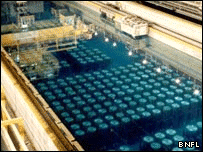 U.S. pools are generally more densely packed than in Japan. Vermont Yankee’s pool contains two to three times the amount of spent fuel as Fukushima Daiichi’s Reactor 4
Alvarez estimated a meltdown of spent fuel in the Indian Point pool, which has three times the radioactivity of four Fukushima spent fuel pools, would kill 5,600 people, do $461 billion in damage and render a large area uninhabitable.
 The U.S. has 65,000 metric tons of nuclear waste, which we leave to our children in perpetuity…don’t make more nuclear waste until we safely dispose of what we have made.
 No more Fukushimas: US plants still face risks, BY GWEN L. DUBOIS, The Baltimore Sun, 14 March 12, “…..Our nuclear plants are no better designed than those in Japan. Twenty-three are Mark 1 boiling water reactors, identical to Fukushima Daiichi reactors 1-5. This includes Peach
Bottom, 36 miles from Baltimore in York County, Pa.; and Vermont Yankee, notorious for pipes leaking radioactive tritium, which was relicensed for 20 years on March 10, 2011, over the objection of Vermonters.
Nor are our plants immune from natural or manmade disasters. Nearly half of the 104 reactors in the U.S. are near major fault lines. In August, a 5.8 earthquake 11 miles from Virginia’s North Anna nuclear power plant, which is 70 miles from Washington D.C., rattled nerves in
Baltimore and far beyond. The quake caused twice the amount of ground movement for which North Anna was designed. Continue reading
USA cannot afford to maintain its hoard of nuclear weapons, and a bad example to others
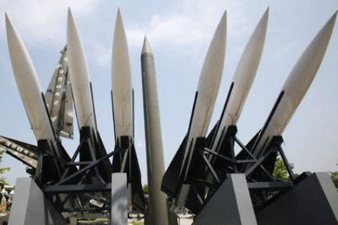 We are telling others, by our hoarding of warheads, that in order to be secure in the world today you need nuclear weapons — and lots of them. Is it any wonder if leaders in Iran and elsewhere might want to buy some protection for themselves with a nuclear stockpile of their own?
the U.S. lavishes over $50 billion a year on nuclear arms related programs.
Obama’s Controversial Plan for Nuclear Sanity Richard Schiffman: 03/14/2012 ” “Iran Worried U.S. Might Be Building 8,500th Nuclear Weapon,” read the headline . This front page banner in the satirical weekly, The Onion may not have gotten the number exactly right. The Obama administration reported in 2010 that the U.S. possesses 5,113 warheads in the stockpile and an additional 4,500 retired , but not yet dismantled, making the grand total even higher than the spoofers had guessed.
While media pundits in the U.S. warn darkly of Tehran’s nuclear ambitions, America itself is regarded as the main nuclear threat in much of the world today. The United States argues that it needs these weapons to deter attacks on itself and its allies, and that it would only use them to prevent or respond to such an attack. But people in other countries wonder why we need so absurdly many of them — secreted away in missile silos, on submarines and in bombers, computer-targeted to obliterate their cities at the turn of a key.
The U.S. rightly wants to prevent the spread of nuclear weapons to nations like Iran that do not yet possess them. Quite simply, the more actors that have the bomb, the greater the risk that it will eventually be used, either as part of a regional war, or in a freelance act of terror. Yet by what right can we ask others to abstain, when we ourselves continue — along with our Cold War rival Russia — to maintain an arsenal large enough to destroy life on the planet several times over?
The problem is not just that we lack the moral authority to preach nonproliferation. The larger problem is that the U.S. is setting a bad example for other nations to follow. Continue reading
Japan’s former P.M. insisted on workers staying to prevent Fukushima total meltdown
“If the workers abandoned the plant, all the reactors and fuel rods in the fuel pools would have melted down, causing many times more fall-out than Chernobyl. “I called the TEPCO president and told him a withdrawal was unthinkable “

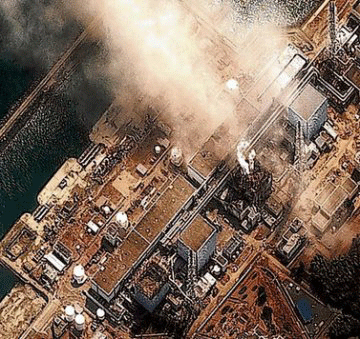 Ex-PM reveals meltdowns almost crippled Japan Mark Willacy, ABC South West Radio March 15, 2012 A year on from the meltdowns at the Fukushima nuclear plant, Japan’s prime minister at the time has told the ABC that the disaster came close to crippling the nation, with the evacuation of tens of millions from Tokyo a real possibility.
In an exclusive interview on ABC’s 7.30, Naoto Kan said the loss of the world’s biggest metropolis would have been like losing a war, leaving Japan without a political and economic capital. He has also confirmed that he confronted the operator TEPCO and rejected its request for its workers to abandon the crippled plant. Continue reading
Americans prefer diplomacy – not an attack on Iran
 Concern About Broader War Dampens Support for Iran abc News, By Julie Phelan, Mar 14, 2012 Broad concern about wider war in the Middle East is dampening public support for U.S. or Israeli military strikes against Iran’s nuclear development sites, with Americans by wide margins preferring diplomatic efforts or economic deterrence instead.
Eighty-four percent in this ABC News/Washington Post poll suspect that Iran is trying to develop nuclear weapons, basically unchanged since late 2009. As then, the preferred approaches are direct diplomatic talks between the U.S. and Iran, backed by 81 percent, and an increase in international economic sanctions, supported by three-quarters.
Many fewer, 41 percent, support a U.S. bombing effort, with 53 percent opposed, again similar to 2009. Support for Israeli strikes is virtually identical, with 42 percent in favor and 51 percent opposed. Israel has threatened such strikes; President Obama, while not ruling out military action, has urged allowing more time for sanctions to work, a position criticized by some of his Republican opponents.
RISK OF WAR – Reluctance to support air strikes stems mostly from a broad concern that they could trigger a larger war in the Middle East. Nearly nine out of 10 in this poll, produced for ABC by Langer Research Associates, see a risk of broader war if Israel were to bomb Iran; three-quarters call it a “major” risk.
Among those who perceive a major risk of war, just 32 percent support Israeli strikes against Iranian nuclear sites, and 35 percent back U.S. bombing efforts. Those who perceive little or no risk of sparking a regional war are far more supportive of air strikes – 76 percent support action by Israel, 64 percent by the United States…… http://abcnews.go.com/blogs/politics/2012/03/concern-about-broader-war-dampens-support-for-iran-attack/
An attack on Iran would REALLY make them want nuclear weapons
 Want Iran to go nuclear? Bomb them — Rep. Smith, Seattle Pi, 14 March 12, A military strike on Iran by Israel and/or the United States would backfire by assuring that the Iranian regime would push ahead with development of nuclear weapons, the ranking Democrat on the House Armed Services Committee warned Wednesday.
“Let the sanctions work,” U.S. Rep. Adam Smith, D-Wash., who also sits on the House Intelligence Committee, told a Seattle neighborhood breakfast.
Smith cautioned against what he described as a “rush to war” in sabre-rattling statements heard on the Republican presidential trail. He argued that sanctions by the U.S. and European Union countries are already biting deep into the Iranian economy.
The best hope, said the congressman, is that the Iranian government will decide that the cost to their economy of developing a nuclear weapons capability is too great….
http://blog.seattlepi.com/seattlepolitics/2012/03/14/want-iran-to-go-nuclear-bomb-them-rep-smith/
Dr Helen Caldicott to speak at Occupy EPA on March 30
 The rally in front of the Administrator’s office on the EPA lawn will feature national speakers
and leaders, such as Dr. Helen Caldicott,
Occupy EPA prepare for March 30th rally Press TV 15 March 112, Occupation, civil rights, environmental, and communities groups from around the country will gather on Friday, March 30th to rally and launch the American Spring (AS) with a demonstration at the headquarters of the U.S. Environmental Protection Agency (EPA).
“What kind of future will our children have if the EPA keeps caving in to corporate demands and allowing exploitation of people and the planet?” said Dr. Margaret Flowers, a pediatrician and organizer for NOW-DC…. Continue reading
Dr Helen Caldicott to speak in Seattle
 Nobel Prize Nominee Caldicott here for Japan nuclear crisis anniversary Dr. Helen Caldicott’s appearance Saturday at Temple United Methodist Church in Seattle is part of weekend events scheduled around the one-year anniversary of Japan’s Fukushima tsunami and resulting nuclear crisis. By Carol M. Ostrom, Seattle Times, 13 March Dr. Helen Caldicott, Nobel Peace Prize nominee and longtime activist who helped start Physicians for Social
Responsibility and Ground Zero Center for Nonviolent Action, will speak at an all-day forum and workshop Saturday. Continue reading
Lynas rare earths processing – Malaysia’s political issue that will not go away
rare earth processing facility developed in 1985 by Mitsubishi Chemical at Bukit Merah n northern Perak state near the city of Ipoh that turned into an environmental disaster. The facility was closed in 1992 amid allegations that it was causing widespread groundwater and other environmental contamination and was responsible for deaths from leukemia as well as birth defects in children living nearby.
protesters say the company still doesn’t have a credible waste and water management plan and that radioactive materials could leach into both the groundwater, as they did at Bukit Merah, as well as into the South China Sea. ...
 Malaysia and the Global Rare Earth Squabble, Asia Sentinel, 14 March 12, “…..Other nations have largely ceased production of the rare earth minerals because of the detrimental effect mining and processing them has had on the environment.
China has belatedly caught up with western sentiment after realizing that substandard mining practices have resulted in environmental catastrophes and has cut back on production, driving prices through the roof….. Continue reading
Yes, rare earths processing does cause environmental damage
Lynas says US-led offensive against China unlikely to succeed, BY: BARRY FITZGERALD, The Australian March 15, 2012 “…….The executive chairman of Sydney-based Lynas, Nick Curtis, said yesterday China had “some complex and possibly legitimate argument about the environmental damage that rare earths was doing in China, and the consequent right it had to limit production through export quotas as a consequence of that”…. The key issue remained that the supply of rare earths was in structural deficit, as China was shrinking supply for environmental reasons, which were real, Mr Curtis said….
Lynas is part of the Western world’s plan to increase non-Chinese supplies of rare earths, a group of 17 elements increasingly used in magnets in hybrid car motors, compact fluorescent light bulbs, flatpanel displays, iPads and automotive catalytic converters. The $2 billion company, with the help of funding from Japan, has developed the Mt Weld rare earths mine in Western Australia and is close to completing a controversial finishing plant in Malaysia.
The Malaysian plant is dogged by local opposition because of radiation
fears…. http://www.theaustralian.com.au/business/mining-energy/lynas-says-us-led-offensive-against-china-unlikely-to-succeed/story-e6frg9df-1226299786618
Luckily, Japan’s latest earthquake and tsunami were smaller
Magnitude 6.8 earthquake strikes Japanese coast, tsunami wave hits coast THE AUSTRALIAN, BY: BY SHINGO ITO IN TOKYO From: AFP March 14, 2012 A small tsunami wave has hit Japan’s northeastern coastline, officials say, after a strong earthquake rocked the region a year on from the country’s worst post-war natural disaster. Continue reading
Utility losing interest in investing in nuclear power
E.ON says its commitment to nuclear is fading LONDON, March 14 (Reuters) – German utility E.ON , which together with rival RWE plans to build new nuclear plants in Britain, said on Wednesday its appetite for investing in nuclear power had slowed down.
“Our appetite to boost nuclear with great energy has become smaller,” said board member Klaus-Dieter Maubach during the company’s 2011 results conference…. time and cost overruns at new nuclear plants in Finland and France….. E.ON posted a net loss of 2.22 billion euros in 2011 as it was hit by Germany’s decision to shut down its oldest nuclear plants in the wake of Japan’s Fukushima accident and losses in its gas business.
French company EDF gives up on new nuclear power station in Lancashire

 Third nuclear power station at Heysham plans on ice, BBC News, Lancashire, 14 March 12, Plans for a third nuclear power station at Heysham in Lancashire have been put on ice.
French company EDF Energy has cancelled an agreement with the National Grid to set up any new connection to the grid from Heysham. The site was one of eight earmarked two years ago for a new generation of nuclear power stations.
EDF Energy said all its plans for new stations will be focused on their sites at Sizewell and Hinkley Point…. http://www.bbc.co.uk/news/uk-england-lancashire-17374496
Iowa pro nuclear Bill scrapes in by just one Senate vote
 Iowa Senate panel passes nuclear power bill, Des Moines Register, Mar. 14, 2012 A bill that could lead to nuclear power expansion in Iowa passed by one vote in a Senate committee Tuesday, and opponents said there would be election consequences for legislators who supported it.
A spokesman for seniors group AARP, one of the most aggressive foes of the bill, told The Des Moines Register that the organization would soon unveil a voter education program complete with a website to highlight how each lawmaker voted on the issue. Continue reading
Climate change making Australia hotter and wetter
 VIDEO also Audio Australia getting hotter, sea levels rising: CSIRO, ABC TV Lateline, TONY JONES, PRESENTER: A snapshot of the nation’s weather reveals Australia is getting hotter, sea levels are rising and we can expect a lot
  more rain. That’s the view of the CSIRO and the Bureau of Meteorology. They found that globally, temperatures could rise as much
as five degrees by 2070. And the greenhouse gases have hit their highest level since modern humans evolved. From Cape Grim in Tasmania, our environment reporter Conor Duffy reports…. http://www.abc.net.au/lateline/content/2012/s3453647.htm
1 This Month


10 March A LIVE WEBINAR THE REAL EFFECTS OF NUCLEAR POWER
What the Industry Isn’t Telling Us
1:00 PM Mountain, 2 pm Central, 3 pm Eastern. Live on the Keepers of the Water Facebook page

18 March Webinar @ 1 PM EST: An Assessment of SMR Projects: The Case of Canada
register for the zoom:
https://us02web.zoom.us/webinar/register/WN_o8BIIOUvQ2ONJR1nta65DQ#/registration


of the week – STOP SMALL MODULAR REACTORS IN CANADA
To see nuclear-related stories in greater depth and intensity – go to https://nuclearinformation.wordpress.com
-
Archives
- March 2026 (62)
- February 2026 (268)
- January 2026 (308)
- December 2025 (358)
- November 2025 (359)
- October 2025 (376)
- September 2025 (258)
- August 2025 (319)
- July 2025 (230)
- June 2025 (348)
- May 2025 (261)
- April 2025 (305)
-
Categories
- 1
- 1 NUCLEAR ISSUES
- business and costs
- climate change
- culture and arts
- ENERGY
- environment
- health
- history
- indigenous issues
- Legal
- marketing of nuclear
- media
- opposition to nuclear
- PERSONAL STORIES
- politics
- politics international
- Religion and ethics
- safety
- secrets,lies and civil liberties
- spinbuster
- technology
- Uranium
- wastes
- weapons and war
- Women
- 2 WORLD
- ACTION
- AFRICA
- Atrocities
- AUSTRALIA
- Christina's notes
- Christina's themes
- culture and arts
- Events
- Fuk 2022
- Fuk 2023
- Fukushima 2017
- Fukushima 2018
- fukushima 2019
- Fukushima 2020
- Fukushima 2021
- general
- global warming
- Humour (God we need it)
- Nuclear
- RARE EARTHS
- Reference
- resources – print
- Resources -audiovicual
- Weekly Newsletter
- World
- World Nuclear
- YouTube
-
RSS
Entries RSS
Comments RSS
 nuclear-news