Nuclear industry frantically lobbying, as world turns against it
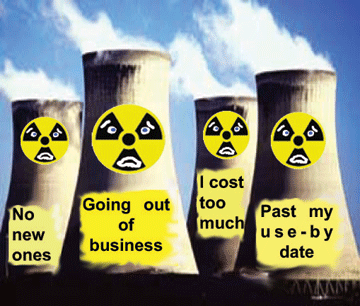 rejection of nuclear energy is growing among people the world over — and building new reactors makes no sense in economic terms…..
Nuclear lobby’s frantic attempts to downplay the nuclear meltdown in Fukushima, with
the aim of nipping the debate about nuclear safety in the bud
Undeterred by Fukushima, Nuclear Lobby Pushes Ahead with New Reactors, Spiegel Online, 13 March 12, One year after the reactor accident in Fukushima, resistance to nuclear energy is growing around the world.
But the atomic industry continues to push for the construction of new reactors, primarily in
emerging economies…… during a celebration marking the opening of
a new reactor, Russian leader Vladimir Putin called on those in his
country’s atomic industry to build nuclear power plants “until your
noses bleed.”…..
No Economic Sense
A year after the catastrophe at the Fukushima nuclear power plant, it
is clear just how little the nuclear lobby and its government
supporters have been unsettled by the disaster in Japan. But rejection
of nuclear energy is growing among people the world over — and
building new reactors makes no sense in economic terms…..
frantic attempts to downplay the nuclear meltdown in Fukushima, with
the aim of nipping the debate about nuclear safety in the bud. For
example, John Ritch, the director-general of the World Nuclear
Association, asserted that the disaster hadn’t cost anyone their life.
“Nuclear power will be even safer after Fukushima,” Ritch told the BBC
in November, “and will continue to mature as the world’s premier
non-carbon technology.”…..
all of these efforts at placating and winning citizens over have
apparently failed. Already in June 2011, the leading British polling
company Ipsos MORI identified a decline in global support for the
continued use of nuclear energy or its expansion. In a survey of
around 19,000 people in 24 countries, the company found that only 38
percent of respondents approved of nuclear energy, which put it at the
bottom of the lists of energy sources, far below even coal-generated
energy. The survey also found that the greatest numbers of people who
had changed their minds about nuclear energy in the wake of Fukushima
were found in South Korea, followed by Japan, China and India.
A poll conducted for the BBC in late November 2011 suggests that these
survey figures are not a flash-in-the-pan reaction to the dramatic
television images from Fukushima. Only 22 percent of the over 23,000
people questioned for the poll considered nuclear energy to be
relatively safe and backed its further expansion. Somewhat
surprisingly, there was also an increase in the number of people
rejecting the construction of new nuclear power plants in France and
Russia, where nuclear energy has traditionally enjoyed strong support.
…..
On balance, it would be a stretch to speak of a renaissance in nuclear
power. According to official figures, there were 436 nuclear power
plants still operating around the world at the beginning of March
2012, or eight fewer than the record figure reached in 2002. “If you
also subtract the reactors in Japan that have been taken off the grid,
the number is only 388,” says nuclear expert Mycle Schneider. “That’s
not exactly a renaissance.”
Indeed, despite all the upbeat rhetoric from the atomic industry,
hardly any nuclear expert seriously believes there will be a
significant increase in the number of nuclear power plants in
operation around the world. Schneider points out that existing
reactors have a high average age and are gradually being disconnected
from the grid. “The nuclear power plants being planned or under
construction will not make up for this unstoppable reduction,” he
adds….
Granted, according to statistics from the International Atomic Energy
Agency (IAEA), 63 nuclear power plants are currently being built.
However, a number of these are projects with no end in sight, such as
the dozen plants that have already been on the organization’s list for
more than 20 years. The current record is held by the second reactor
unit of the Watts Bar Nuclear Plant in the US state of Tennessee,
whose construction commenced in 1973. The Westinghouse reactor is
supposed to finally begin operation this year, but its launch was
recently pushed back yet again.
China leads the pack with 26 new nuclear power plants. Despite its
skyrocketing energy needs, the country still conducted safety checks
at all of its new plants in the wake of Fukushima. Construction work
on several new plants is scheduled to commence this year, and a number
of plants, such as the Hongyanhe Nuclear Power Plant in northeastern
China, are supposed to begin generating energy. However, officials
have not approved any new building projects since March 2011, the
month of the Fukushima disaster.
China is also putting much emphasis on renewable energy. Indeed, in
2010, the country boasted 42,287 megawatts in installed wind energy
capacity, or over four times as much as its nuclear reactors can
generate. This gradual turning away from carbon-based energy
production is also supposed to continue, with plans calling for
100,000 megawatts of wind energy and 43,000 megawatts of nuclear
energy capacity by 2015……
after Fukushima, there has also been growing resistance to nuclear
energy among Indians. In October 2011, demonstrations were held
against the Rosatom-built power plant in Koodankulam, on the southern
tip of India, which have succeeded in postponing its start-up…..
many of the 104 nuclear reactors currently in service in the United
States are extremely old, and most of them have already been operating
for over 30 years. To buy some time, since 2000, the NRC has extended
the operational life span of 71 reactors to 60 years.
The main focus of criticism are the 23 ancient boiling water reactors,
developed by the US industrial giant General Electric. These are the
same type of power plant that blew up in Fukushima…….
http://www.spiegel.de/international/world/0,1518,819452-2,00.html
No comments yet.
1 This Month

of the week – Shut Down Drone Warfare!


Tell the Ukrainian Government to Drop Prosecution of Peace Activist Yurii Sheliazhenko

Petition to revoke the licensing of the Near Surface Nuclear Disposal Facility (NSDF) at Chalk River. https://www.ourcommons.ca/petitions/en/Petition/Details?Petition=e-7247
To see nuclear-related stories in greater depth and intensity – go to https://nuclearinformation.wordpress.com
-
Archives
- March 2026 (237)
- February 2026 (268)
- January 2026 (308)
- December 2025 (358)
- November 2025 (359)
- October 2025 (376)
- September 2025 (257)
- August 2025 (319)
- July 2025 (230)
- June 2025 (348)
- May 2025 (261)
- April 2025 (305)
-
Categories
- 1
- 1 NUCLEAR ISSUES
- business and costs
- climate change
- culture and arts
- ENERGY
- environment
- health
- history
- indigenous issues
- Legal
- marketing of nuclear
- media
- opposition to nuclear
- PERSONAL STORIES
- politics
- politics international
- Religion and ethics
- safety
- secrets,lies and civil liberties
- spinbuster
- technology
- Uranium
- wastes
- weapons and war
- Women
- 2 WORLD
- ACTION
- AFRICA
- Atrocities
- AUSTRALIA
- Christina's notes
- Christina's themes
- culture and arts
- Events
- Fuk 2022
- Fuk 2023
- Fukushima 2017
- Fukushima 2018
- fukushima 2019
- Fukushima 2020
- Fukushima 2021
- general
- global warming
- Humour (God we need it)
- Nuclear
- RARE EARTHS
- Reference
- resources – print
- Resources -audiovicual
- Weekly Newsletter
- World
- World Nuclear
- YouTube
-
RSS
Entries RSS
Comments RSS
 nuclear-news
Leave a comment