Summary of nuclear news this week

Christina Macpherson's websites & blogs
Fukushima Day: Worldwide – rallies against nuclear power, commemorations of the Fukushima disaster. Many revelations of the seriousness of the Fukushima nuclear disaster, and the cover-ups, as well as more news on the dire state of the global nuclear industry.
Ageing nuclear reactors: United Nations preparing huge report on nuclear safety, with concerns about the world’s aging reactors.
Iran: Israeli sabre-rattling about Iran, as Obama tries to tone down the fervour for an attack on Iran. 6 world powers to resume nuclear talks with Iran.
India Indian government becoming more tense about anti nuclear public feeling – banning visa of a Fukushima survivor who had been invited to India, and continuing its moves against non government organisations that oppose nuclear power.
Switzerland: court orders closure of Mühleberg nuclear plant, critics want Beznau nuclear plant closed, too.
Marshall Islanders want compensation for cancers caused by USA atomic bomb testing in 1950s
Malaysia’s saga of Lynas rare earths plant drags on. Lynas might want to return its radioactive wastes to Australia.

Nuclear industry frantically lobbying, as world turns against it
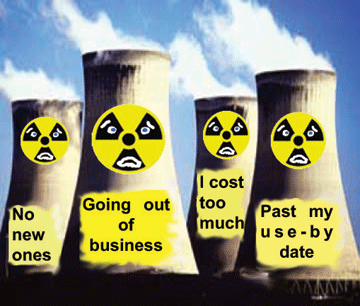 rejection of nuclear energy is growing among people the world over — and building new reactors makes no sense in economic terms…..
Nuclear lobby’s frantic attempts to downplay the nuclear meltdown in Fukushima, with
the aim of nipping the debate about nuclear safety in the bud
Undeterred by Fukushima, Nuclear Lobby Pushes Ahead with New Reactors, Spiegel Online, 13 March 12, One year after the reactor accident in Fukushima, resistance to nuclear energy is growing around the world.
But the atomic industry continues to push for the construction of new reactors, primarily in
emerging economies…… Continue reading
With nuclear power plans, France gets control of UK energy policy
UK nuclear plans ‘put energy in French hands’, BBC News, 13 March 12, By Richard Black, BBC News Government plans for nuclear power risk handing control of the UK’s climate and energy policies to France, according to four senior environmentalists,
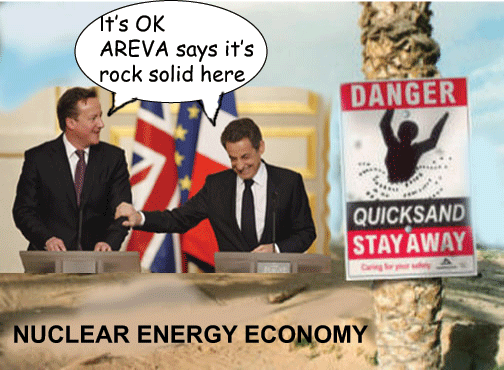
Energy giant EDF and reactor builder Areva, big players in the UK’s plans, are largely French government-owned. Continue reading
Kids get a sanitised tour of Hanford nuclear plant
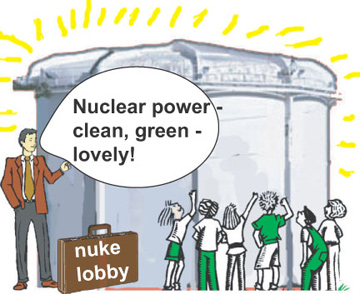 The Stories Kids Touring Hanford’s Nuclear Plant Won’t Get to Hear, Seattle Weekly, By Johnathon Fitzpatrick ., Mar. 13 2012 Washington’s Hanford nuclear facility is home to the world’s worst radioactive dump site. This year for the first time ever, the Department of Energy is allowing school kids to tour the world’s original production-scale nuclear reactor, but there are plenty of secrets which the tour guide probably won’t mention.
Last fall, we published a cover story that looked at the boondoggle that is the massive cleanup of the nuclear dump site, with a follow up on what an environmental crisis at Hanford would look like. Then, last month, we published another cover story about whistleblowers crying foul over the institutional problems within Hanford management . Given all that coverage, here are some facts about Hanford you likely won’t hear on the tour: Continue reading
Legal action against Taipower nuclear company for deceiving public
“Taiwan cannot afford a single nuclear disaster,”…Japan is about 10 times the size of Taiwan. If a radioactive leak occurs in Taiwan, people would have nowhere to escape,
Taipower misleading public: activists, Taipei Times, 14 March 12, ATOMIC ANGST:Environmentalists said Taipower wasted taxpayers’ money promoting nuclear power and falsely claimed Taiwan would face power shortages without it By Lee I-chia
Taiwan Power Co (Taipower) released misleading information to the media and public that power rationing would have to be implemented if nuclear power plants were shut down,
environmentalists said yesterday. Saying the misinformation was a bid by the company to ensure the continuation of its nuclear projects, environmental groups said they would file a lawsuit against the state-run company for “document forgery.” Continue reading
Indigenous opposition to uranium mining in Grand Canyon
 Grand Canyon Uranium Mining Ban Defended By Havasupai Tribe, Conservation Coalition ENews Park Forest, , 13 MARCH 2012 Denver, CO– Arizona’s Havasupai Tribe joined conservation groups joined in filing legal papers on Monday to defend the U.S. Department of the Interior’s 20-year ban on new uranium mining claims across 1 million acres of public lands adjacent to the Grand Canyon. Uranium pollution already plagues the Grand Canyon and surrounding area. Proposals for new mining have prompted protests, litigation and proposed legislation. (Neil Jacklin) Continue reading
Serious concerns about safety of aging nuclear reactors

 UN nuclear body says ageing reactors fuel safety concerns, Google News, 14 March 12, VIENNA — Eighty percent of nuclear power plants are more than 20 years old, raising safety concerns, the UN atomic agency warned in a draft report seen by AFP on Tuesday, a year after Japan’s Fukushima disaster.
This “could impact safety and their ability to meet member states’ energy requirements in an economical and efficient manner,” the International Atomic Energy Agency’s draft annual Nuclear Safety Review said.
Countries opting for what it called “long term operation (LTO) must thoroughly analyse the safety aspects related to the ageing of ?irreplaceable’ key components,” said the report, due to finalised and published in mid-2012.
The IAEA, which promotes the peaceful use of nuclear technology, said that five percent of the world’s 435 nuclear facilities have been in operation for more than 40 years and 32 percent for more than 30 years.
It said that there were “growing expectations that older nuclear reactors should meet enhanced safety objectives, closer to that of recent or future reactor designs.”
“There is a concern about the ability of the ageing nuclear fleet to fulfil these expectations and to continue to economically and efficiently support member states’ energy requirements,” it said.
It also said that 70 percent of the world’s 254 research reactors — for producing medical isotopes and other uses — have been in operation for more than 30 years, many of them “exceeding their original design life.”
This has raised “serious concerns” amongst research reactor operators, regulators and the public, it said…… http://www.google.com/hostednews/afp/article/ALeqM5jmno_YFxU-9xDAwd–lhSvHCM0kw?docId=CNG.f9ffe8f8ebfdfa8a7979295ffada5054.311
USA’s nuclear loan guarantees – like blood transfusions for a dying patient
 Undeterred by Fukushima, Nuclear Lobby Pushes Ahead with New Reactors, Spiegel Online, 13 March 12, …..The US Department of Energy has $18.5 billion in federal guarantees available for building new nuclear power plants. Energy Secretary Steven Chu, the co-winner of the 1997 Nobel Prize in physics, praises the expansion project in Georgia as pioneering. “The Vogtle project will help America to recapture the lead in nuclear technology,” he says.
Approval could also soon be in the works for two reactor blocks in South Carolina. Indeed, energy suppliers are putting added pressure on the NRC, which has already received applications for some 30 additional reactor blocks.
Still, critics doubt that all of the planned facilities will actually be built. Even under the best of
conditions, a single nuclear power plant costs, per megawatt of capacity, almost twice as much as a coal-fired power plant and almost four times as much as a gas-fired one.
For this reason, Amory Lovins, an energy expert at the Colorado-based Rocky Mountain Institute, thinks that the supposed renaissance of atomic energy is nothing more than a nuclear-industry fabrication. Indeed, since a significant portion of the financing for nuclear
facilities comes from federal subsidies and private investors are hardly ever involved, Lovins compares the situation to a form of “nuclear socialism.”
“The nuclear industry is in a desperate effort to demonstrate that it is healthy,” he says. “Loan guarantees are not a sign of economic health,” he adds, in the same way that “blood transfusions are not a sign of medical health.”….. http://www.spiegel.de international/world/0,1518,819452-2,00.html
Health problems secondary to radiation therapy
 New Report: Cancer and CVD After Radiation Therapy Medscape , Nick Mulcahy March 13, 2012 — Second cancers and cardiovascular disease (CVD) after radiotherapy are being experienced by “an ever-growing number of cancer survivors,” according to the authors of a national report published in the March 7 issue of the Journal of the National Cancer Institute. Continue reading
Rice farming ruined by Fukushima nuclear fallout

In Japan, Nuclear Cleanup May Be Mission: Impossible PBS Newshour, 12 March 12, In the second installment of a three-part series on Japan’s recovery, Miles O’Brien reports on Japanese residents who are struggling to clean up contaminated farms, roads and school yards after the massive earthquake, tsunami and resulting nuclear disaster struck Japan one year ago. Here’s an advanced look at
the piece,… http://www.pbs.org/newshour/rundown/2012/03/in-japan-nuclear-clean-up-may-be-mission-impossible.html
After 500 Years in Family, Rice Farmers Forced Off Land by Fukushima PBS Newshour 12 March 12 One year after an earthquake and tsunami struck Japan, the country is still trying to recover and decontaminate land and buildings from partial meltdowns of three Fukushima nuclear reactors. In his second report from the region, science correspondent Miles O’Brien explores the challenges and possibilities of radiation cleanup http://www.pbs.org/newshour/bb/science/jan-june12/fukushimapt2_03-12.html
Trends in renewable energy, efficiency, and energy storage
5 renewable energy trends to watch in 2012, ZD Net, By Heather Clancy | March 13, 2012, Summary: Advances in energy efficiency and grid-connected storage projects shape investments over the next 12 months, according to a new report from cleantech research firm Clean Edge. Continue reading
New computer spy malaware targets U.S. military computers
 New malware preys on Iran nuclear weapons tension, msnbc, 13 March 12, Researchers: China-based hackers goal is to corrupt US military computers Chinese cybercriminals have crafted a sophisticated, robust malware attack that exploits growing political tension and fear over Iran’s alleged covert nuclear weapons program to infect PCs.
The goal of the hackers is to corrupt the computers of U.S. military employees, according to researchers from the security firm Bitdefender , who detected the malware.
Calling it “the perfect firebomb,” the China-borne malware embeds itself in an email with an attached Microsoft Word document titled “Iran’s Oil and Nuclear Situation.doc.” The document, Bitdefender explained, contains an Adobe Shockwave Flash applet that attempts to get the recipients to load a fake YouTube video. While the rigged video (an .mp4 file) loads, the malware exploits an Adobe Flash flaw that sneaks an executable file into the initial Word document.
If it sounds complicated, that’s the point, Bitdefender’s Bogdan Botezatu said. “The operation is covert: the MP4 file triggering the exploit is streamed from the Web, which means the PC will be exploited by the time an anti-virus would generally scan a file,” he wrote. “Further, the malicious file delivered inside the doc file (us.exe) has multiple
layers of obfuscation to dodge detection.”
Once the malware is implanted on a victim’s computer, it communicates with a command-and-control server in China. Carefully crafted exploits aimed at military targets are nothing new; a November congressional report outlined state-sponsored cybercrime missions carried out by Chinese and Russian criminals against U.S. government agencies……
http://www.msnbc.msn.com/id/46722543/ns/technology_and_science-security/#.T2EiZ8WPX_M
Dangerous fire at Fort Calhoun nuclear plant
NRC: Nebraska nuclear plant fire was serious threat, Boston Globe, By Josh Funk | ASSOCIATED PRESS MARCH 13, 2012, OMAHA – A fire that briefly knocked out the cooling system for used fuel at an idled Nebraska nuclear plant last June represented a serious safety threat, federal regulators said Monday. Continue reading
Down, down, continues the price of uranium
Spot Uranium Drifts Downward. by Melissa West, Uranium Researcher, 13 March 12 Uranium Investing News, Platts reported spot uranium prices are continuing to drop at a slightly faster rate than earlier this year. As quoted in the market news:
TradeTech on Friday lowered its weekly spot price to $51 a pound U3O8, a drop of 80 cents/lb from TradeTech’s price March 2. TradeTech said the drop was due largely to a lack of buying interest and “aggressively priced material offered by one motivated seller.” http://uraniuminvestingnews.com/10910/spot-uranium-drifts-downward.html
China restricting rare earths production for environmental reasons
China defends rare earths limits The Age, JOE McDONALD March 13, 2012 China defended curbs on production of rare earths used in mobile phones and other high-tech products as an environmental measure Tuesday… Beijing needs to limit environmental damage and conserve scarce resources, said a foreign ministry spokesman, Liu Weimin.
“We think the policy is in line with WTO rules,” Liu said at a regular briefing…… Rare earths are 17 elements including cerium, dysprosium and lanthanum that are used in manufacturing flat-screen TVs, batteries for electric cars and wind turbines. They also are used
in some high-tech weapons…. http://news.theage.com.au/breaking-news-technology/china-defends-rare-earths-limits-20120313-1uygw.html
1 This Month

of the week – Shut Down Drone Warfare!


Tell the Ukrainian Government to Drop Prosecution of Peace Activist Yurii Sheliazhenko

Petition to revoke the licensing of the Near Surface Nuclear Disposal Facility (NSDF) at Chalk River. https://www.ourcommons.ca/petitions/en/Petition/Details?Petition=e-7247
To see nuclear-related stories in greater depth and intensity – go to https://nuclearinformation.wordpress.com
-
Archives
- March 2026 (237)
- February 2026 (268)
- January 2026 (308)
- December 2025 (358)
- November 2025 (359)
- October 2025 (376)
- September 2025 (257)
- August 2025 (319)
- July 2025 (230)
- June 2025 (348)
- May 2025 (261)
- April 2025 (305)
-
Categories
- 1
- 1 NUCLEAR ISSUES
- business and costs
- climate change
- culture and arts
- ENERGY
- environment
- health
- history
- indigenous issues
- Legal
- marketing of nuclear
- media
- opposition to nuclear
- PERSONAL STORIES
- politics
- politics international
- Religion and ethics
- safety
- secrets,lies and civil liberties
- spinbuster
- technology
- Uranium
- wastes
- weapons and war
- Women
- 2 WORLD
- ACTION
- AFRICA
- Atrocities
- AUSTRALIA
- Christina's notes
- Christina's themes
- culture and arts
- Events
- Fuk 2022
- Fuk 2023
- Fukushima 2017
- Fukushima 2018
- fukushima 2019
- Fukushima 2020
- Fukushima 2021
- general
- global warming
- Humour (God we need it)
- Nuclear
- RARE EARTHS
- Reference
- resources – print
- Resources -audiovicual
- Weekly Newsletter
- World
- World Nuclear
- YouTube
-
RSS
Entries RSS
Comments RSS
 nuclear-news