Plenty of future work for Japan’s nuclear professionals – in shutting down the world’s nuclear reactors
concerns over where Japan’s nuclear professionals will end up. We believe, however, that this concern needs to be reframed. There are more than 430 nuclear reactors in the world, and one by one they will all reach the end of their service lives. Regardless of the future paths of nuclear policies around the world, there will be plenty of reactors that need to be shut down.
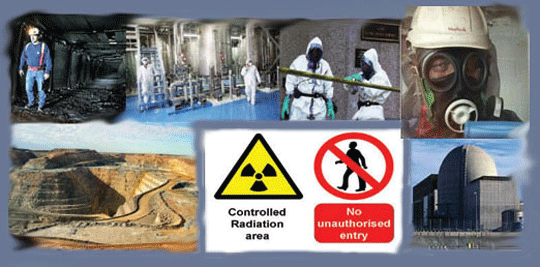
Editorial: Time to say goodbye to nuclear power, Mainichi Daily News, 7 March 12, The illusion of nuclear power safety has been torn out by the root. The Fukushima nuclear disaster that followed the great waves of March 11 last year made sure of that..
.. Economic concerns, however, have begun to wear down the fear of nuclear disaster. And so, as we consider our nuclear power and energy policy’s future, we must remember what the Fukushima No. 1 nuclear plant meltdowns have done to Japan, the pain of the people who have lost their hometowns, and the radioactive contamination that will blight the landscape for decades to come.
Unfortunately, that it makes us so uneasy to think about this speaks
volumes about the state of politics in Japan.
First of all, the government has indeed begun to hammer out plans to
reduce the country’s dependence on nuclear power, and there are no
whisperings that this will be overturned. On the other hand, we have
yet to see an overall vision or process on how the government will
evaluate the risks associated with nuclear power and advance policy to
decouple our economy from it…..
According to a Japan Atomic Energy Commission (AEC) subcommittee report, considering the economic impact and nuclear proliferation risks, over the next 20-30 years simply disposing of spent fuel would be better than going ahead with the nuclear fuel cycle program. There is, therefore, absolutely no justification for letting work at the Rokkasho reprocessing plant in Aomori Prefecture go on.
Even now, Japan’s buildup of plutonium stocks has become a problem in terms of
the risks of nuclear weapons proliferation.
The fuel reprocessing project is, however, also being used as the
reason to rid nuclear plants of their spent fuel rods. This
positioning must be done away with, and the treatment of the rods
included in an overall rethink of nuclear energy policy.
It is necessary to instill the idea that those who benefit from
nuclear power are responsible for dealing with its byproducts, spent
fuel rods chief among them. Knowing that not just the profits but the
risks of nuclear power belong to them, these parties will take a
greater hand in the move to abandon it.
Meanwhile, the decommissioning of the Fukushima No. 1 plant will
continue — for decades. Building any new plants has also been
rendered effectively impossible. These circumstances have raised
concerns over where Japan’s nuclear professionals will end up. We believe, however, that this concern needs to be reframed. There are more than 430 nuclear reactors in the world, and one by one they will all reach the end of their service lives. Regardless of the future paths of nuclear policies around the world, there will be plenty of reactors that need to be shut down.
Of course the end of the Fukushima No. 1 reactors will be very
different from a standard decommissioning, but engineers will gain a
lot of experience from the project. The development of robots and
remote control devices for Fukushima could become Japan’s trump card
in the global reactor decommissioning business. Furthermore, we can turn Fukushima into a hub of nuclear research, including in the nuclear safety, radioactive substance management and decontamination fields, and attract foreign talent.
After more than 40 years of nuclear power generation in Japan or, to
put it another way, more than 40 years of procrastination on what to
do with nuclear waste, we are now faced with the problem of how to get
rid of it. This is yet another issue the government must make progress
on. http://mdn.mainichi.jp/perspectives/news/20120307p2a00m0na003000c.html
No comments yet.
1 This Month

of the week – Shut Down Drone Warfare!


Tell the Ukrainian Government to Drop Prosecution of Peace Activist Yurii Sheliazhenko

Petition to revoke the licensing of the Near Surface Nuclear Disposal Facility (NSDF) at Chalk River. https://www.ourcommons.ca/petitions/en/Petition/Details?Petition=e-7247
To see nuclear-related stories in greater depth and intensity – go to https://nuclearinformation.wordpress.com
-
Archives
- March 2026 (230)
- February 2026 (268)
- January 2026 (308)
- December 2025 (358)
- November 2025 (359)
- October 2025 (376)
- September 2025 (257)
- August 2025 (319)
- July 2025 (230)
- June 2025 (348)
- May 2025 (261)
- April 2025 (305)
-
Categories
- 1
- 1 NUCLEAR ISSUES
- business and costs
- climate change
- culture and arts
- ENERGY
- environment
- health
- history
- indigenous issues
- Legal
- marketing of nuclear
- media
- opposition to nuclear
- PERSONAL STORIES
- politics
- politics international
- Religion and ethics
- safety
- secrets,lies and civil liberties
- spinbuster
- technology
- Uranium
- wastes
- weapons and war
- Women
- 2 WORLD
- ACTION
- AFRICA
- Atrocities
- AUSTRALIA
- Christina's notes
- Christina's themes
- culture and arts
- Events
- Fuk 2022
- Fuk 2023
- Fukushima 2017
- Fukushima 2018
- fukushima 2019
- Fukushima 2020
- Fukushima 2021
- general
- global warming
- Humour (God we need it)
- Nuclear
- RARE EARTHS
- Reference
- resources – print
- Resources -audiovicual
- Weekly Newsletter
- World
- World Nuclear
- YouTube
-
RSS
Entries RSS
Comments RSS
 nuclear-news
Leave a comment