Fukushima’s psychological trauma, as well as radiation cancer risk
 Radiation is still leaking from the now-closed Fukushima Dai-ichi nuclear plant, though at a slower pace than it did in the weeks after the March 11 earthquake and tsunami. It’s not immediately fatal but could show up as cancer or other illnesses years later.
The uncertainty breeds fear.
 The [cancer] risk is cumulative. The radioactivity in one’s body builds up through various activities, including eating contaminated food every day or staying in a hot spot for an extended period.
 Uncertain risks torment Japanese in nuclear zone, THE HINDU, 8 March 12, Yoshiko Ota keeps her windows shut. She never hangs her laundry outdoors. Fearful of birth defects, she warns her daughters — never have children.
This is life with radiation, nearly one year after a tsunami-hit nuclear power plant began spewing it into Ota’s neighbourhood, 60 km away. She’s so worried that she has broken out in hives.
“The government spokesman keeps saying there are no immediate health effects,” the 48-year-old nursery school worker says. “He’s not talking about 10 years or 20 years later. He must think the people of Fukushima are fools. It’s not really OK to live here,” she says. “But we live here.” Continue reading
India’s democracy disappearing under nuclear lobby pressure?
‘The fact that the government is going to the extent of cancelling legitimately granted visas clearly shows that they don’t want people from Japan to come to India and share their experience’ said Karuna Raina of the green group. Kobayashi helped save children from
radiation as part of a network of local mothers……

 Scared India denies visa to nuclear activist and Fukushima disaster survivor Mail Online India, By DINESH C SHARMA, 7th March 2012 ‘We are a democracy, we are not like China’. Prime Minister Dr Manmohan Singh professed while making his ‘foreign hand behind nuclear protests’ remark recently.
However, actions of his government show that India is behaving much like China when it comes to muzzling dissent. The latest example of the government’s intolerant behaviour is denying a survivor of Fukushima disaster from visiting nuclear protest hotspots in India on the eve of the first anniversary of the Japanese nuclear accident on March 11. Continue reading
77% of Americans want government loans for renewable energy, not nuclear
More than three out of four Americans (77 percent) would support “a shift of federal loan-guarantee support for energy away from nuclear reactors” in favor of wind and solar power.

 Survey: Americans Not Warming Up to Nuclear Power One Year After Fukushima, Market Watch, WASHINGTON, March 7, 2012 Contrary to Industry Predictions, Reactor Disaster Seen As Having a”Lasting Chill” on Perceptions;
It’s Not All Fukushima: 3 in 5 Americans Less Supportive Due to Woes of U.S. Nuclear Industry in Last Year. Continue reading
Plenty of future work for Japan’s nuclear professionals – in shutting down the world’s nuclear reactors
concerns over where Japan’s nuclear professionals will end up. We believe, however, that this concern needs to be reframed. There are more than 430 nuclear reactors in the world, and one by one they will all reach the end of their service lives. Regardless of the future paths of nuclear policies around the world, there will be plenty of reactors that need to be shut down.
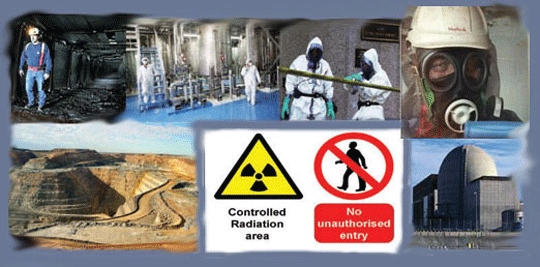
Editorial: Time to say goodbye to nuclear power, Mainichi Daily News, 7 March 12, The illusion of nuclear power safety has been torn out by the root. The Fukushima nuclear disaster that followed the great waves of March 11 last year made sure of that.. Continue reading
Move to close Mühleberg atomic plant, then Beznau
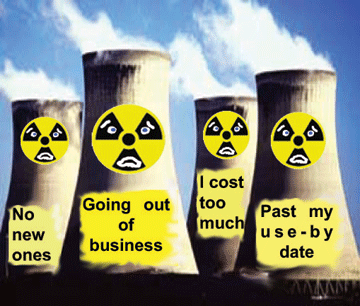
 Future of nuclear plant on shaky ground by Clare O’Dea, swissinfo.ch Mar 7, 2012 The Mühleberg atomic plant near Bern will lose its operating licence at the end of June 2013 on security grounds, the Federal Administrative Court has ruled…. In its judgment on Mühleberg, the court said various factors imposed a limit on the plant’s viability, including the condition of the reactor’s core shroud, which has fissures in it.
Other security questions cited were the inconclusive evaluations on security in the event of an earthquake and the absence of a cooling system independent of the Aare river…. The court’s decision has been hailed as a victory by anti-nuclear campaigners who swiftly called for the same action to be taken for Switzerland’s and the world’s oldest nuclear power plant Beznau.
Greenpeace called it “a stage victory for the safety of the Swiss population”, while the anti-nuclear organisation Swiss Energy Foundation (SES) said the verdict was a slap in the face for the federal authorities, whose work had clearly been called in
question…. the lawyer for the group that pursued the case against BKW – more than 100 local residents and an environmental group – said the decision spelled the end of Mühleberg. “I do not think that BKW is going to make such an investment within a year,” Rainer Weibel told Swiss television.
Shaky ground With the future of Mühleberg now on shaky ground, the focus will shift to the Beznau I plant in canton Aarau, commissioned in 1969.
Critics say safety issues prove Beznau’s time is up, claiming the emergency power supply is unreliable, the reactor cover has corrosion problems and the steel container has cracks….
http://www.swissinfo.ch/eng/politics/Future_of_nuclear_plant_on_shaky_ground.html?cid=32250844
Misunderstanding, wrong translation of Ahmadinejad’s supposed words “Israel must be wiped off the map”
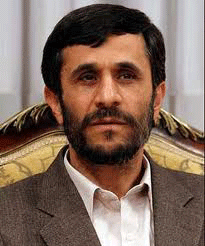 from Wikileaks: Translation controversy Many news sources repeated the Islamic Republic of Iran Broadcasting statement by Ahmadinejad that “Israel must be wiped off the map”,[5][6] an English idiom which means to “cause a place to stop existing”,[7] or to “obliterate totally”,[8] or “destroy completely”.[9]
Ahmadinejad’s phrase was “بايد از صفحه روزگار محو شود” according to the text published on the President’s Office’s website.[10]
The translation presented by the official Islamic Republic News Agency has been challenged by Arash Norouzi, who says the statement “wiped off the map” was never made and that Ahmadinejad did not refer to the nation or land mass of Israel, but to the “regime occupying Jerusalem”. Norouzi translated the original Persian to English, with the result, “the Imam said this regime occupying Jerusalem must vanish from the page of time.”[11] Juan Cole, a University of Michigan Professor of Modern Middle East and South Asian History, agrees that Ahmadinejad’s statement should be translated as, “the Imam said that this regime occupying Jerusalem (een rezhim-e eshghalgar-e qods) must [vanish from] the page of time (bayad az safheh-ye ruzgar mahv shavad).[12] According to Cole, “Ahmadinejad did not say he was going to ‘wipe Israel off the map’ because no such idiom exists in Persian.” Instead, “he did say he hoped its regime, i.e., a Jewish-Zionist state occupying Jerusalem, would collapse.”[13] The Middle East Media Research Institute (MEMRI) translated the phrase similarly, as “this regime” must be “eliminated from the pages of history.”[14]
Iranian government sources denied that Ahmadinejad issued any sort of threat. On 20 February 2006, Iran’s foreign minister Manouchehr Mottaki told a news conference: “How is it possible to remove a country from the map? He is talking about the regime. We do not recognize legally this regime.”[15][16][17]
Even Netanyatu’s supporters offended by his inflammatory remarks about Iran

 Netanyahu’s references to Holocaust in relation to Iran nuclear threat bother some Israelis Washington Post By Associated Press, March 7 JERUSALEM — The Israeli prime minister’s linking of Iran to Nazi Germany evoked ringing applause this week at a gathering of a pro-Israel lobbying group in Washington. Back home, though, it drew some heavy criticism.
The Nazi Holocaust of World War II is a delicate and charged topic in Israel, and many felt Benjamin Netanyahu’s repeated equating of the Nazis with the possible modern-day threat of a nuclear-armed Iran went too far..
…. His parallels were clear: Just as the Nazis tried to exterminate European Jewry during World War II, Netanyahu implied that Iran’s apparent pursuit of nuclear weapons is part of a plot to wipe Israel off the map. “Never again” is the signature phrase of the Jewish pledge that the Holocaust must not be repeated.
Critics accused Netanyahu of both cheapening the memory of the Holocaust and unnecessarily escalating tensions at a time when the U.S. was urging restraint….. Yehuda Bauer, a Holocaust scholar at Israel’s national Holocaust memorial, Yad Vashem, said Netanyahu’s Auschwitz analogy in Washington this week was “sheer nonsense.” While acknowledging the dangers of a nuclear Iran, Bauer said, “to bring up Auschwitz is a cheap way of gaining public attention.”
The uproar caused some discomfort even among Netanyahu’s supporters.
http://www.washingtonpost.com/world/middle_east/netanyahus-references-to-holocaust-in-relation-to-iran-nuclear-threat-bother-some-israelis/2012/03/07/gIQAFC6GxR_story.html
Early shutdown for nuclear power plant – court orders
 Swiss court orders nuclear plant offline in 2013 By Katharina BartMar 7, 2012 ZURICH, March 7 (Reuters) – A Swiss court ruled that Switzerland’s Muehleberg nuclear power plant must go offline next year for security reasons, according to a judgment made public on Wednesday.
“The state of the nuclear shell, the assessment of the plant’s resistance to withstand earthquakes which is not complete, and lacking cooling possibilities independent of the river Aare allow operations of Muehleberg only up to mid 2013 at the most,” the federal
administrative court said in a ruling handed down March 1.
The ruling backs residents near to the plan in their bid to have the court overturn a previous decision by environment, transport energy and communication department UVEK to grant a longer operational period…
.. Muehleberg, built in 1972, is one of the plants frequently cited by opponents of nuclear energy as ripe for mothballing. The government decided to scrap plans to build new nuclear reactors after Fukushima shook public confidence in the industry. Until now, it had not planned to shut existing power plants prematurely…. http://af.reuters.com/article/commoditiesNews/idAFL5E8E771P20120307
Conflict of interest in India’s nuclear regulation
 In India, all Indian nuclear plants are in the public sector and so are the agencies that exercise regulatory functions and promotional responsibilities. In this situation, conflict of interest between regulation and promotion is inevitable.
How Fukushima is relevant to Kudankulam, THE HINDU, T. N. SRINIVASAN, T. S. GOPI RETHINARAJ, SURYA SETHI, 8 March 12, “……REGULATORY INDEPENDENCE The Fukushima accident highlighted the need for the independence of regulators from plant operators. The Atomic Energy Regulatory Board (AERB) has long been criticised for being subservient to DAE, the promoting organisation for nuclear power.
After Fukushima, the establishment of a truly independent regulator has been promised.
Currently, institutional deficiencies are structurally inbuilt and hard to eliminate. If they remain, the credibility and autonomy of the regulator cannot be ensured. Historically, nuclear policymaking in India was not transparent and involved only a handful of people in the
government. Continue reading
Killing Iran’s nuclear scientists – counter productive says U.S. security agency

 Assassinations will not stop Iran’s nuclear program: ISIS Press TV 7 March 12, The US-based Institute for Science and International Security (ISIS) says killing Iranian nuclear scientists will not delay the progress of Tehran’s nuclear energy program.
In its March 7 report on Iran, the institute focused on the situationof the Iranian nuclear energy program and efforts by Western countries to prevent the Islamic Republic from acquiring nuclear capability.
Referring to Western efforts to stymie Iran’s nuclear energy program, the report said the assassination of Iranian scientists or threatening Tehran with a possible military strike were not good options for preventing the progress of the country’s nuclear energy program.
Pointing to the disadvantages of employing “risky” strategies against Iran, the report said, “Assassinations of Iranian nuclear scientists and engineers have occurred with greater frequency but should be stopped because they carry too high a risk of retaliation.”
Moreover, the ISIS report added, assassinations are unlikely to be effective in setting back the Iranian nuclear energy program because they involve thousands of specialists and ingrained know-how.
The institute cautioned the West that “Iran might argue that assassinations are equivalent to a military attack and use this as justification for further provocations.”
“An under-siege mentality created by use of such tactics could motivate Iran to further degrade its cooperation with IAEA [International Atomic Energy Agency] and resist offers of
negotiation,” the report stated. … http://presstv.com/detail/230477.html
UK and the world under threat of radioactive ‘dirty bomb’
WHAT IS A DIRTY BOMB?
A dirty bomb combines normal explosives (such as dynamite or Semtex)and radioactive materials.
The bomb blast rapidly spreads the radioactive particles, creating a
major contamination hazard.
The blast itself is as forceful as any other type of high-explosive
device but would boost radiation levels in the detonation area,
causing long-term damage. It could increase the risk of cancer and
kill people several years in the future.
 Nuclear-armed terrorists are a real threat to Britain, Deputy Prime Minister Nick Clegg will warn
Police ‘unable to contain’ nuclear threat
Spectre of nuclear attack ‘impossible to ignore’
Countries must ‘work together’ to prevent destruction
Maol Online, By MATT BLAKE, 7th March 2012 Stateless terrorists are closer to unleashing a nuclear attack on Britain than ever before, Nick Clegg will warn today.
The Deputy Prime Minister will say materials and internet instructions on how to make a ‘dirty bomb’ have become so readily available in recent years that police forces are unable to contain such a threat.
Al Qaeda are already known to be actively trying to amass nuclear material and recruit rogue scientists to build a radioactive ‘dirty bomb’ while diplomatic temperatures between Iran and the West are at boiling point.
Mr Clegg will issue a plea for more co-operation between countries to fight the spectre of terrorism, crime and economic collapse Continue reading
Nuclear power – an antiquated and uneconomic technology
The economic argument for renewable energy is also compelling. Nuclear power is an antiquated technology that requires billions of euros in subsidies; so far, German taxpayers have contributed €196 billion for this purpose.
A German government study has estimated that, between 2010 and 2050, Germany could save more than €700 billion by relying on non-nuclear renewable energy instead of nuclear power or imported fossil fuels such as coal, gas, and oil.
No nuclear please, we’re German, ABC JGEN TRITTIN, 8 March 12, “…….. while Germany is now heading in the right direction, the security risks of nuclear power plants in neighbouring countries, such as France and the Czech Republic, remain. There must be a general shift in both European and global energy policies.
The current European stress tests of nuclear-power plants are a first step; but, as long as they are voluntary and under the operators’ control, they will be nothing more than political window
dressing. Continue reading
Santa Susanna’ s radiation pollution from 1959 nuclear accident
 Santa Susanna pollution data raises more questions about long term radiation than it answers, 89.3 KPCC, March 6, 2012 | By Molly Peterson I did a short story today about the former Santa Susanna Field Laboratory site, where Rocketdyne and others once had operations, and where in 1959 a nuclear accident released far more radioactive material than Three Mile Island. I don’t just hang out on the EPA’s website, or at the gates of that property. Instead, I heard about the data release from State Senator Julia Brownley’s release yesterday :
“This confirms what we were worried about,” said Assemblywoman Julia Brownley, D-Oak Park, a long-time leader in the fight for a complete and thorough cleanup of this former Rocketdyne rocket engine testing laboratory. “This begins to answer critical questions about what’s still up there, where, how much, and how bad?”
Brownley’s release asserts that the new samples collected are up to 1000 times higher than the “radiation trigger levels” approved by state and federal officials in 2010, when state officials reached agreements deemed, at the time, “historic,” with NASA and the Department of Energy for cleanups. Continue reading
Radiation therapy – necessary, but can cause secondary cancers
Younger patients are especially susceptible to the effects of radiation, and the three cancers that have been most strongly associated with radiation are breast cancer, thyroid cancer and bone marrow cancers, including leukemia
Clinicians say the benefits of radiation treatment for many types of cancer far outweigh the potential risks of experiencing serious adverse effects years later, and say radiation is now a lot safer than it once was. …. “We try to use radiation as sparingly as possible, but unfortunately, it is frequently part of the cure in a lot of cancers and it’s absolutely necessary,”
 Radiation Therapy Linked to Secondary Cancers KBOI News, 7 March 12, (NEW YORK) — While the number of cancer survivors has tripled since the 1970s and continues to grow, the cost of that survival for many has been the development of secondary cancers and cardiovascular disease related to radiation treatment, according to an upcoming report by a scientific committee. Continue reading
Virginia – hasty uranium regulations, behind closed doors
Activists urge caution on regulations for uranium mining, Virgnia Politics, 03/07/2012, By Anita Kumar As Gov. Bob McDonnell’s administration begins developing regulations for uranium mining, some activists are expressing concerns about the process.
In a letter to the administration, representatives of the Piedmont Environmental Council, Virginia League of Conservation Voters and Sierra Club say they worry that the regulations, which are supposed to be written over the next year, will be done too quickly, behind closed doors and with little input from the public.
Another group of business leaders from Southside Virginia called for additional data instead before the regulations are developed. In January, McDonnell (R) recommended that the state further study the impact of excavating a site in Southside Virginia that contains the nation’s largest known uranium deposit before lifting a mining ban.
He created a multi-agency group — comprised of staff from the Virginia Department of Health, the Virginia Department of Environmental Quality and Virginia Department of Mines, Minerals and Energy — to study the site and draft regulations for a possible new mining industry in Virginia. The group will accept public comments during four open meetings and on a new Web site ….. Environmental groups — worried that a uranium mine in Virginia’s relatively rainy climate could contaminate natural resources, cause illness and have long-term effects on plants and animals — are disappointed that McDonnell wants to begin preparing regulations….. http://www.washingtonpost.com/blogs/virginia-politics/post/activists-urge-caution-on-regulations-for-uranium-mining/2012/03/07/gIQAwJpYxR_blog.html
1 This Month

of the week – Shut Down Drone Warfare!


Tell the Ukrainian Government to Drop Prosecution of Peace Activist Yurii Sheliazhenko

Petition to revoke the licensing of the Near Surface Nuclear Disposal Facility (NSDF) at Chalk River. https://www.ourcommons.ca/petitions/en/Petition/Details?Petition=e-7247
To see nuclear-related stories in greater depth and intensity – go to https://nuclearinformation.wordpress.com
-
Archives
- March 2026 (230)
- February 2026 (268)
- January 2026 (308)
- December 2025 (358)
- November 2025 (359)
- October 2025 (376)
- September 2025 (257)
- August 2025 (319)
- July 2025 (230)
- June 2025 (348)
- May 2025 (261)
- April 2025 (305)
-
Categories
- 1
- 1 NUCLEAR ISSUES
- business and costs
- climate change
- culture and arts
- ENERGY
- environment
- health
- history
- indigenous issues
- Legal
- marketing of nuclear
- media
- opposition to nuclear
- PERSONAL STORIES
- politics
- politics international
- Religion and ethics
- safety
- secrets,lies and civil liberties
- spinbuster
- technology
- Uranium
- wastes
- weapons and war
- Women
- 2 WORLD
- ACTION
- AFRICA
- Atrocities
- AUSTRALIA
- Christina's notes
- Christina's themes
- culture and arts
- Events
- Fuk 2022
- Fuk 2023
- Fukushima 2017
- Fukushima 2018
- fukushima 2019
- Fukushima 2020
- Fukushima 2021
- general
- global warming
- Humour (God we need it)
- Nuclear
- RARE EARTHS
- Reference
- resources – print
- Resources -audiovicual
- Weekly Newsletter
- World
- World Nuclear
- YouTube
-
RSS
Entries RSS
Comments RSS
 nuclear-news